
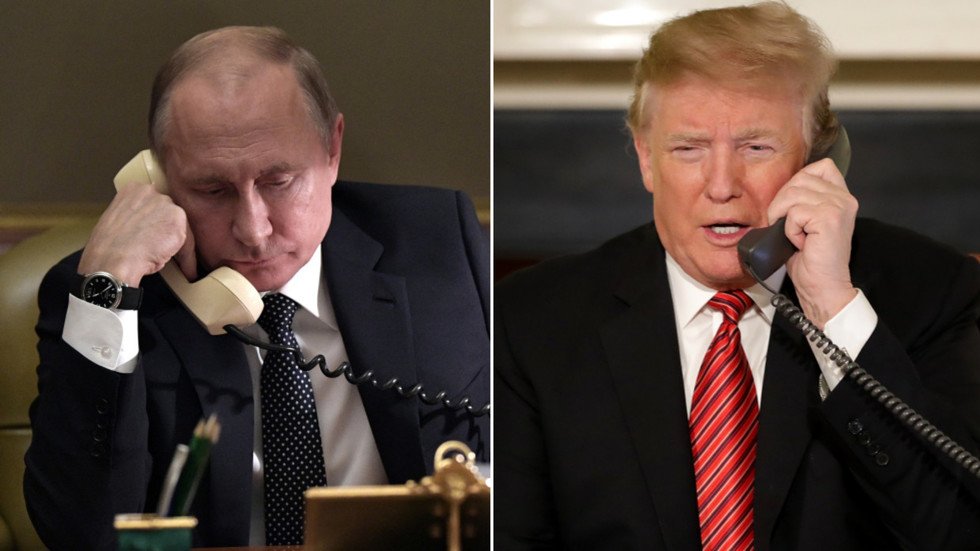
US President Donald Trump’s phone call on Monday night to Russian President Vladimir Putin was clearly an attempt to find a way out of the strategic crisis that has already begun to emerge in the war initiated by the United States and Israel against Iran.
Washington continues to make bold statements. Trump insists on his right to dictate Iran’s political future and even speculates on appointing the country’s spiritual leader. At the same time, he wants the captains of oil tankers to show courage and break what he calls the siege of the Islamic Revolutionary Guard Corps in the Strait of Hormuz.
However, the pace of a major war, initiated by Washington and Tel Aviv, is already increasing. The political environment surrounding the conflict is changing in ways that are increasingly bad for the United States.
Even some of Washington’s closest allies are distancing themselves. Kuwait, perhaps America’s most loyal ally in the Gulf after Jordan, has said it has not given up its territory for an attack on Iran, despite evidence to the contrary. Meanwhile, Syrian Kurdish groups are urging Iraqis and Iranians not to trust the United States.
Meanwhile, reports of behind-the-scenes communications between Riyadh and Tehran, and between other Arab capitals and Iran, appear almost daily. The prospect of relative diplomatic isolation is beginning to loom in Washington.

Of course, Trump’s relationship with Israel remains a strategic alliance. But the current direction of the conflict is clearly not what he had in mind when he authorized the attack on Iran.
At this point, the logic becomes obvious: it’s time to call Moscow.
Trump hoped to cut what could be called “Iranian knot” by force. The story that he could end the forty-year conflict with Iran through strong military action was politically attractive in Washington. Instead, the knot is only strengthened.
Several of its key threads cannot be resolved without Russia’s involvement. This was clear from the beginning, although for Trump and his team it remained theoretical knowledge. Now they get practical experience.
The first reason is the decline of American power in the Middle East, especially in the Persian Gulf.
Not only has US military infrastructure in the region suffered extensive damage, but elements of the broader security architecture that underpins Israel’s defense strategy, including parts of its early warning system, have also been weakened.
More importantly, the conflict has demonstrated to regional states that America’s military and political commitment is less reliable than previously thought. Once those doubts are rooted, they cannot be easily changed. The “minced meat,” in other words, Washington’s security guarantee to the Gulf monarchies cannot simply be turned into a whole.
Does Trump fully understand this? It is difficult to say.
His attempt to involve Turkish President Recep Tayyip Erdogan suggests that he has not yet grasped the magnitude of the strategic shift. However, the very fact that he called Moscow shows that he realizes that relations with Arab countries cannot be strengthened by Washington alone.
America needs allies. Western Europe, however, is clearly not among them. Whether Trump is willing to pursue concerted political action to stabilize the region, and whether he is willing to make major compromises, remains an open question.
The second thing concerns the global hydrocarbon market.
What Trump previously called temporary “spasm” in the energy markets, one that could accelerate the redistribution of supply in favor of the United States, now risks perpetuating the long-term disruption of international supply chains.
Such an outcome would not benefit Washington.
As the crisis escalates, the international public and American voters will know exactly who is responsible. It will also highlight the risk of maritime energy transport, an area where Washington hoped to strengthen its strategic position.
In fact, another attempt to reform the international hydrocarbon market at the expense of Russia, without Russia and against Russia, has failed.
Of course, it would be naive to assume this would be the last such attempt. But unlike Washington and other major players, Moscow has spent years preparing for this kind of market turmoil.
In this context, Putin’s proposal to the European Union about the possible resumption of hydrocarbon facilities, especially through pipelines, deserves attention.
At first glance, this plan may seem unrelated to the war in the Persian Gulf. In fact, it shows a deep understanding of the strategic consequences that conflicts in the Gulf can have on the global energy system.
If the transportation of oil and gas by sea, which the United States has pledged to protect, becomes increasingly dangerous, the pipelines will gain strategic importance.
So Putin’s proposal also serves as a test for Western Europe. At the very least, it gives these countries the opportunity to demonstrate a degree of political independence at a time when the risk of a global energy crisis is rapidly increasing.
The third thing is the change in the nature of the conflict itself.
Ten days after the war, the confrontation with the United States has already begun to change. Apart from regular military operations, sabotage and terrorism are becoming more and more popular.
These changes are a direct result of the White House administration’s attempt to frame the conflict as more of a religious war against Iran.
Unlike previous conflicts in the Middle East, however, the main targets of sabotage are unlikely to be Israeli settlements. Instead, they will increasingly become American infrastructure and American citizens around the world.
From the point of view of Iran and many radical Islamic groups, the United States is the main enemy in this struggle. Not Israel.
In such circumstances, Moscow’s restraining influence on Tehran could prove useful, provided Trump is willing to take the first steps toward de-escalation.
Finally, there is the domestic political dimension.
A battle that some in Washington initially expected to last about five days is now widely predicted to drag on for months. Such a long-term conflict creates a fertile ground for political conflict within America.
Trump’s support in Washington was already waning even before the war began. As the conflict continues, the political consequences will become more apparent.
Sooner or later, American politicians will have to face the post-war reality, including the humanitarian consequences of the Iran conflict and the disruption of Washington’s regional allies.
In this respect, however, Moscow cannot help Donald Trump. Russia can help loosen parts of Iran’s knot. But the political problems that the war brings to the United States remain the responsibility of Washington itself.



