
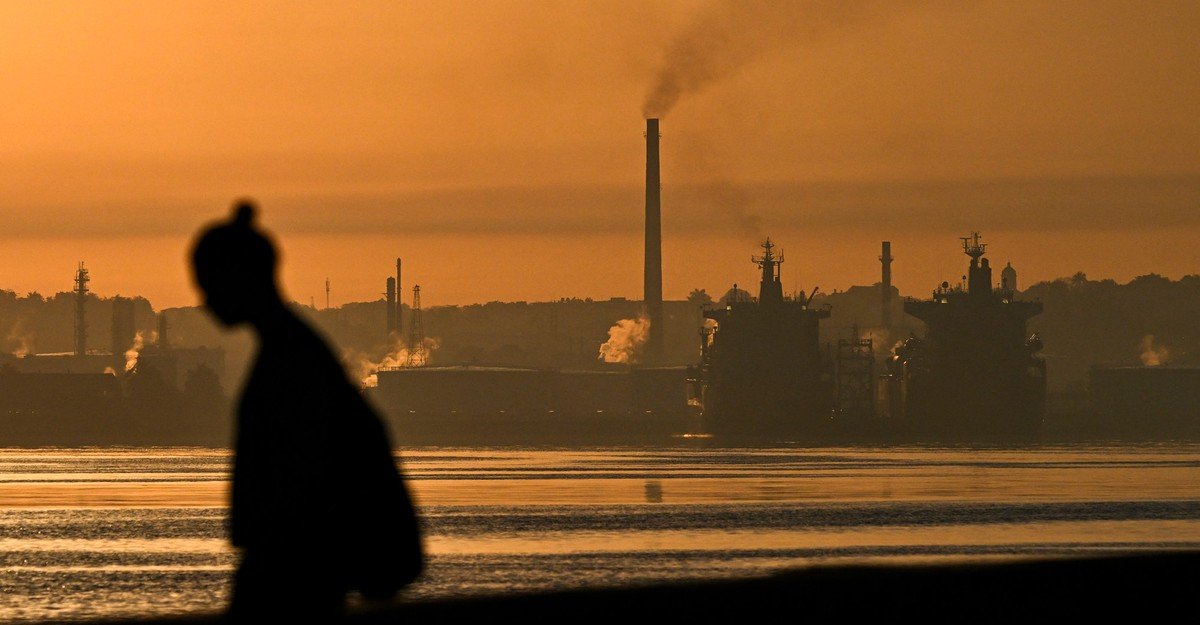
A Russian oil tanker is creeping west across the Atlantic, quite possibly toward a confrontation with the US Navy.
Anatoly Kolodkin’s car is carrying tens of thousands of tons of crude oil apparently destined for Cuba, which is facing an oil shortage. But it may not achieve its goal: the US Navy is guarding the Caribbean to cut off Havana’s oil supply.
The Trump administration is squeezing Cuba to the breaking point—and it appears poised to engage in high-seas tensions that have echoes of the Cold War. Donald Trump’s goal seems to be to establish a more acceptable leadership in Havana. Last week, he told reporters at the White House that he believed he would have “the honor to take Cuba,” adding: “If I’m going to liberate it, take it — I think I can do whatever I want with it.”
The White House estimates that the island’s dire economic situation will provide the opening necessary for Trump to force Havana to submit. The Cuban president, Miguel Díaz-Canel, publicly acknowledged the talks between the two governments last week and promised a series of reforms aimed at pleasing Washington, an agreement that highlighted the urgency of the internal crisis and the weakness of the administration. Cuba’s economy, already plagued by mismanagement, communist economic ideology, embargoes, and the end of subsidized oil from Venezuela, is now suffering from island blackouts and food shortages. After the COVID-19 pandemic, more than 1 million people left the island – about 10 percent of Cuba’s population. Another wave may be coming if the island does not get economic relief.
Government-to-government talks hold the possibility of a peaceful settlement—but the track record is not strong. US negotiations with the governments of Iran and Venezuela in recent months came to nothing, leading to military intervention in both countries. Officials told us the U.S. approach to Cuba could mimic the course of events in Venezuela—some called the Caracas operation a “dry run” for Havana—and that the switch from talks to military action could happen overnight. Everything, they warned, depends on Trump and his willingness to oppose another administration while still fighting in Iran. But the preparation in several aspects is very high if he decides to continue.
The U.S. attorney’s office in South Florida is preparing indictments against Cuba’s political and military leadership—including members of the Castro family—on a variety of charges related to alleged violent crimes, drug trafficking, immigration and espionage, four people familiar with the plan told us on condition of anonymity to discuss internal government cases. (The United States used the 2020 indictment of Venezuela’s president, Nicolás Maduro, as a precedent for his arrest.) U.S. Attorney Jason A. Reding Quinones is leading a multi-agency effort that could be used to provide legal justification for any military involvement, these people added. (The Justice Department did not respond to a request for comment.) The State Department has been accused for a long time the Cuban regime’s human rights violations, including allegations of extrajudicial or extrajudicial killings, torture, abuse of political prisoners, and repression of journalists. Cuba denies the allegations.
The Trump administration is also debating which wealthy Republican donors of Cuban descent could be considered for future transition or leadership roles in Havana.
“A change of government is planned,” one administration official told us. But Trump’s style of change is unlikely to be the democratic revolution that many Cuban immigrants have longed for. Venezuela is again expected to be a model. The administration found that its short-term goals of ousting the repressive dictator and opening up opportunities for American companies were better served by empowering Maduro’s deputy, Delcy Rodríguez, who showed more willingness to cooperate with Washington. Much of the Caracas administration still exists.
Administration officials told us they see results in Cuba that would allow Trump to declare victory and open the spigot to American business — “There are billions of dollars to be made there,” one said — while avoiding major political and social unrest that could exacerbate a humanitarian crisis and trigger a migrant crisis 90 miles from Florida.
Trump’s view is: “We control our world, and we have the power to do this,” one person familiar with the planning told us. “We want these hostile governments out of our world, and we’re going to start a business community, because we don’t believe in diplomacy.”
In Cuba, signs of severe stress they are everywhere. Cities like Havana and Santiago de Cuba disappear at night due to blackouts. Stocks of hospital supplies, gas, and other basic items are running low. Water supply has been disrupted because the pumps have stopped working. Uncollected garbage piles up on city streets because garbage trucks run out of fuel. Experts warn that the island’s economic recession has left Cuba in its most vulnerable position since the collapse of the Soviet Union, its former economic benefactor and political protector.
The United Nations has warned of the possibility of a “collapse” if the oil shortage continues, given the rise in food prices, the failure of agricultural production, and the spread of electricity. Citizens are waiting hours for gasoline; businesses are closed due to lack of electricity; and benefits guaranteed by the government—health care, food supplies—have eroded. (China has provided renewable energy equipment, expertise, and funding to mitigate the crisis, but how it might scale up this effort is unclear.)
“The island that was once the crown jewel of the Caribbean has plunged into poverty and deep darkness,” the Foreign Ministry said in a statement. “This is the sad result of more than sixty years of Communist rule.”
Influential Cuban donors and activists in Florida are pushing the Trump administration to seize the opportunity to overthrow the administration. But some Cubans still respect the 1959 revolution, and, as one foreign official told us, have no desire to humiliate Raúl Castro (Fidel’s 94-year-old brother and former president), or even Díaz-Canel, who is viewed by many as a weak bureaucrat. “They just want life to improve,” the official said.
Trump is less concerned with regime change or forcing an ideological shift away from communism than with getting the U.S. wide latitude to invest in, develop, and eventually finance Cuba’s underdeveloped cities and beaches, people familiar with his thinking told us.
“The Trump administration will put Cuba in Chapter 11,” John Kavulich, president of the US-Cuba Business and Economic Council, told us, referring to the part of the bankruptcy code that companies use to reorganize while still operating. “It’s not going to be a Chapter 7 repeal. It’s going to be a Chapter 11 — reorganizing the country. But the whole point is business.”
Trump has sought opportunities in Cuba since his real estate days. In October 2008, he applied for a trademark in Cuba, according to records from the Cuban Industrial Property Office. The request was approved in March 2010 and was used until its expiration in 2018. Trump held discussions about financial opportunities in Cuba with administration officials and Trump Organization staff during his first term in the White House. One person who met with Trump at the time told us that the president was more excited about the prospect of Trump-branded hotels or condos. “He’s interested in Cuba as a market for him, and he doesn’t know politics at all,” this person said. “He didn’t care.”
That contradicts the views of Secretary of State Marco Rubio, who has long been calling for the overthrow of the administration. Last week, Rubio he said Cuba needed “new people in charge” but did not say the government had to go.
Rubio has privately turned his attention to economic reform—especially breaking up Grupo de Administración Empresarial SA, Cuba’s largest conglomerate, known as GAESAseveral foreign officials with direct knowledge told us. Controlled by the Cuban military, GAESA runs a chain of companies that comprise 40 to 70 percent of the Cuban economy.
Manuel Marrero Cruz, the current prime minister, is among the leaders Washington could work with, officials told us. The Communist Party member is also viewed as a practical technocrat by some in Washington. Deputy Prime Minister Óscar Pérez-Oliva Fraga, the nephew of Fidel and Raúl Castro, is another potential successor, though less likely, some told us. Fraga said NBC News last week that Cuba was open to “water commercial relations” with American companies.
The talks between the two governments are about the demands of the United States for a change in leadership, the return of property seized by the Cuban government, and the opening of investment and trade.
“We are talking to Cuba, whose leaders want to make a deal and they should make a deal, which President Trump believes will be easily done,” Anna Kelly, a White House spokeswoman, told us in a statement. “Cuba is a failed state whose rulers have suffered greatly by losing support from Venezuela.”
But the talks could be, in part, a form of manipulation, one person familiar with the talks told us, just as they were with Venezuela. The United States can claim that Cuba has refused to violate certain important conditions as a model of law enforcement backed by the military.
Cuba appears to be aware of the threat: Its diplomats and negotiators have been seeking meetings with American academics, academics, and journalists in an effort to sway American opinion and buy time to prepare for a potential conflict, several people familiar with the communications told us. US officials, meanwhile, are debating how best to work with US and international business communities, and religious organizations, to gain support for US intervention.
Aany action against Cuba it will come at a time of great stress for the Trump administration amid a bitter war with Iran. Before starting hostilities in Venezuela and Iran, the US military spent several weeks building up naval and air assets. That has yet to happen off the coast of Cuba, in part because the Navy has been preoccupied with those other conflicts. The USS Gerald R. Ford’s aircraft carrier group, for example, moved from Croatia to the Caribbean for the raid on Caracas before heading to the Middle East for war with Tehran, extending its current deployment by months.
In the past, before going to war with Iran, any White House would have worried about how the Kremlin might respond. Burdened by the financial and military cost of its war with Ukraine, Russia has remained on the sidelines. But, perhaps seizing an opportunity to inject Washington into its world, Moscow sent two oil tankers to the Caribbean, loaded with oil that is subject to US sanctions. “This is a fight,” one Trump administration official told us nervously.
The United States appeared to offer an opportunity when the Treasury Department earlier this month lifted sanctions for 30 days on Russian energy exports in a bid to stabilize global energy prices. But a week later, the Treasury Department amended the terms to eliminate transactions with a few countries, including Cuba. Samir Madani, co-founder of TankerTrackers.coma maritime intelligence company, told us one of the tankers appears to be headed for Venezuela. But Anatoly Kolodkin plows ahead.
Nancy A. Youssef contributed reporting to this story.



