
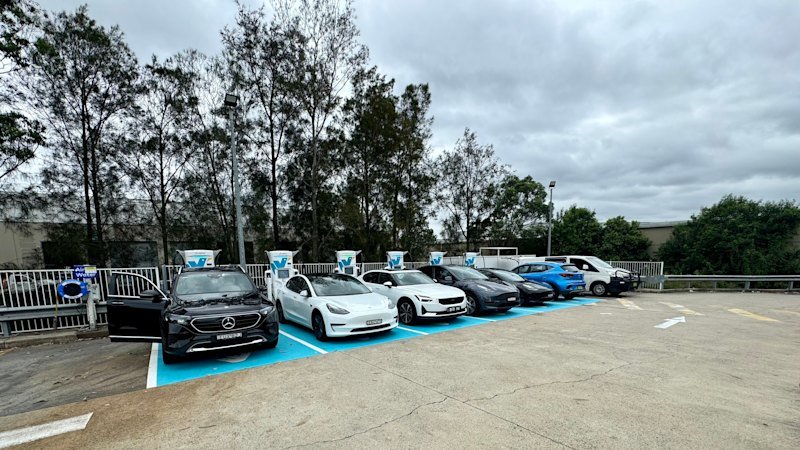

Electric vehicle rentals are on the rise as drivers try to avoid high gasoline prices ahead of the Easter long weekend, and one website reported that reservations for EVs and hybrids were up 388 percent on one day this month compared to last year.
The Iran war has fueled the rise in petrol and diesel prices. The fuel tax cut will come into effect on Wednesday but consumers have been told that in regional areas, it could take more than a week to take effect.
Convenience and Fuel Traders Association of Australasia chief executive Rowan Lee said busy inner-city service stations that switched to quick fuel sales could provide cheap petrol and diesel within days, while remote service stations could sell more expensive fuel for 10 days or more.
“The oil in the ground at your local servo is currently subject to a higher rate of excise duty,” he said. “The more it comes out of the ground, the less taxed oil goes in.”
Turo CEO Rob Chan said that in March, bookings for EVs and hybrids increased by 70 percent compared to the same period last year, and one day – March 15 – had a 388 percent increase compared to last year.
“We are seeing a significant increase in the booking of fuel-efficient vehicles in the market,” Chan said.
“People traveling in Australia who may never have driven an EV or hybrid before are keeping them.”
Theresa Maitre, of Perth, used the Turo car rental website to book an EV for an upcoming trip to Sydney. His decision was influenced more by the cost of oil.
“I currently drive a Prado, and it costs me about $400 to fill up the car, so I was thinking it might be a good time to try an EV, just to see how it went,” he said.
On Wednesday, the federal government’s $33 billion green bank announced it would offer financing for new and used electric vehicles, offering up to a 1 per cent discount on loans provided by Volkswagen Financial Services Australia.
The Clean Energy Finance Corporation says consumer loan customers who buy qualifying EVs priced below the $92,000 luxury vehicle tax threshold can save more than $1900 on a typical $70,000 loan, over five years, under the offer.
Eligible vehicles include Volkswagen, Audi, Skoda, Cupra and Volvo, as well as other eligible EVs purchased through the Volkswagen Financial Services authorized dealer network.
CEO Richard Lovell said the announcement was unrelated to the current energy crisis, although fuel prices and the transition to renewables were “obviously important at the moment”.
“The reality is that the transport sector will be an increasing source of emissions in Australia by percentage, and by 2030 it could be the largest source of emissions by sector,” Lovell said.
The $100 million financing follows a similar offering in February, when Clean Energy Finance partnered with Hyundai Capital Australia to provide $60 million in discounted loans, and previous partnerships with Macquarie Leasing, Metro Finance and Eclipx.
The discounted loans will be co-financed by Volkswagen Financial Services Australia and CEFC, both of which will offer a 0.5 per cent discount on finance.
Lovell said the program will also fund vehicle-to-grid (V2G)-enabled models, which can act as mobile phone batteries that can charge or discharge to the national grid.
“We’re making it easier for businesses to choose advanced electric vehicles, including those with future-proof features such as V2G, by reducing barriers such as high upfront costs and by encouraging manufacturers to increase model availability in Australia,” he said.
“This investment is helping to reduce costs today and build a strong market for affordable, second-hand EVs tomorrow, making clean transport more affordable for more Australians and their businesses.”
Albanon government this week halve the fuel tax for three monthsreduce the price of petrol and diesel by 26.3¢ per litre.
The government will also do that to cancel the payment of heavy road user vehicles of 32¢ a liter for three months to help ease pressure on the shipping industry.
The cuts, which begin Wednesday, will cost taxpayers $2.55 billion.
Brent crude was trading at $US114 a barrel on Tuesday, nearly double the $60 a barrel it was hovering around before the war.
A BloombergNEF study two weeks ago showed the global adoption of EVs last year saved 2.3 million barrels of oil per day.
Taylor Blackburn, personal finance expert at comparison site Finder, said his consumer sentiment tracker showed the number of Australians who listed fuel as one of their most stressful bills had risen from 11 per cent in January to 19 per cent in March.
“For many Australians, fuel has gone from a common expense to a major source of financial fear,” Blackburn said.
 Bianca Hall is the environment and climate reporter for The Age, and has worked in a variety of roles including as a senior reporter, city editor, and in the federal politics office in Canberra.Connect through X, Facebook or email address.


