
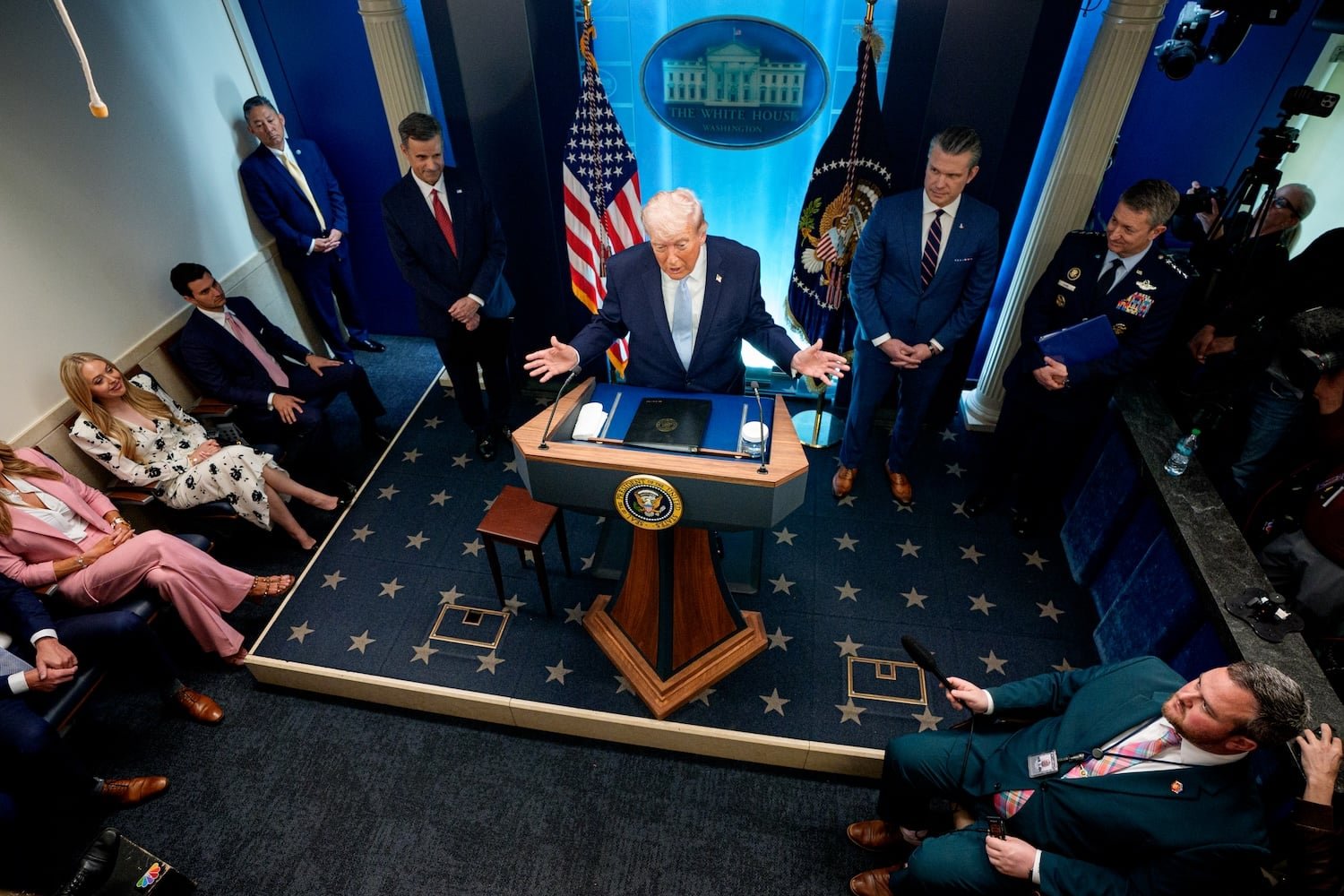

Since the United States and Israel removed the supreme leader of Iran, Ali Khamenei, more than a month ago, the issue of who speaks for Iran has been rooted in every aspect of the ongoing conflict in the Middle East, and especially regarding the issue of how to achieve peace.
Usually said less forcefully by the American media is a parallel question: Who is talking about America? Iran’s supreme leader, Mojtaba Khamenei, son of the former leader, is said to be recovering from injuries sustained in an attack on his father and has not been seen in public since. The President of the United States, Donald Trump, by contrast, is everywhere at once, literally and figuratively.
Since the United States and Israel removed the supreme leader of Iran, Ali Khamenei, more than a month ago, the issue of who speaks for Iran has been rooted in every aspect of the ongoing conflict in the Middle East, and especially regarding the issue of how to achieve peace.
Usually said less forcefully by the American media is a parallel question: Who is talking about America? Iran’s supreme leader, Mojtaba Khamenei, son of the former leader, is said to be recovering from injuries sustained in an attack on his father and has not been seen in public since. The President of the United States, Donald Trump, by contrast, is everywhere at once, literally and figuratively.
In one recent 24-hour news cycle, Trump went out of his way to issue threats of general, indiscriminate violence against Iran unless it complies with his demands, and announced ceasefire for two weeks which seemed to make a big deal for Tehran while also demanding the victory of the United States.
In other words, no sooner had the White House threatened to commit what many international law experts believe would be a war crime than it declared that Iran’s leadership was composed of effective actors. It makes sense, indeed, that the morning after Trump rescinded his warning to destroy Iran’s civilization, he was calling for the possibility of Washington and Tehran jointly managing the Strait of Hormuz for good.
Many of the profound lapses in Trump’s foreign policy, of which this is the latest and perhaps the greatest example, defy rational explanation and seem unrelated to any rational theory of power or statecraft. Trump seems to be enjoying the attention he is getting for his quick and uncertain remarks. But there is something very dangerous to the future of the United States, and indeed the world, that risks getting lost amid the constant surprise and disruption brought on by Trump’s steady stream of provocations.
About a week ago, the White House announced that it intends to seek a 40 percent increase in the country’s military spending in its 2027 budget—a total of $1.5 trillion—which would raise the cost of the Pentagon to historic heights, including during world wars.
It seems unlikely that Congress would pass such an expansion of military spending outright. Like Trump’s recent comments about the federal government’s inability to pay for Medicare and Medicaid while “fight a war” seems to agree, significantly increasing defense spending will soon require a re-examination of the government’s role in national defense and security.
Yet in addition to fundamental concerns about the future health and well-being of America’s society, there are other compelling reasons to push back on such a drastic budget request. The first is immediate. Trump has repeatedly shown himself to be an unstable and increasingly apathetic leader. In his second term, the unchecked personal power he has amassed—enabled by a weak and discredited cabinet and a (albeit slim) Republican majority in Congress—seems to have gone to his head. This has created the worst kind of delusion for Trump about the limitless nature of America’s power while fueling the personal grandiosity that has always characterized him.
Such an irresponsibly inflated Pentagon budget would amplify the anxiety already brewing around this presidency, as well as Trump’s belief that there are few problems that excessive use of hard power cannot solve. This will be bad for the interests of the United States and the broader interests of peace and human development on the planet.
Another reason for opposing the massive military growth of the United States is based on a combination of a long-standing sense of the country’s orientation as a so-called great power and a reading of the past. Turning America into a modern-day Sparta through unrestricted weapons would undermine the nation’s social welfare, including health and education, which are both important and yet largely overlooked aspects of absolute power. At the same time, it will weaken the country economically, and accelerate the growth of the national debt for unproductive purposes.
Beyond what a reasonable assessment of national defense needs seems necessary, buying weapons systems ceases to be an investment and is equivalent to burial capital. In other words, it does not contribute properly to the growth of the productive sectors of the economy.
At a time when China is outpacing the United States in a growing number of frontier industries, from electric cars to batteries to renewable energy, turning the country’s resources into advanced weapons amounts to a foolish choice. Add to that the fact that the United States seems unable to invest in maintaining critical national infrastructure—including roads, railroads, bridges, tunnels, power grids, air traffic control, and water supplies—and the request to invest more in weapons systems begins to look like a recipe for slowdown.
In fact, in the short term, Trump or some early successor may succumb to a form of high blood sugar. But a sharp and painful bill for this is inevitable, even if it is only faced by the next generation that must face not only the debt and decay of these policies, but also the decline in national status that will inevitably accompany them.
The historical part of this involves great power rivalry and how the Soviet Union fell into an irreversible state. Experts differ on the extent to which arms sales contributed to this, but there is widespread agreement that the more productive American economy allowed Washington to force the Soviet Union into what became a vicious arms race.
The contrast to what is currently being done is instructive and should worry even the most ardent advocate of increased US military spending. Although its military is large and its defense spending has risen sharply in recent years, Beijing appears vulnerable to the kind of trap that Washington imposed on the Soviets.
First, the Chinese economy is more modern and diversified than the Soviet economy. China has not only proven to be capable of rapid innovation in many fields, but is also ranked as the world’s leading industrial power, ahead of America. Meanwhile, even as its military power grows, China seems wary of trying to match the United States system for system. Even after years of expansion, its power projection remains largely regional in scope, and its nuclear deterrent, though growing, shows little sign of prioritizing the full-size US arsenal.
This leads us to the ironic conclusion that it is the United States, not China, that most risks failing to learn the lessons of recent history, which saw the dissolution of an extended superpower. If Congress approves an exaggerated budget request for the Pentagon, we may finally see Washington follow the Soviets in the recession, only this time, in a race against time with itself.



