
Galileo Galilei, one of the first people to see the moon through a telescope, described it using what he knew about the sun and the Earth. To present the play of sunlight in the holes, for example, he asked for the rising of the sun on earth, “when we see the valleys, which are not yet flooded with light, but the mountains that surround them on the side facing the Sun are already burning with the beauty of its rays.”
Perhaps you can imagine this vision of the moon—hold that image in your mind and transmit it from this planet and to our shining companion. Peaks in the sun? I have seen that.
This week, we’ve got a different moon—the moon of Artemis. The moon captured by America’s first mission there in generations is not the moon I look for every time I go outside. It’s not the moon I grew up with or the one my parents learned about during the Apollo missions.
On Monday—the day of the moon—we were introduced to a brown, beaten world. All the regions of his scarred far side did not appear to be the white color of the moon, but the more familiar, home color. Mushroom, chestnut, hazel, cocoa, coffee, tea-stained, russet, brown: earth tones. Straight lines running across the surface of the moon; concentric rings that look like coffee cup rings.
The new approach comes from a combination of technology, orbital motion, and human nature, all of which are part of the Artemis II mission stage. The quality of the cameras on Artemis, let alone the ability to stream live feedback, was not possible during the Apollo era. The film from the cameras specially designed for Apollo had to first get home, then be processed, before the images could grace the front pages of newspapers around the world. During Artemis, we get at least a few of those directly from the astronauts’ Instagram Stories. More stunning images will be brought home by astronauts this evening, when their Orion capsule is scheduled to splash into the Pacific, off the coast of San Diego.
The views are different from those of several decades ago because of the geometry of the planet. Artemis went further from the moon than even Apollo 13, revealing a whole new perspective on the moon-Earth system. And during Apollo, the far side was the dark side: Missions were timed so that the astronauts had daylight on the near side to do their work. But that was not important for this mission, which is why the Artemis crew was able to describe areas of the moon that no human eye had ever seen before. The scientists made a list of important surface features that they wanted astronauts to observe.
This month is tripartite. It’s surrounded by space rocks right now, and seeing its scars, boy, I’m glad we have our own atmosphere. Galileo wrote about the moon bursting with dark spots; above Artemis, astronauts saw bright spots—new impact craters and ejecta—that no one before them had seen. They named the one at the border of the near and far sides of the moon, Carroll Crater.
When our own planet was covering the sun, at least from the perspective of the Artemis capsule, the astronauts saw the milky green glow of the sun’s atmosphere and its dust, visible around the moon. On Earth, you can sometimes see a similar phenomenon through the atmosphere, when the air reflects the moonlight and the moon appears to be covered by a halo. My youngest daughter’s middle name is the Turkish word for this: these. I showed him the aerial version on Tuesday, just before bed.
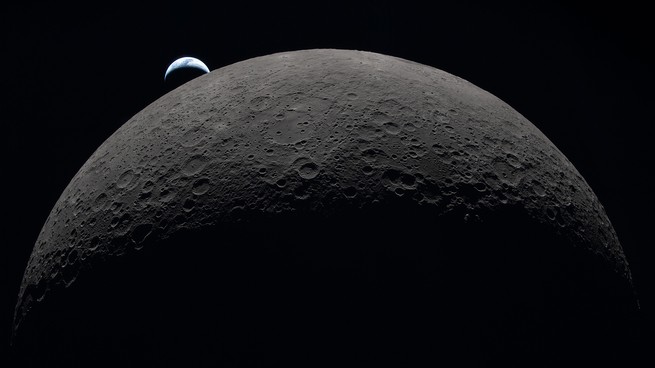
Of all the pictures Artemis has taken so far, the one I can’t stop looking at is a picture of the far side of the moon: a thick crescent preceding the small Earth, a crescent moon. This is our planet viewed as we normally see our moon, and our moon as we have been able to see Earth since astronauts first orbited this planet. I have never seen the moon this way. And I’ve looked at it a lot. This new perspective was both sad and exciting. I felt—to borrow a a new word– “joy of the month.”
Mission specialist Christina Koch felt moved by the moon as well. At one point, after the astronauts explained various features they had previously memorized using flashcards, Koch shared his surprise with simple words: “It’s a real place.”
If Galileo was the first to explain the characteristics of the moon in detail, Johannes Kepler his contemporary and sometimes pen pal was the first person who may have understood the importance of taking us there. Kepler spent much of his career researching eyes, and was arguably the first scientific thinker to explain the difference between eyes. to see and to identify. For Kepler, the human mind played a major role in any cognitive act. Seeing something on the moon, describing it, and photographing it from a very close distance is a different experience than looking at something from a distance, or even seeing a close-up image captured by a robotic camera. NASA, too, seems to appreciate this difference—enough to do this wonderful thing of throwing people on the moon and asking them to look around and tell us about it with metaphors and human emotions.
The first humans to orbit our moon, in 1968, saw a giant Earth coming over the moon’s horizon. That Earthrise image, along with the slightly later Blue Marble image, renewed our view of this planet; Artemis has a chance to do the same for our moon. That brown rock, with the markings on the front is ours too. What do we owe to this fellow world that has shepherded all our lives?
The Integrity Squad will carry many different legacies. It is supposed to be the first ship in a flotilla that will carry economic development, national interests, and the desire for scientific discovery to the moon. No country can build factories or human settlements on the moon anytime soon, but this is what NASA officials say they want. What China is planning, too.
Commander Reid Wiseman said at the launch of Artemis that he hoped his mission would be forgotten, overshadowed by successive landings and even braver crews and missions. But the pictures he took, and the way he and his colleagues explained what they were seeing, should remain in our memory. The pilot, Victor Glover, describing the sunlight that appears on the volcano, asked for one of the most visible things on Earth: “If you’ve ever seen the light over the Luxor at night in Las Vegas, this looks like it wants to be when it grows.” Koch likened the tiny holes to light shining through a compressed lampshade. All the worldly, human, 21st century language we have doesn’t convey the magnitude of what they witnessed: a brand new moon for everyone.




