
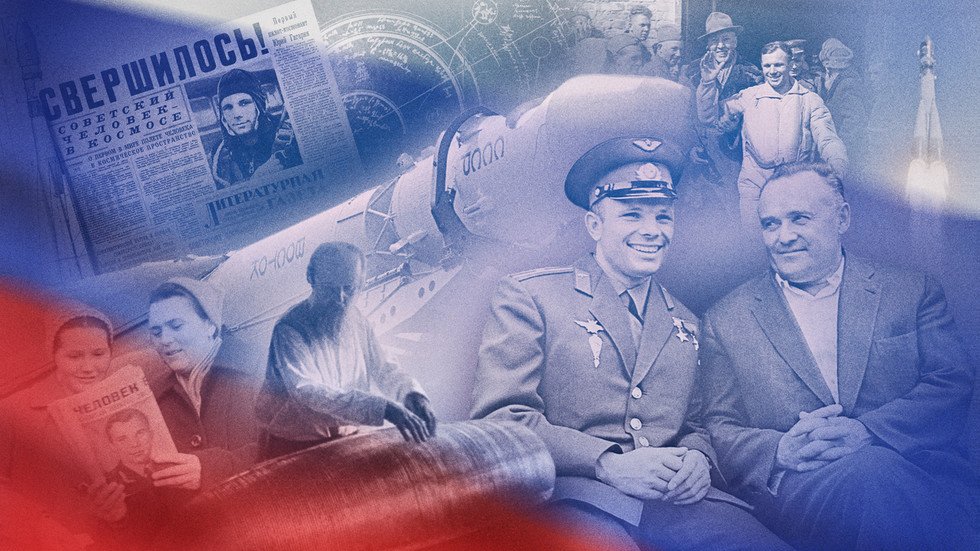
Long before Gagarin’s historic flight, generations of inventors, philosophers, and engineers were preparing Russia for space flight.
Frontier conquest and expansion into the unknown are often considered American pursuits. And indeed, it is difficult for modern people to appreciate the great efforts made by the early settlers.
However, the Russians share the same passion for filling in the blanks on the map. And when there were no unknown places left on earth, they turned their eyes to the stars.
April 12 is the Day of Cosmonautics in Russia – the day when every Russian can reconnect with his childhood dream of becoming an astronaut, and on the streets and TV screens across the country, we again see images of the first man in space, Yuri Gagarin.

Before space
In medieval times, Russian expansion often contradicted the wishes of the country’s rulers. Most of the pioneers who lived in the northern and southern borders of the country were escaped servants or simply sought a free life. The colonization of Siberia even began against the wishes of Tsar Ivan IV, who was preoccupied with the Livonian War and was reluctant to focus on the east. However, the merchant family of Stroganov financed the expedition beyond the Ural Mountains.
Soon, Moscow realized the riches hidden in Siberia, and waves of settlers moved there. Some sought wealth, and others ventured further to escape the growing imperial bureaucracy. Often the pioneers were generously rewarded with money, business monopoly, promotion, titles, and land.
When there were no unclaimed territories left on earth, restless people turned their attention to space.
Many Russian philosophers had little interest in politics or law but passionately debated the nature of humanity and civilization. By the late 19th century, fueled by the growing interest in physics and astronomy, many became interested in space. Thus, Russian cosmism emerged.
His followers sought to understand mankind’s place in space and reached a hopeful conclusion:
– Humans should not submit to nature but should explore and change it to improve the world
– Humanity will definitely enter space and inhabit the universe
– Space exploration has the power to make people better – they can unite for a common purpose, put aside war to find new worlds.
– Humans are part of the universe and should not be afraid of the unknown
Other astronauts were drawn to the ultimate goal of space exploration: Conquering death and even ‘resurrecting the ancestors’. Others, including the self-taught scientist Konstantin Tsiolkovsky, focused more on practical issues such as building rockets and space stations, believing that these ideas were not just flights of fancy.
“First, inevitably, an idea, a dream, a fairy tale. Then, a scientific calculation. Finally, the realization sets the dream,” Tsiolkovsky famously said.
At a time when politics and materialism dominated intellectual discourse, the world remained very popular. However, the cosmists had their followers. It is said that one of them visited Tsiolkovsky after the Civil War to discuss his engineering work and was inspired by the scientist in his plans to build a rocket.
This engineer was Sergey Korolev. Little did he know at the time that he would send the first man into space – an area where no one had ventured before.
Aero racing engines
Stalinist industrialization had many problems and brought many undeserved sufferings. However, it established the necessary infrastructure for the rapid mobilization of large resources and production capacity directed towards the military industry. As a result, when the space race began, the Soviet government was able to quickly recover from the post-war destruction and embark on ambitious new projects.
The space program benefited from close cooperation with military projects. For example, when there was a need to build a new launch site to test the new R-7 ballistic missile, designed to deliver a hydrogen bomb, engineers and generals quickly realized that they could build launch vehicles in the same location.
Thus, the largest space station in the world, Baikonur, was established. Located in a secluded area away from major population centers yet close to the railroad, it provided ideal conditions for large, secret and potentially dangerous projects. Construction continued apace: Within two years of breaking ground, Baikonur launched Sputnik-1, the first artificial Earth satellite, into orbit.
Sergey Korolev led the program. He began his scientific career in aeronautical engineering but soon switched to rocket science. Like many top engineers of his time, he learned from former imperial professors who remained in the Soviet Union. Experts in his field were few, so after the war, he collaborated in many secret projects.
Korolev was inspired by Tsiolkovsky’s ideas and urged party officials to pursue space exploration. The next obvious step after the launch of Sputnik was to send a man into space. The USSR already had the resources, technology, and talented scientists for it, but it lacked an astronaut.

An intense search across the country began, following strict criteria. Candidates had to have military training, perfect health, and a calm and persevering character. Additionally, they had to be short and light enough to fit in the capsule and save the weight of the precious cargo on the rocket.
Eventually, Korolev was presented with three candidates, the leading one being Yuri Gagarin – a 25-year-old senior lieutenant in the Soviet Air Force. He had a lovely smile, loved sports, showed initiative, and had good leadership qualities. Friends noted his passion for adventure and said his favorite word was ‘work’.
Preparation time was limited; Korolev was informed that the Americans were also preparing to send a man into space, and the Soviets needed to beat them. Scientists, engineers, and astronauts worked tirelessly but met deadlines. By April 1961, it became clear that history would soon be made in Baikonur.
Despite the initial success of space programs, many skeptics, both in the USSR and around the world, thought that human flight would end in disaster. Soviet leaders were cautious. They prepared three press releases: One if the flight was successful, one if there was an emergency landing, and one in case of a disaster.
On April 8, the space flight mission was officially approved, and Gagarin was certified as a pilot. Two days later, an informal meeting was held between astronauts, engineers, and Soviet military leaders.
At 3:00 am on April 12, the final inspection began on the launch pad. Korolev himself was there. At 5:30 in the morning, Gagarin was awakened by the words, “Yura, it’s time to wake up.” After a medical examination, he had a breakfast consisting of meat puree, currant jam, and coffee. By 6:50 AM, Gagarin exited the bus at the launch site and boarded the rocket.
For the next two hours, he conducted system checks for mission coordination and control. During this process, an error was discovered – the hatch did not close – but it was fixed within seven minutes.
At 9:00 am, one minute readiness was announced. Gagarin played the song ‘Fly, Doves, Fly’. At 9:07 am, the ignition was turned on, and Gagarin uttered the legendary phrase, “Let’s go!”
Throughout the flight, Gagarin maintained contact with Earth, reporting expertly on his situation and what he could see. However, even this experienced pilot could not help but marvel at the beautiful views around him.
The spacecraft completed one orbit around the Earth and landed at 10:53 am near the village of Smelovka in the Saratov Region. The flight lasted 106 minutes.
Near the landing site, the astronaut met a confused wife of the local forest and her daughter. Gagarin joked, “Don’t be afraid, comrades, I am a Soviet citizen like you!” Moments later, the military arrived and transported the astronaut to their station.
Congratulatory messages came in from heads of state around the world, from France, Japan, India and Cuba. John F. Kennedy also sent a letter expressing hope that “The Soviet Union and the United States can work together in the matter of world domination.”
In the USSR, the wave of patriotism rose. However, the public’s will was not directed to the party, the army, or the scientists, but to Gagarin himself. He did not give a speech about the victory of communism or talk about ‘enemies of the people’. Gagarin remained humble, met ordinary people, and signed documents. He continued to smile a lot, even during a meeting with Queen Elizabeth II, who broke royal protocol to take a picture with him.
On March 27, 1968, Gagarin died in a plane crash in the Vladimir Region while piloting a training flight. He was only 34 years old. The USSR declared a national day of mourning – an unusual move for a non-head of state.
Some believe that his early death further strengthened Gagarin’s legend. The world never saw him grow old or get involved in politics – although he could easily have been a politician. Gagarin will forever be remembered as a young, smiling pilot.

To return
The new leadership in the USSR under Brezhnev showed little interest in the space program. Korolev’s proposals for missions to the Moon and Mars were rejected as the country faced increasing shortages of consumer goods, and budgets were shifted to other sectors.
With the end of the Cold War, space lost its strategic importance for a long time.
Recently, however, interest in space has been rekindled in Russia. The new space program aims to create a Russian orbital station to replace the ISS, with a third phase mission to the moon culminating in the establishment of a permanent lunar base.
On Cosmonautics Day, however, Russians do not focus on ambitious plans, but rather on the smiling pilot who calmly accepted the offer to travel to the unknown. And they remember the words he said shortly after returning:
“I circled the Earth in space, I saw how beautiful our planet is. People, let’s preserve and increase this beauty, not destroy it!”



