
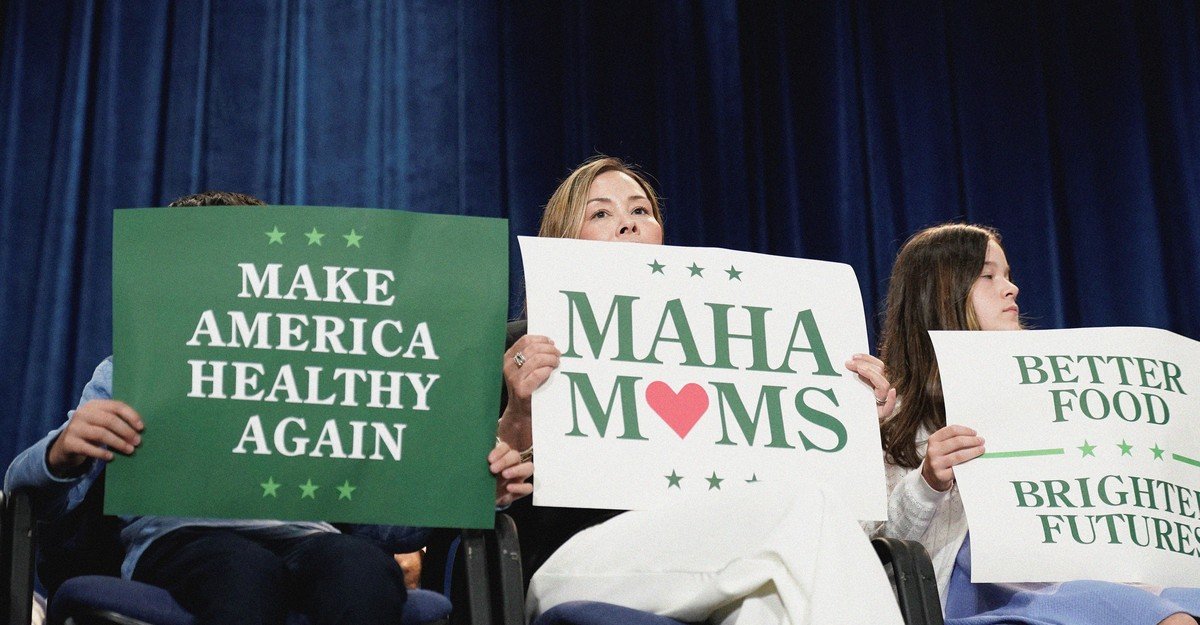
Earlier this month, MAHA’s mothers went to the White House. Several key figures in the “Make America Healthy Again” movement gathered around a table in the Roosevelt Room to speak with Secretary of Health Robert F. Kennedy Jr. and other senior administration officials. The guests—who included health activist Kelly Ryerson, health broadcaster Alex Clark, and nutritionist Courtney Swan—were all women. They are influential among a loose coalition of Kennedy supporters known as MAHA mothers, many of whom are concerned about the health of their children. This was a chance for them to present their grievances to the Trump administration—which have grown in recent months. Later, they were ushered into the Oval Office to see President Trump, who, according to Ryerson, welcomed them as “my MAHA leaders.”
The union between MAHA and MAGA was not always possible. Kennedy was a Democrat before his independent presidential run in 2023, and many of his priorities — such as promoting healthy eating — have traditionally been the domain of the left. Recently, the partnership has begun to falter. Core MAHA supporters were outraged when Trump signed an executive order in February that could provide liability protection to manufacturers of glyphosate, the weed killer used in Roundup that studies have linked to cancer. (Ryerson is so anti-chemical that she writes “Glyphosate Girl” on Instagram.) The movement has also been frustrated by the stalled nomination of perhaps MAHA’s most famous mother, Casey Means. Trump’s pick for surgeon generalwho has not yet received a Senate confirmation vote. Means was also at a recent White House meeting, which appeared to be an attempt to patch things up with MAHA before the midterms.
Not unlike the “silent majority” that propelled Richard Nixon to victory in 1972 or the Tea Party movement that started a red tide during the 2010 midterms, MAHA mothers have been claimed to be an important factor in the upcoming election. MAHA is “at the center of our coalition,” Steve Bannon, Trump’s former chief strategist, told us. Without the support of the movement, he believes, there is no chance that the Republicans can win in November. The president seems to be on the same page: “I read an article today where they think Bobby will be very good for the Republican Party in the midterms,” Trump said during a Cabinet meeting in January, referring to the health secretary. “So, I have to be very careful that Bobby likes us.” In an email, the deputy chief press secretary at the White House Kush Desai told us that the administration is committed to implementing the MAHA agenda. The meeting at the White House “was one of the many productive engagements the Administration has had and continues to have with the MAHA community,” he wrote.
These voters are politically desirable on party lines. Some of MAHA’s priorities—such as eliminating petroleum-based food dyes or reducing pesticide use—are popular. About one-third of independent parents, along with one in six Democratic parents, identify as supporters of the MAHA movement, according to a poll last year. Most Democrats too trying to win over the mother MAHA disaffected.
Famous MAHA moms tend to be swing voters rather than Trump loyalists. Vani Hari, the activist known as the “Food Babe,” was a delegate to the Democratic National Convention in 2012 but is now a prominent MAHA lobbyist (she was invited to the White House meeting but was unable to attend). Ryerson voted for Trump because of Kennedy. “I probably wouldn’t have voted otherwise,” he told us.
But Hari and Ryerson—both of whom were health activists long before MAHA came along—may not be representative of rank-and-file voters. For this story, we spoke to several MAHA supporters, including a documentary filmmaker who had worked on anti-vaccination films, moms with a parenting podcast, and an Instagram influencer who told us about her four-ingredient recipe for homemade Goldfish crackers. One of us spoke to more than a dozen attendees at CPAC, the annual Republican convention. Many were MAGA before becoming MAHA, and said their midterm votes were not based on health issues. Of course no one said he would actually consider voting blue in November.
And then there is the question of numbers. Hearing MAHA leaders say, their followers are forming a small army. Tony Lyonswho runs MAHA PAC, the movement’s political arm, has said there are millions of MAHA mothers and, in a letter to GOP leaders, said embracing the movement is the way to “win big in the midterms.” Hari claimed on X in January that thousands of MAHA supporters have been calling state legislatures in recent months over concerns about legislation that would give drugmakers immunity from lawsuits (though, when we asked about it, he admitted the number was likely in the hundreds). In Tennessee, which considered a drug bill earlier this year, a lawmaker told us he received “150 emails and about 50 phone calls to my office.” But in our report, we were unable to track down evidence to suggest that mothers who will cast their votes based on their MAHA beliefs are present in numbers that may change between term. MAHA “isn’t going to affect the total, but it could affect different districts that are very close together,” Bob Blendon, a Harvard professor who studies public opinion on health, told us.
The most famous competition in which MAHA has participated so far is not even a seat that is literally in danger of flipping from red to blue. MAHA PAC has pledged to spend $1 million to unseat Sen. Bill Cassidy of Louisiana, who was the primary vote to advance RFK Jr.’s nomination. as health secretary but since then he has repeatedly called her out in public. The group has endorsed another Republican candidate, Julia Letlow, and health has not been a major issue in the race. Instead, both candidates have competed to prove that they are more loyal to Trump. (Trump has endorsed Letlow over Cassidy.)
Of course, a lot can change between now and November. US elections have been stalled in the past by groups of voters who were seen as difficult and seemingly absent. The Tea Party, for example, appeared at first to be widespread—much like the modern MAHA movement—but the effort was well-funded and well-organized, Patrick Rafail, a professor at Tulane University who wrote a book about the movement, told us. “I don’t see a match for MAHA,” he said.
MAHA seems to be one of the few unifying factors across the political spectrum. But broad appeal doesn’t necessarily translate to the ballot box.



