
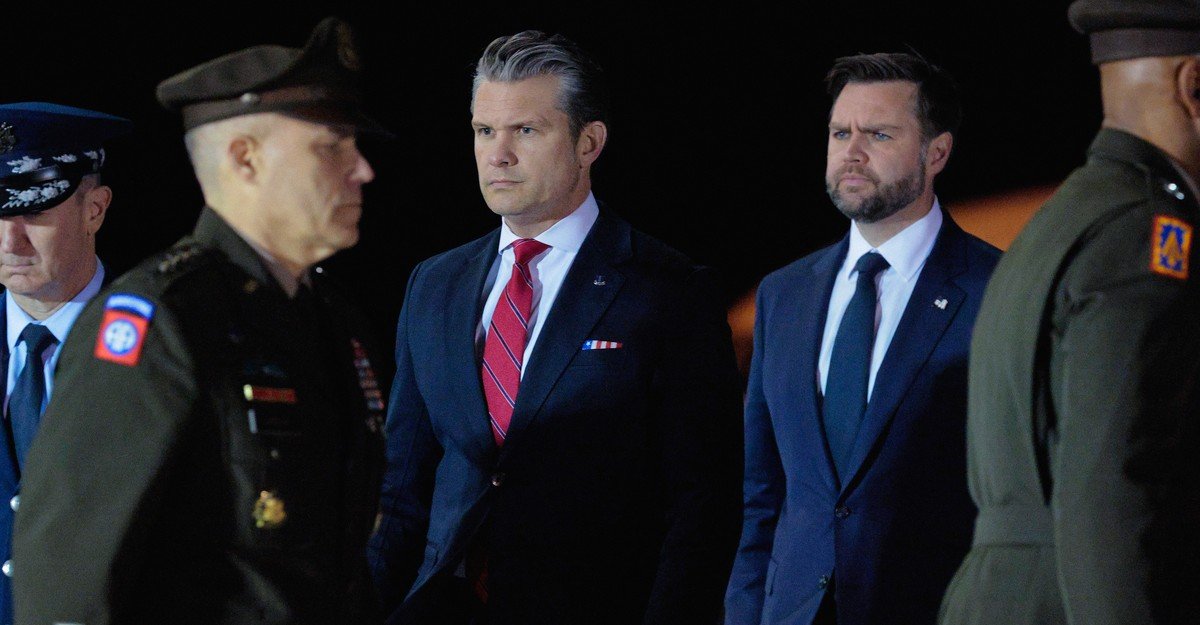
In closed meetingsJD Vance has repeatedly questioned the Defense Department’s portrayal of the war in Iran and whether the Pentagon has overlooked what appears to be a significant shortfall in the US missile stockpile.
Two senior administration officials told us that the vice president has questioned the accuracy of information the Pentagon has provided about the war. He has also expressed concern about the acquisition of certain missile systems in discussions with President Trump, several people familiar with the situation told us. The consequences of a significant depletion of weapons stockpiles could be dire: US forces would need to draw from those same stockpiles to defend Taiwan against China, South Korea against North Korea, and Europe against Russia.
Pete Hegseth, the defense secretary, and General Dan Caine, who is the chairman of the Joint Chiefs of Staff, have said publicly that the US weapons stockpile is strong, and they have shown the damage to the Iranian forces after eight weeks of fighting to be great. Vance’s advisers, who spoke to us on condition of anonymity, told us that the vice president has presented his concerns as his own rather than accusing Hegseth or Caine of misleading the president.
Vance is trying, advisers suggested, to avoid making this personal, or divisive in Trump’s embattled Cabinet. Some of Vance’s confidantes, however, believe that Hegseth’s image has been misleadingly positive. In a statement, Vance said the Pentagon chief is “doing a great job,” and cited Hegseth and Trump’s work to ensure “heroic behavior” in the top ranks of the military. A White House official told us that Vance is “asking a lot of probing questions about our strategic plans, as are all members of the president’s national security team.”
Trump has echoed many of Hegseth’s and Caine’s positive statements about the war, declaring weeks ago that the damage done by US forces was already a victory and that the US stockpile of critical weapons was “infinite.” Some advisers suggested that Hegseth’s showmanship and sometimes combative tactics with the press appeared designed to give the president what he wanted to hear; The 8 a.m. Pentagon meeting takes place when Trump is known to watch Fox News. “Pete’s TV experience has given him the skills to know how to talk to Trump, how Trump thinks,” one former Trump official told us.
Pentagon officials’ positive portrayals present an incomplete picture, people familiar with the intelligence assessments told us. According to internal estimates, Iran has retained two-thirds of its air force, most of its missile capability, and most of its small and fast boats, which can lay mines and disrupt traffic in the Strait of Hormuz. At least in terms of restarting the stalled maritime trade, “those are the real threat,” one person told us.
In March, Hegseth boasted about “total control” of Iran’s air force. But in April, Iranian forces shot down a U.S. fighter jet, setting off a massive rescue operation—which Hegseth compared to the Resurrection of Jesus Christ. And Tehran is bringing more missile launchers online every day; about half could be regained after a two-week ceasefire that was set to expire last Tuesday, according to people familiar with the assessment. Trump extended the ceasefire indefinitely but then canceled trips planned last week to Pakistan for peace talks with Vance and, later, special envoys Steve Witkoff and Jared Kushner when Iran refused to enter the talks.
Officials and outside advisers told us that the use of critical weapons—including interceptors that protect against Iranian missiles, and offensive weapons such as Tomahawk missiles and the Joint Air-to-Surface Standoff—has created severe shortages that limit America’s ability to fight future wars, despite efforts to quickly develop alternatives. Vance has raised concerns about the weapons shortage in meetings with the president and other national security officials. Already, the United States may have gone through more than half of its pre-war supply of four key weapons, the Center for Strategic and International Studies, a Washington, DC think tank, he said this week. Even before the Iran war, reserves had been provided by ammunition production and ammunition donations to Ukraine and Israel. Pentagon officials have warned that the shortfall threatens the military’s ability to dominate in a hypothetical conflict against Russia or China.
Sean Parnell, a Pentagon spokesman, told us in a statement that Hegseth and other Pentagon officials “tend to give the president a full, unvarnished picture.” A senior official told us that Caine, meanwhile, was “accurate, thorough, and detailed” in assessing the effectiveness of military operations.
The vice president had doubts about the merits of attacking Iran before the war began; Trump has admitted that Vance was “probably a little less enthusiastic” about the conflict, which has proven unpopular with American voters. But the vice president has a lot to balance: his desire to work well with other senior officials, his record of opposing “perpetual war,” and his prospects if he wins the presidency in 2028.
Vance and Hegseth all have a great contribution to the outcome of the war. Several people close to Trump believe Vance now sees his political future as tied to what happens in Iran, one of the senior officials told us. Other officials and individuals familiar with those involved told us Hegseth has his own aspirations for elected office, even possibly president. The defense secretary recently addressed the National Religious Broadcasters Network, where he defended the spread of Christianity in government, and the National Rifle Association, where he defended the “God-given right” of Americans to bear arms. Former defense secretaries have largely distanced themselves from partisan politics and divisive social issues.
Hegseth’s job depends on retaining the president’s support at all costs. His confirmation process was messy, and some of his actions in his first months on the job angered the White House. Since then, he has overseen the tactically successful strikes on Iran’s nuclear program last June and the capture of Venezuelan dictator Nicolás Maduro in January. He also began a campaign to MAGA-fy the military—rolling back diversity programs and firing or sidelining large numbers of senior female and minority officers. All the while, he has been a staunch supporter of the administration, criticizing Democrats, the press, and US allies. White House officials told us that she and the president remain difficult. Hegseth has fewer fans among congressional Republicans than most other Cabinet secretaries, leaving him in favor of Trump. Hegseth is “struggling to tell the president exactly what he wants to hear,” one former official told us. “I think that’s dangerous.”
Hegseth and Vance both served as members of the ground services in Iraq around the same time. (Hegseth was a National Guard lieutenant attached to the 101st Airborne Division; Vance was a Marine Corps reporter.) But they drew different conclusions from Iraq and other counterinsurgency conflicts. As a young veteran, Hegseth defended the 2007 invasion of Iraq embraced by hawkish Republicans like John McCain. In more recent years, Hegseth argued that the United States failed in Iraq and Afghanistan because restrictive rules of engagement limited the military’s ability to fight. In the Pentagon, he has embraced innovation, endorsed and celebrated America strike on small boats in the South American coast that the United States claims is used by drug traffickers. He boasted that Iran’s current campaign had launched twice as much force in its first five days as a prelude to the “shock and awe” of the Iraq War in 2003, which lasted about a month.
People who know Vance say that he believed that the Afghanistan and Iraq Wars were flawed from the start. “We were lied to,” he declared while serving in the Senate. Vance has argued that America’s interests are best served by prioritizing resources at home. Before becoming vice president, he warned that helping Ukraine would deplete important US weapons stockpiles. “This is not our war,” he said.
A senior administration official told us that the president is satisfied with the information he has received from the Pentagon. This person provides a different opinion within the president’s security team—which includes Hegseth, Vance, Secretary of State Marco Rubio, and White House Chief of Staff Susie Wiles—as part of the positive tension that serves the president. Wiles refrained from taking a position on the rationale for the Iran war before it was launched, and has focused instead on trying to encourage an open discussion with the president about the risks and rewards of each major decision. “The truth is that under the leadership of President Trump, the United States military weakened the Iranian regime in just 38 days,” White House Press Secretary Karoline Leavitt said in a statement.
Hegseth and Vance’s the differences extend to Secretary of the Army Dan Driscoll, a close friend of Vance’s who once beat the Pentagon boss. Driscoll attended Yale Law School with Vance and is expected to help Vance run for president, people familiar with his plans have said. Hegseth’s rivalry with Driscoll is an open secret in the Pentagon. Last year, the White House gave Driscoll a second role—directing the Bureau of Alcohol, Tobacco, Firearms and Explosives—as Rubio holds the titles of secretary of state and national security adviser. And Trump sent Driscoll, not Hegseth, to Kyiv in the final season of peace talks between Ukraine and Russia.
Driscoll and Hegseth have also been at odds over Army personnel appointments. Hegseth forced out the chief of staff, General Randy George, a close ally of Driscoll, despite Driscoll’s objections. Hegseth also fired Vice Chief of Staff General James Mingus, whom Hegseth replaced with his military aide, General Christopher LaNeve. George was responsible for overseeing the arms embargo, and his removal caused an outcry on Capitol Hill. “I, too, love General George,” Driscoll told a House committee this month. A senior administration official told us that Trump does not know Driscoll well and has not commented on the Army secretary’s future.
Far from Hegseth’s prediction of a quick and certain victory, the war in Iran has now descended into a costly, unmeasurable mess. Last Tuesday, as the minute hand ticked toward the end of the initial ceasefire, Vance’s plane pulled up on the runway, ready to take him to peace talks in Pakistan. But when Iran appeared unwilling to send in its mediators, Trump backed off, extending the deal indefinitely. Meanwhile, the two countries’ standoff in the Strait of Hormuz escalated last week when the Islamic Revolutionary Guard Corps seized commercial shipping for the first time – a sign that its forces remain strong and that the war could again defy a high-profile assessment from Pentagon officials.
Jonathan Lemire and Ashley Parker contributed reporting to this story.



