
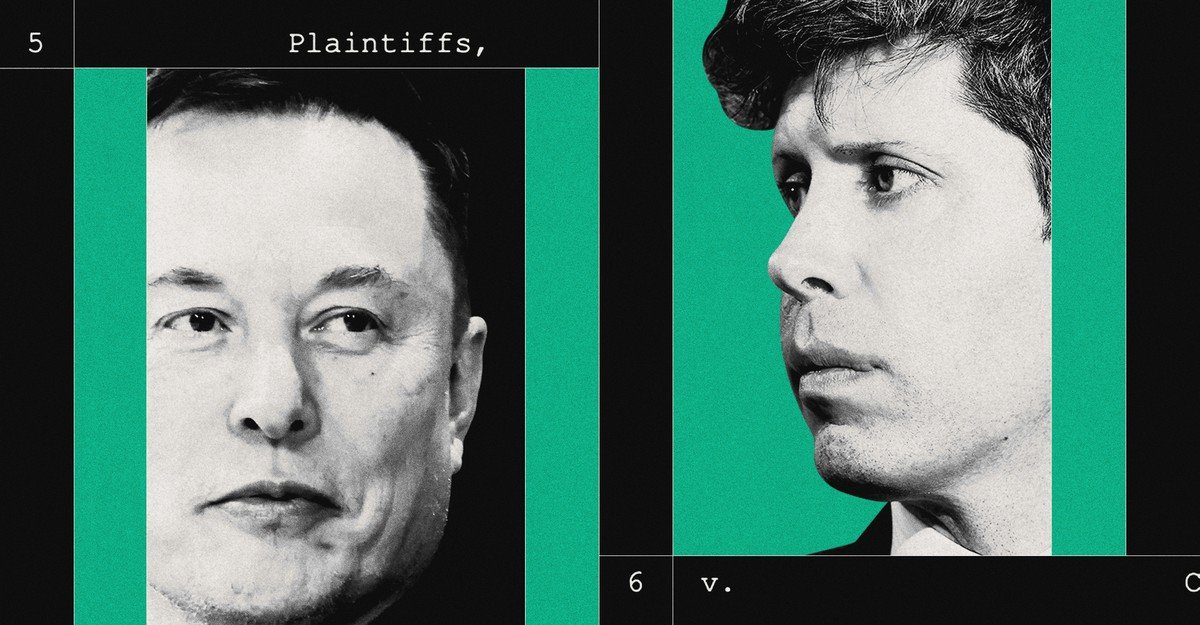
Elon Musk and Sam Altman are two of the most influential people in Silicon Valley, if not the world. Between the two of them, Musk and Altman run multi-trillion dollar technology companies that promise to reshape civilization. But this morning, both sat under bright lights in a downtown Oakland courtroom, suffering all kinds of technical glitches as their attorneys began their long-awaited trial. Musk vs. Altman.
As Steven Molo, Musk’s attorney, begins his opening arguments, confusion seems to have swept the courtroom. “We can’t hear you,” Judge Yvonne Gonzalez Rogers said. Someone fixed his microphone. Later, when Molo began to question Altman’s integrity, his microphone cut out again, and his presentation disappeared from the screen in the room. (“We’re funded by the federal government,” Gonzalez Rogers joked. “The court is happy to take more money.”)
Musk is suing Altman and OpenAI, among others, demanding legal and financial remedies that would destroy OpenAI as we know it. The battle dates back to 2015, when Musk teamed up with Altman to create OpenAI out of concern, as they said, that Google DeepMind could not be trusted to create general artificial intelligence. Corporate greed would hinder community development, they claimed, so OpenAI would be a non-profit organization. After falling out with Altman and the other co-founders, Musk left in 2018. This was all before OpenAI raised a for-profit entity, and before ChatGPT became the fastest-growing consumer app in history. In 2024, Musk sued, claiming that by placing profits over its founder’s mission, OpenAI had violated its founder’s charter and misappropriated Musk’s prior contributions. “It’s very simple,” Musk testified today. “It is not right to steal charity.” Others named in his complaint are OpenAI co-founder Greg Brockman and Microsoft, a major investor in the company.
Musk is asking that Altman be removed from OpenAI’s board, that the company be turned into a non-profit organization, and for the return of alleged “ill-gotten gains” — about $150 billion — that Musk says would go to OpenAI’s charity. External legal experts say that Musk is unlikely to win all or even most of these. His reasoning is controversial: OpenAI has indeed evolved from a non-profit lab to a for-profit, consumer vendor, and a group of critics have argued that it has deviated from its original mission of ensuring that AGI benefits humanity. But Musk himself seems to insist that OpenAI cannot continue as a non-profit organization – for example, in early 2018, he wrote email address with OpenAI leadership saying that merging the company with Tesla “is the only way it can even hope to hold a candle to Google.” And even before suing, Musk launched a rival for-profit company, xAI. “Mr. Musk’s case is a case of hypocrisy,” William Savitt, OpenAI’s attorney, told the jury today, later adding that Musk had “fresh grapes.” (OpenAI, which declined to comment, he wrote yesterday that the case is an “unfounded and jealous intention to disrupt a competitor.” Musk’s legal team did not respond to a request for comment.)
The core of these claims is important to the AI industry as a whole. The implications of this case go beyond any company or executive: The conflict between Musk and Altman has directly shaped the course of the AI industry. In fact, it is the founder’s argument for the AI boom. The next few weeks of the trial will highlight the tension around AI development that has only grown more urgent—between profit and social good, and over who can be trusted with this technology.
Already, the pre-trial process has provided no shortage of drama. Both sides published internal communications between Musk and OpenAI leadership. OpenAI shared a text suggesting that Musk had used a former OpenAI board member to keep tabs on the company. (That board member, Shivon Zilis, has many children with Musk, and has said in his post that he is in a romantic relationship with her; when asked about Zilis today, Musk said he was “my chief of staff and uh, well, yeah,” smiling.) Musk’s alleged use of ketamine during a key OpenAI conversation, which he has said he doesn’t remember being a significant issue, until Roger grew up hearing a recent lawsuit. he considered this line of inquiry irrelevant.
The experiment makes the AI boom look pessimistic and small. In his oath depositionAltman wrote that Musk sent him a message of complaint that he wanted more credit for OpenAI’s success and was upset that he was not included in the memorial photo. Altman has he also said, regarding Musk and his case, “Maybe his whole life is based on insecurity. I feel for the guy.” In the courtroom, Altman sat stone-faced next to Brockman and left before Musk got to the witness stand.
Musk, for his part, has said that he will drop his lawsuit if OpenAI changes its name to “ClosedAI.” Yesterday, as jury selection began, Musk began posting angrily on X and repeatedly called the co-founder “Scam Altman.” Before the start of the debate today, Gonzalez Rogers admonished Musk and Altman for their use of social media, asking them to reduce their “propensity” to post about the case; they both agreed softly, “Yes.”
Now we all live in the chaos of Musk and Altman’s vendetta. Disagreements over the direction of Google DeepMind led to the creation of OpenAI, and then further disagreements led to Musk’s founding of xAI. Similarly, a few years ago, Dario Amodei and six other OpenAI employees split off to form a competing AI company, Anthropic, themselves, not trusting OpenAI’s design or its leadership to prioritize the benefit of humanity over financial gain. And there’s Mark Zuckerberg, who Musk asked about joining forces to buy OpenAI in 2025, according to documents released in early discovery. (Met previously declined to commentSince then Zuckerberg has spent tens or even hundreds of billions of dollars to revamp the AI team at Meta in an effort to catch up on the AI race. The very kind of AI divide that started with Musk and Altman continues to repeat itself.
A deeper explanation for this dynamic is that AI growth is made up of a very small group of men, almost all of whom claim to be humanity’s best stewards while largely ignoring their competition. At the same time, the goal of creating an organizational structure, whether nonprofit or corporate, to issue a check to the CEO has faded. An independent board was supposed to govern OpenAI, but the company has essentially become Altman’s property—just as Anthropic is Amodei’s and xAI is Musk’s. Grok has sometimes clearly arranged his responses and Musk’s political views by mimicking his social media posts.
Both sides have made the issue of concentration of power—that no one company or person should control such transformative technology—the core of their arguments. “If you have someone who is dishonest in managing AI,” Musk testified, “I think that’s very dangerous for the whole world.” The defense, meanwhile, said that “a single person in control was inconsistent with OpenAI’s core mission.” Apparently, the irony was lost on everyone.
This trial will provide the clearest overview of a group of scholars whose contention is building the most expensive infrastructure in human history in the name of a technology that could upend the labor market, spell the end of education as we know it, and reshape the geopolitical order. That is, as long as the microphones continue to work.



