
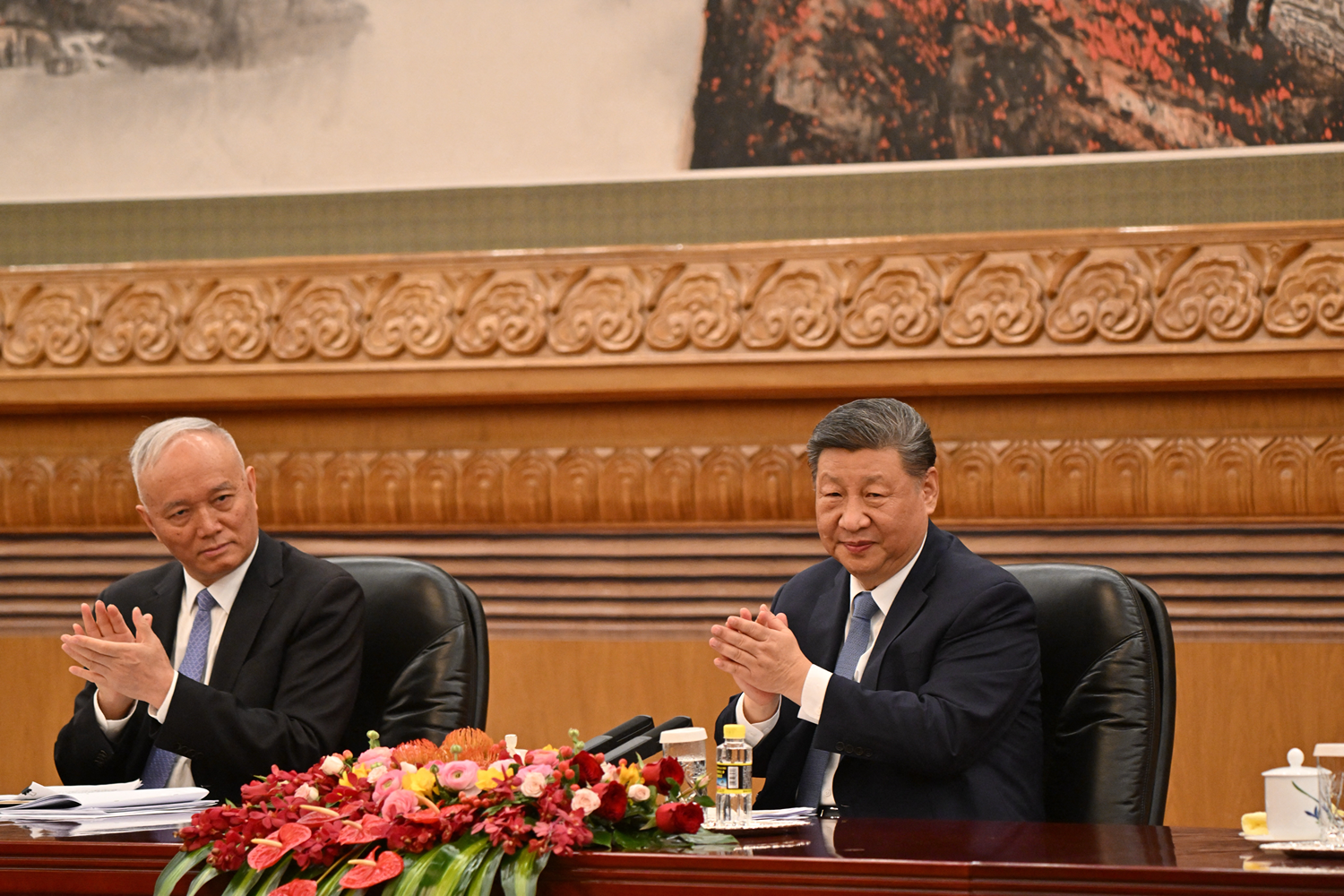

Since the 20th National Congress of the Chinese Communist Party (CCP), there has been a debate about who is President Xi Jinping’s second in command. As 70-year-old officer Cai Qi’s role has grown, many observers have come to identify him as “Number 2.” Latest article in Economist he correctly takes this view, saying that Cai—as a member of the Politburo Standing Committee, first member of the CCP Secretariat, and director of the CCP Central Office—has long accompanied Xi on important events and controls the leader’s schedule, documents, meetings, information flow, and security arrangements.
Cai is indeed one of the closest people to Xi in Chinese politics today. But proximity to supreme power is not the same as being close to holding it. Cai is certainly important, but he is not China’s second in command. Such a person, under a leader as paranoid about power-sharing as Xi, does not exist at all.
In a highly personalized power system, the role of gatekeeper can often carry real power. The great eunuchs of ancient China had real power not because they held an official institutional position, but because they monopolized the channel between the emperor and the outer court. They were the custodians of the things the emperor read, who he met, what he heard, and how the outer court understood the will of the emperor. They depended on royal authority, but that gave them too much power.
But even measured by this standard, Cai is not de facto No. 2. He has not monopolized the path between Xi and the party, government, military, and other systems, nor has he created an independent power bloc. Maybe it’s not that he doesn’t want to, but that he can’t.
Xi is not an emperor confined by Cai, who can access outside information only through him. The military, national security, discipline inspection, personnel organization and equipment, and economic and governmental administration all have their own systems. Cai is close to Xi, but that doesn’t mean he controls all the channels leading to Xi.
This is the difference between Kai and the chief eunuch or favorite minister who becomes number 2. The chief eunuch or favorite could stand “less than one man and more than 10,000,” as the saying goes, because both represented the emperor and could use the emperor’s name to make his own political agenda.
The strength that Cai has shown is implementation, distribution, coordination and management. He may develop Xi’s affection, but there is no indication that he can replace him. He can push for implementation, but there is no indication that he can rearrange policy priorities independently. Cai’s power lies in being a master in Xi’s power plants.
Proximity to the supreme leader is not the only source of power. One must also consider a number of more complex criteria: whether the relevant official controls a critical system; if he can, in the absence of the senior leader, settle matters on behalf of the station; if he is listed in front of other members of the Standing Committee on major party platforms; and whether he can mobilize resources, personnel, finance, security, and internal enforcement systems. By these standards, Cai can hardly be described as the de facto No. 2.
The simplest example is the question of who “keeps awake at home.” The CCP has institutional rules: If the top leader goes abroad and is absent for a very long time, a person in charge must be appointed to serve as acting general secretary, handle major government and military affairs, and maintain the daily operations of the top leadership. That person can only be Li Qiang, the Premier of China, not Cai.
Li occupies the second place in the Standing Committee, is the prime minister of the State Council, and is the first person to receive and develop governmental and economic systems. In the central party commissions and in the sectoral meetings, the whole party, Li’s role is more important than Cai’s.
Several core institutions of the CCP—the Central National Security Commission, the Central Commission for Comprehensive Development Reform, and the Central Commission for Financial and Economic Affairs—are among the party’s key discussion and coordination platforms in the Xi era. If Cai was truly number 2, he should at least take a position in these commissions that shows a higher level of responsibility than Li. But Li is ahead of Cai on many of these platforms.
In the Central Financial and Economic Affairs Commission in particular, Li is the deputy leader, while Cai is only an ordinary member. Since the reform and opening up, financial and economic work has practically become, most of the time, the most important business of the CCP, and the financial and economic commission is the main platform where the party leads economic work.
The presiding and concluding roles in important party meetings also reflect this. The study sessions for senior provincial cadres and ministers are high-level party meetings ruled by Xi, not State Council meetings or regular administrative meetings. Their procedure is that Xi gives the keynote speech and Li presides. The General Economic Work Conference is more open: Xi speaks, Li presides and gives the closing speech, while Cai only attends both meetings.
These settings are not party details. In the politics of CCP meetings, “attending,” “in charge,” “delivering a closing speech,” and “implementing” represent different political roles. Cai’s attendance indicates that he is within the core circle; Li’s management and conclusion show that he bears the responsibility of overall responsibility under Xi.
Some may say that Li handles government affairs while Cai handles party affairs, and that in the CCP system the party stands above the government. This is correct in principle. But when it comes to real power, it cannot be said broadly. The party itself has layers. The most important parts of the party’s work are organization and personnel, disciplinary control, political and legal issues, security and ideology.
What Cai really controls is the Central Office; daily coordination of the Secretariat; Executive Committee of Central and State Government Agencies; and documents, meetings, study sessions, implementation, and management based on Xi’s will. These are of course important, but they are more about carrying out Xi’s wishes than using Cai’s own power.
In addition, the most important organizational power in party affairs is not in Cai’s hands. The head of the Central Organization Department, which controls promotions and appointments within the party system, is Shi Taifeng, and the organization system works directly under Xi. Cadre selection, inspection, promotion, and transfer are the primary links through which the power of the CCP is released. Cai can put forward political requirements for the work of the organization at the Secretariat level, and can attend important meetings of the organization system, but this does not mean that he directly controls the Central Department of the Organization. In other words, what Cai holds in party matters is the ability to coordinate decisions that have already been made, not the ultimate power of the organization.
In contrast, Li controls the governmental and economic systems. Government matters are not raised as party matters in principle, but in the national administration they have a stronger role. How financial aid is provided, how domestic debt is settled, how the property sector is handled, how consumption is stimulated, how industrial policy is developed, how foreign investment is strengthened, how local governments function, and how employment pressure is reduced—these are all complex problems of the state machine. Cai can oversee implementation; Li must perform the operation. The pressure and responsibility he has is greater and more important than the normal tasks of the party.
This is also where it is EconomistA person’s judgment is very easy to make mistakes. It sees Cai’s place on Xi’s side but downplays the fragmented nature of the CCP’s power structure. The Xi era is indeed one of personal integration, but that does not mean that all power is channeled through Cai alone.
In contrast, Xi’s approach is to divide power between different people, allowing his own trusted allies to control different power blocs. Cai is an important hub that connects these systems, but does not control it.
As noted above, a true second-in-command is not only important when the leader is present; he must also be able to hold the situation together when the leader is not present. Cai’s power depends heavily on Xi’s presence. The stronger the Xi, the more important the Cai; the more Xi is now, the more important Cai is. But once Xi is gone, the person who can continue the general rule for a while is still Li, not Cai.
Thus, any judgment of Kai must avoid two extreme positions. To say he is just a secretary would definitely be an understatement. He is not an ordinary secretary, but a chief administrator at the level of the Standing Committee, “the chief lawyer of the local court.” The information, methods, and management skills he controls are enough to make him one of the most important people in the Xi system. But to say that he is the second most powerful man in China is to overestimate him.
In fact, the essence of Xi’s system is not that Cai has replaced Li as the new number 2, but that Xi has deliberately eliminated any second-in-command in the real sense. Everyone is given a piece of power, but no one is allowed to create their own power center, not even one under Xi. Cai is just the piece closest to Xi, the most important operator of close range in Xi’s personal power machine.
Cai’s popularity gives outsiders the impression that Xi is relying on him more and more. But this is not because he has become the second center of power. It’s because in a true peerless system, the person closest to the leader is the most vulnerable to error.



