
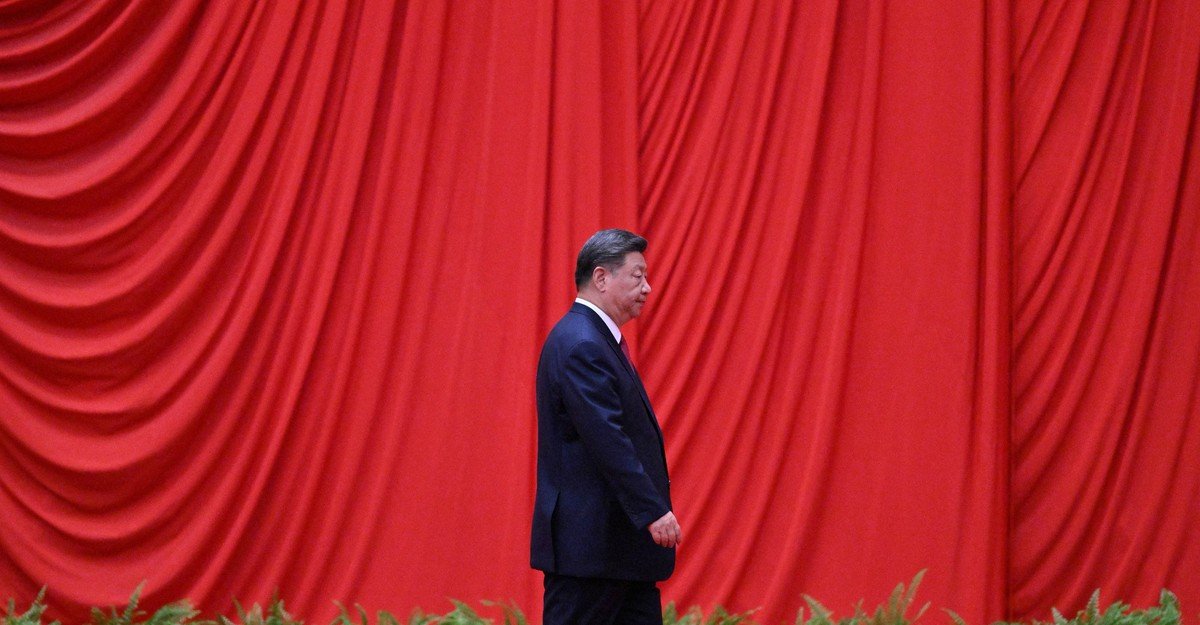
Now that the United States has been distracted by domestic politics, alienated allies, and once again engulfed in war in the Persian Gulf, this seems like an opportune time for China to seize the mantle of global leadership. Yet Beijing has avoided capitalizing on these conflicts and public outcry. Instead of confronting the United States by defending Iran, a long-time strategic partner in the region, China has offered only indirect support and is largely sitting on the sidelines.
China’s restraint should not be seen as a sign of weakness. Instead, the country is biding its time, positioning itself as a ready option to fill the leadership void when the United States shuts down. China’s leaders are striving to create a world in which their rule appears not as a grandiose victory over Western interests but as a ground truth.
In private conversations and public writings, China’s leaders and their advisers often describe America as “declining but dangerous” — a late power prone to aggressive outbursts in hopes of arresting its slide. As early as the 1990s, the height of the United Nations’ power, Chinese thinkers were already theorizing about America’s decline. Wang Huning, then a relatively unknown scholar, was inspired by his travels through the United States to write the book America Against Americain which he described a nation plagued by social division, inequality, and political chaos. Alarmed by the country’s problems of homelessness, drug addiction, racial violence, social divisions, and low levels of education, Wang concluded that America contained the seeds of its own destruction.
Wang is now a member of the seven-member Politburo Standing Committee, the pinnacle of power in the Chinese Communist Party. He is also a close advisor to President Xi Jinping of China and the main architect of the country’s strategic plans. The themes Wang identified decades ago—American social decay, economic inequality, and political paralysis—are central to China’s official narrative of the United States.
That is why China believes that the surest way to gain international power is not through direct confrontation but through patience. Why should Beijing risk getting into a fire war or challenging US leadership in the Middle East or elsewhere when the US is degrading itself, militarily, financially and politically? China’s mission, then, is not to seize this moment but to lay the foundation for its preferred future.
That means strengthening the Communist Party by reducing the country’s vulnerability to external pressure. Independence is clear through the line of the party’s latest five-year plan. China is striving to ensure that it is less dependent on the world—and that the world is more dependent on China. Thanks to massive government investment and subsidies, Chinese companies are moving up the industrial value chain in a variety of sectors, including electric vehicles, clean energy, and communications infrastructure. The state is also strengthening domestic alternatives to foreign technologies, such as semiconductors, software and aircraft. The desire is not only to gain market share but to thwart foreign efforts to curb China’s rise by restricting access to key resources and materials.
China is quietly preparing for a time when its economic weight and technological prowess make it the center of gravity in international affairs. China’s leaders are working to create a world that is largely sustainable Chinese artificial intelligencepowered by Chinese clean energy technology, and where Chinese computer software improves medical, educational, technical and administrative outcomes around the world.
This economic strategy is part of the geographic compass. Instead of overturning the post-World War II international order outright, Beijing is trying to push it to better reflect the wishes of the Chinese. Chinese leaders have long argued that the existing international order reflects Western priorities—that the rest of the world is more interested in economic growth than in so-called universal values and individual freedom. As a superpower and a country still identifying with the developing world, China sees itself as poised to lead a new global order.
Similarly, Beijing resents the US security cooperation network, which it sees as coming at China’s expense. Chinese leaders have instead been saying that security alliances are a remnant of the Cold War that do more to divide and create tensions than to solve security challenges. Instead of moving around the world in which Washington sits at the center of a network of alliances in Asia and elsewhere, Beijing is interested in countries prioritizing material interests over ideological solidarity. This, Chinese leaders believe, would allow China to remove the United States from the center of a new map of practical cooperation.
China has pursued this strategy with impressive discipline. Yet plans are based on assumptions that can easily prove wrong. China is betting that America’s decline will continue. But the United States has bounced back from bad times of division and distrust in the past (such as after the Watergate scandal and the Vietnam War) and can do so again.
Beijing’s export-driven economic agenda may also run afoul of its borders. As Chinese companies eliminate competitors in a growing range of industries, foreign governments are responding by increasing sanctions to protect their domestic producers – the United States, the European Union, India, Indonesia, and Mexico, among other places. Instead of acting as a magnet to draw other countries closer, China’s exports could end up destroying industries in the developed world and fueling resentment and anger against China in the process.
Beijing’s assumption that neighbors will grow more impolite as they become more economically dependent on China is also worth investigating. Despite Beijing’s growing military power and growing economic weight, Tokyo and Taipei remain resistant to China’s vision of controlling Taiwan, the Senkaku/Diaoyu Islands, and surrounding waters. If other Asian countries are also defying Beijing’s demands for favoritism, China’s strategy of tolerance is starting to sound less and less.
At the same time, a lot of domestic China the economy is faltering. Beijing’s aggressive investment in manufacturing and technology has enabled it to dominate these industries but it has also created it. deflationary spiral which distribution of goods well exceeds the requirements. Growth is slowing. Domestic debt is increasing. The transition to a more advanced, high-tech economy is generating social problems, including high youth unemployment. The country’s gains in longevity and declining birth rates also promise a demographic crisis where fewer working-age adults will be supporting more retirees. These trends complicate China’s plans for economic growth and national security.
However, Chinese leaders remain convinced that the challenges of the United States are more severe than their own. They are making a long-term bet that the United States is accelerating a downward spiral that will require a greater and stronger role for China in the new world order. Whether this gamble pays off depends largely on what the US does next.



