
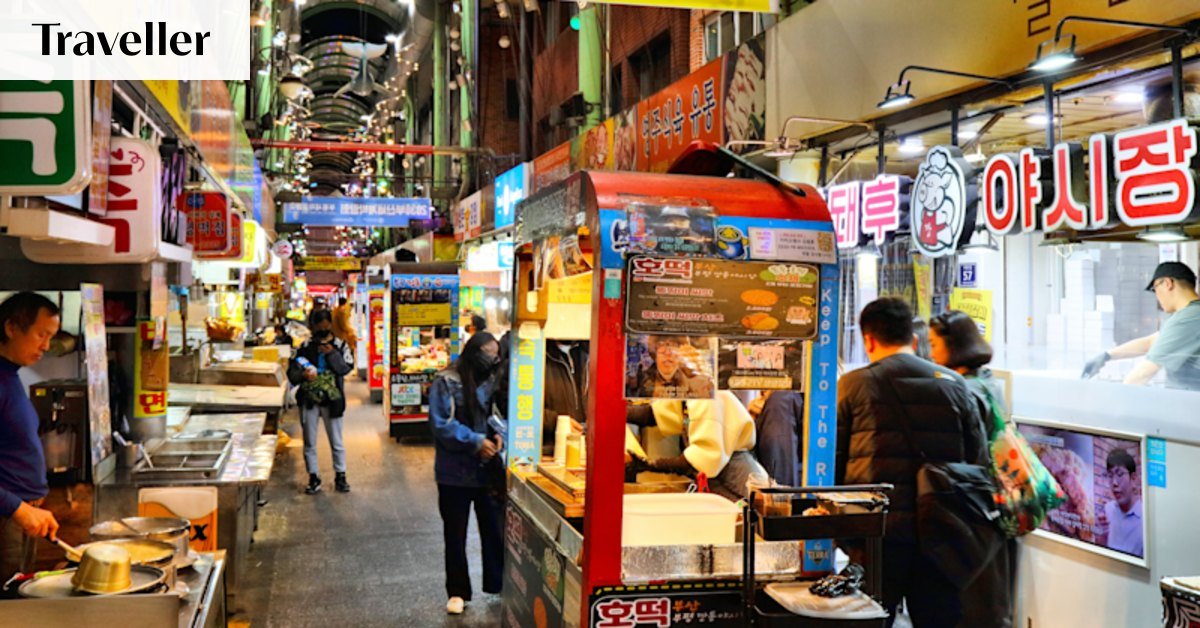

“You have to mix these noodles really well,” Chris Tharp tells me, leaning in conspiratorially. “Or the women will yell at you.”
The women look at me kindly, smiling encouragingly from behind the counter as I pick up my chopsticks and handle the bowl, but I’m not one to ignore local advice, so when I mix, I mix with enthusiasm.
The dish is called bibim dangmyeon, a Busan street specialty of cold sweet potato noodles piled high with grated carrot, garlic, fish cake and daikon radish.
There’s a light soy and chili dressing too, which you stir through the noodles as you mix all the ingredients together.
And then, eat.
Sign up for the Travel Deals newsletter
Get exclusive travel deals delivered straight to your inbox. Register now.
Chris and I eat at Bupyeong Kkangtong, an old-school Busan market that once sold canned goods during the Korean War, but now hosts stalls selling fresh produce and food prepared in a basic, unpretentious environment.
If you love markets, then you’ll love this part of Busan, a bustling, diverse port city in the southern part of South Korea. In a walkable circle in the downtown area you have Bupyeong Kkangtong, as well as the large Gukje Market, with many street food stands, and Jagalchi, Busan’s main fish market, which also hosts many busy restaurants.
What’s the best place for a street food tour?
Chris is an American who has lived in South Korea for over 20 years, and in that time has discovered a thing or two about Busan’s street food scene.
He knows you have to mix bibim dangmyeon well to avoid embarrassment. He also knows that when you see ojingeo muchim on the menu, you order it, which is why our decision at the next restaurant we come across, just down the road from the market, is already taken care of.
This is the thing about Korean food. You may know the basics by now, barbecue, banchan, kimchi, but you get to the country and realize you know nothing. There is a whole world of dishes and ingredients out there, both local and special, that will blow your mind.
Ojingeo muchim is a cold salad of fried or boiled squid mixed with cabbage, carrot, radish, and gochujang (Korean chili paste) with sesame oil. It’s spicy, sour and sweet, and specially designed to make you want to drink as much Korean beer as possible.
Although this is a food tour, so we need to continue, we need new dishes. The next stop is a restaurant that is a cult favorite among Busan students, where you can get a huge plate of yellowtail sashimi with all the trimmings for a very reasonable price. And that’s what Chris and I have, with another beer or two to honor the local culture.
There are so many things to accompany the generous, rough-cut fish laid out in front of us: sesame leaves, salted nori sheets, green peppers, garlic, spicy ssamjang, bowls of rice. It’s hard to know what to do with it all.
“There are no rules with Korean food,” Chris assures me. “You can put anything with anything else. It’s great.”
And that’s what you find here, in a country where it’s hard to avoid comparisons to neighboring Japan: tastes in Korea shift more toward big and bold than subtle and cute. You get big portions, and big flavors. Lots of peppers. Lots of garlic. Strong sesame oil was poured over the lot.
And perhaps best of all, you can discover the classic beauty of pojangmacha, food carts surrounded by wooden benches, where hot snacks and cold drinks are served until the wee hours of the morning on the streets of Busan. During the winter, each car is covered with thick plastic sheets, keeping the heat inside, a nice place to end the tour.
It’s late at night now, everyone has been out for hours, there’s a relaxed atmosphere as the Korean students at the end of our cart start sending food to our end, and the Japanese tourists next to us clamoring for drinks, and the night is made up of attempts to break language barriers through pork bulgogi and Cass mixed with soju.
There is a lot of noise here, but the good kind – happiness, joy and satiety.
EXPLANATION
TOUR
The Busan street food tour is part of InsideAsia’s 10-day “Soul of Korea” tour, which starts from $7329 per person, including accommodation, guide and some meals. Take a look insideaasiatours.com
THE BIRD
Asiana flies from Sydney and Melbourne direct to Seoul, with connections to Busan. Take a look flyasiana.com
The author traveled as an Inside Asia guest.
 Ben Groundwater is a Sydney-based travel writer, columnist, broadcaster, writer and frequent tour guide with over 25 years experience in the media, and a lifetime experience around the world. He is an expert on food and wine – writing about them, as well as consuming them – and at any given moment Ben is probably thinking about ramen in Tokyo, pintxos in San Sebastian, or carbonara in Rome. Follow him on Instagram @bengroundwaterConnect through email address.


