
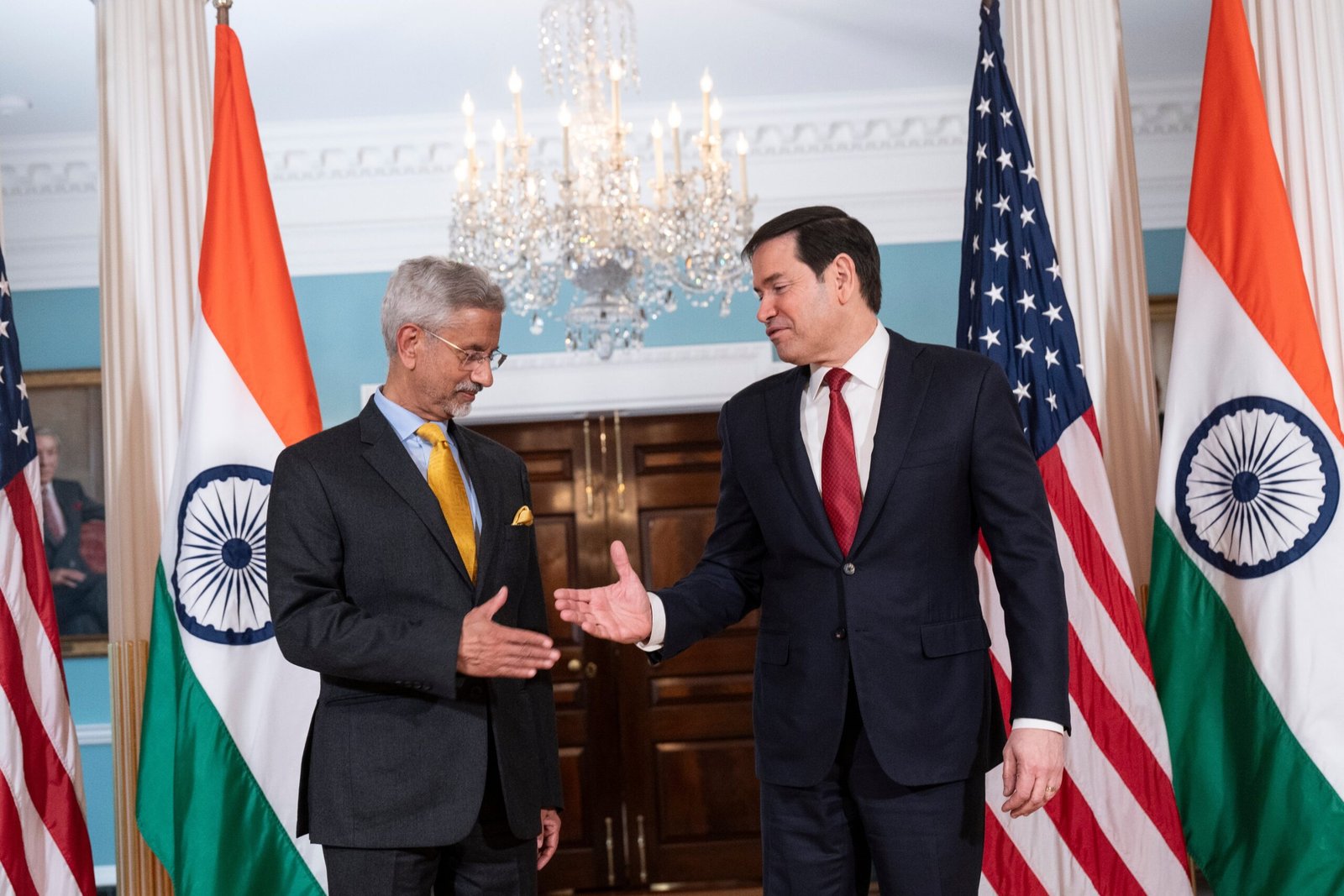

US Secretary of State Marco Rubio is scheduled to travel to India this month, to meet with the other three foreign ministers of the Quadrilateral Security Dialogue, or Quad, and try to restore relations between Washington and New Delhi. The visit comes at a difficult time: Since last year, relations between the two countries have been under serious strain.
Rubio’s stated reasons for the visit include attending a Quad meeting—with ministers from Australia, Japan, and India—and discussing trade and energy issues with Indian officials. In New Delhi, Rubio will most likely meet with Indian Foreign Minister Vikram Masri, who was in Washington last month, as well as his official counterpart, Indian Foreign Minister S. Jaishankar.
US Secretary of State Marco Rubio is scheduled to travel to India this month, to meet with the other three foreign ministers of the Quadrilateral Security Dialogue, or Quad, and try to restore relations between Washington and New Delhi. The visit comes at a difficult time: Since last year, relations between the two countries have been under serious strain.
Rubio’s stated reasons for the visit included attending a Quad meeting—with ministers from Australia, Japan, and India—and discussing trade and energy issues with Indian officials. In New Delhi, Rubio will most likely meet with Indian Foreign Minister Vikram Masri, who was in Washington last month, as well as his official counterpart, Indian Foreign Minister S. Jaishankar.
But the visit has more significance given the strained relations between the US and India and the fact that last year’s Quad summit, which India was scheduled to host, was postponed due to these bilateral tensions.
US-India relations began to deteriorate shortly after the brief but bitter conflict between India and Pakistan a year ago, which followed terrorist attack in Indian-administered Kashmir. US President Donald Trump said his intercession brought the conflict to a quick end. India, which has long resisted outside efforts to resolve its dispute with Pakistan, insisted that the United States played no role in facilitating the ceasefire.
It is believed that Trump was angry that India refused to congratulate him for helping end the conflict. Meanwhile, Pakistan took the opposite step, praising the US president’s role in ensuring a ceasefire and even nominating him for the Nobel Peace Prize. Last June, Trump invited Pakistan Army chief Asim Munir to the White House for lunch. Understandably, this gesture was met with great distress and frustration in New Delhi.
A few months later, in August, Trump imposed a 50 percent tariff on India — because of its purchases of Russian oil and arms. Washington and New Delhi began trade talks, reaching transitional contract in February where most Indian goods would face 18 percent US tariffs. The US Supreme Court’s decision to strike down most of Trump’s tariffs invalidated this agreement.
However, great damage had already been done to the relationship between the two countries due to Trump’s actions, from inviting Munir to the White House for his football business tactics, which caused great pain in various sectors of India. Decades of loyalty carefully cultivated by Democratic and Republican administrations were lost.
Trump’s crackdown on H-1B visas, which allow foreign professionals to work in the US for up to five years, also strained relations between the two countries last year. Under pressure on immigration from his center, Trump significantly restricted access to these visas by imposing a $100,000 fee on employers who file H-1B applications. The policy had a disproportionate impact on Indian citizens, who contributed more than 70 percent of H-1B visa approvals in 2025.
Finally, another issue emerged recently that may have Rubio’s interlocutors in New Delhi wary of his reach: Pakistan became an unlikely mediator between the United States and Iran. The Trump administration has welcomed this role. Although a 21-hour meeting with Iranian negotiators in Islamabad in April failed to produce significant results, Pakistan remains involved in efforts to end the war. India has found itself sidelined in the process.
As a result, Rubio may face a polite but frosty reception in New Delhi, and Trump has made his job more difficult. Last month, the president of the United States reprinted comments from conservative radio host, Michael Savage, in which he referred to China and India as “hell-hole” countries and Indians as “bandits with laptops.”
India, which had shown restraint in not engaging in previous inflammatory remarks from Trump himself, to be called the comments are “clearly uninformed, inappropriate and in poor taste.” This shows a change. In his first term—despite reportedly mocking Indian Prime Minister Narendra Modi in private—Trump did not criticize India publicly. But now, Trump and his officers they have used condescending language when negotiating with India on trade issues, even praising Modi personally.
Presumably with the intention of avoiding the growing anger in India for these words, the American Embassy in New Delhi. made a statement calling India a “great country.” But it is far from obvious that this effort will serve as a sufficient emollient.
Rubio cannot talk about these differences when he meets his Indian colleagues. Both sides, however, can ensure that the relationship between the two countries does not continue to waver in more troubled waters. The United States and India share a number of economic, strategic, and diplomatic issues—which, if handled well, can ensure that the relationship does not lose its momentum.
America remains India main business partner; in turn, India is the 10th largest trading partner of the United States. Indian investment in the US in various sectors ranging from pharmaceuticals to energy is responsible for creating more than 400,000 jobs. This economic cooperation should remain strong, especially due to the great uncertainty about the business and investment environment of the United States and China.
The security partnership between the US and India, which Rubio will no doubt address in New Delhi, remains fruitful. In this regard, amid the turbulence of bilateral relations in other fields, the two sides continued the defense cooperation agreement for another decade for the third time last October. At the same time, two sides he confirmed again their commitment to a “free and open Indo-Pacific region.”
There is little reason to believe that, despite the apparent tension, this important shared concern will be resolved—especially if Rubio has the mandate to revive the Quad. However, given Trump’s “America First” foreign policy orientation, he may push Quad partners to shoulder more responsibilities and burdens. Indeed, other foreign ministers may use the opportunity to ascertain whether the United States is still watching Quad as a useful tool in the Indo-Pacific.
Finally, because US diplomatic relations with traditional European allies are under some strain, it may be especially important to ensure that relations with India can be maintained. It is obvious that India has been left out of a proper US-Iran dialogue. But India is in a rare position where it has a strong relationship with Israel and a working partnership with Iran. If Pakistan fails, perhaps India can play an important role in de-escalating tensions.
During most of the Cold War and beyond, Washington and New Delhi could afford to ignore each other as their relationship was not economically, strategically, or diplomatically balanced. Despite the recent tensions that have characterized the partnership, its fundamentals remain the same. The task before Rubio is to see if he can convince his interlocutors that they can still build together on this existing foundation.



