
Stan Choe
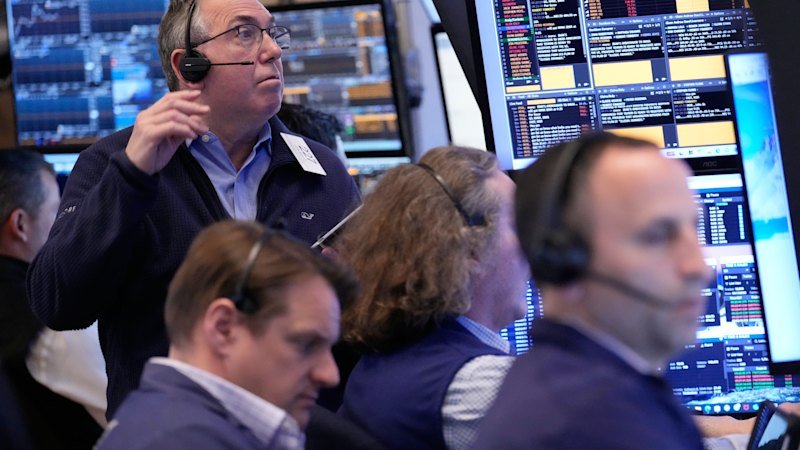
Wall Street is reeling in mixed trading Wednesday after another disappointing update on inflation and a recovery in tech stocks.
The S&P 500 rose 0.8 percent and was on track to squeeze past its all-time high earlier in the week. The Dow Jones Industrial Average was down 52 points, or 0.1 percent, as of 2:19 p.m. ET, and the Nasdaq composite was 1.4 percent higher.
Australian shares are expected to fall, with futures at 5.02am AEST pointing to a fall of 39 points, or 0.5 per cent, at the open. Part of the ASX lost 0.5 percent on Wednesday, bank stocks plunged after the release of the federal budget. The Australian dollar is trading at US72.58¢ at 5.16am AEST.
Gains in Wall Street technology stocks helped support the market, such as Micron Technology’s 4.6 percent and On Semiconductor’s 11 percent. They had stumbled the day before after momentum came to a sudden halt in stocks riding on excitement around artificial intelligence technology.
Nvidia, the chip company that was among the first faces of the AI boom, rose 2.9 percent and was the strongest driving force on the S&P 500 because of its size. Its CEO, Jensen Huang, received an invitation to join President Donald Trump in his trip to Chinawhere they could discuss allowing the export of Nvidia AI chips to the world’s second largest economy.
Meanwhile, the Senate narrowly confirmed Kevin Warsh as chairman of the Federal Reserve, setting off the most controversial leadership transition at the US central bank in decades and a test of his political independence.
The 54-45 vote on Wednesday was the narrowest confirmation rate ever for a central bank chief, reflecting the divisive politics in Congress and Democrats and fears that Warsh will give in to President Donald Trump’s demands to cut interest rates quickly.
Earlier in the day, Japan’s SoftBank Group said its profit for the 12 months to March rose nearly fivefold from a year earlier as its AI investment paid off. China’s Alibaba Group said its AI and cloud growth accelerated in the latest quarter, and its U.S.-traded shares rose 7.7 percent even though its overall results fell short of analysts’ expectations.
But most stocks outside the tech industry fell, as pressure mounted on Wall Street.
“Corporate earnings and AI momentum are acting as primary market drivers, but the road is getting rougher,” said Tim Waterer, chief market analyst at KCM Trade.
A report on Wednesday showed that US headline inflation was worse last month than economists had expected. That followed Tuesday’s report showing rising inflation in the US consumer base.
Prices are rising for fuel, transportation and all sorts of other things because of taxes, bad weather affecting food prices and other factors. But on top of all that is the rise in oil prices caused by the war with Iran, which has reduced the international flow of crude to customers around the world.
On Wednesday, oil prices moved little more following strong gains earlier in the week, with Brent crude oil prices down 1.7 percent at $105.90 a barrel.
That remains above its price of about $US70 from before the war, and the International Energy Agency said on Wednesday that global oil inventories are shrinking at a record pace. Rising oil prices have forced traders to despair of further interest rate cuts this year by the Federal Reserve. If anything, a rate hike looks like the next bet after not moving rates this year.
Lower rates can boost the economy by making mortgages and other loans cheaper. But they can also exacerbate inflation while driving up the prices of stocks and all kinds of other investments.
The yield on the 10-year Treasury rose to 4.48 percent from 4.46 percent on Tuesday evening and is above its pre-war level of 3.97 percent.
Rising yields helped send utilities and real estate stocks to the sharpest losses in the S&P 500. Such companies tend to pay relatively high dividends, which are less attractive to investors looking for income when bonds pay more in interest.
American Electric Power fell 3.2 percent after announcing a $US2.6 billion stock offering of its shares.
Elsewhere on Wall Street, Birkenstock Holding fell 13 percent after the British company said its latest quarter results were hurt by US tariffs and other factors.
In stock markets abroad, indexes rose across Europe and Asia.
South Korea’s Kospi led the way with a jump of 2.6 percent. It had sunk 2.3 percent the previous day after a senior administration official suggested the government could redistribute the benefits of AI from companies to citizens. That momentum took off from AI stocks globally on Tuesday.
AP
The Market Recap is a summary of the day’s trading. Let’s find each otherekday afternoon.



