
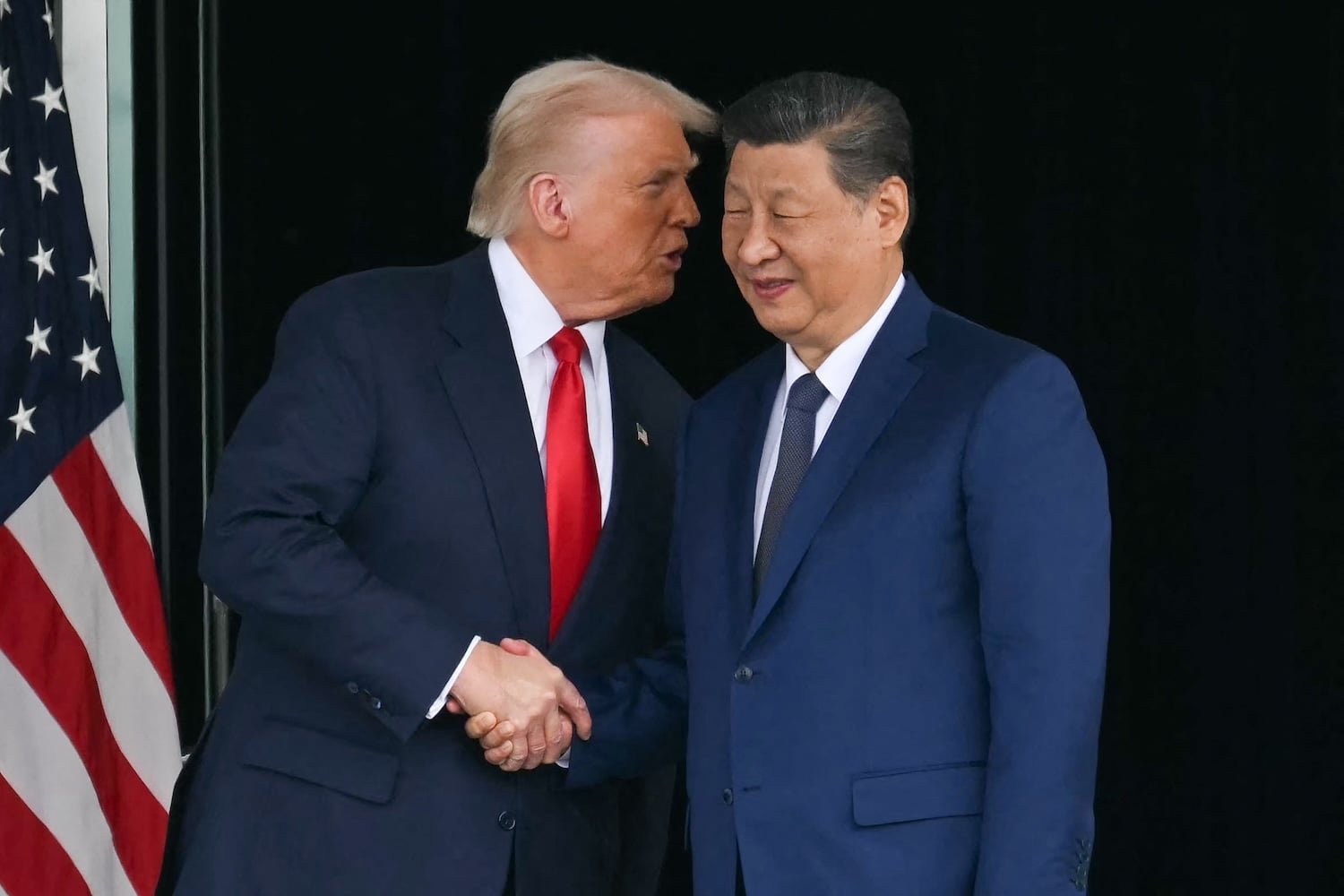

There are two ways to understand this week’s summit in Beijing between Chinese leader Xi Jinping and US President Donald Trump.
The first, and most interesting, is to see the meeting between the two men known as the most powerful men in the world, and the personal chemistry and drama surrounding their second ever meeting in China. The second is about the conflict between the incarnate nations—and while this is the most difficult to define, it is also the most important.
There are two ways to understand this week’s summit in Beijing between Chinese leader Xi Jinping and US President Donald Trump.
The first, and most interesting, is to see the meeting between the two men known as the most powerful men in the world, and the personal chemistry and drama surrounding their second ever meeting in China. The second is about the conflict between the incarnate nations—and while this is the most difficult to define, it is also the most important.
Common narratives about the different directions of these two countries are often superficial and misleading. The US under Trump is said to be a stagnant and declining superpower, oblivious to its own direction, or at least incapable of arresting it. China, by contrast, is often thought of as a nation on the move, full of purpose and hell-bent on development. And this is not just how outsiders think of China; at the level of national discourse, at least, that seems to be how China’s leaders think of themselves.
The truth, in both cases, is more complicated. When they meet, Trump and Xi preside over systems of great strength and weakness, making easy estimates of direction for either country difficult.
The greatest danger, meanwhile, lurks in the simplistic and widespread ideas that circulate within the two bodies politic about the inherent advantages of the people or their systems. During his second term in particular, Trump has demonstrated the dangers of overconfidence and vacillation. There is little room for complexity in the way he and his inner circle talk about the world, and insufficient recognition of the limits of American power.
One can see this in the way that Washington’s superficial success in Venezuela, where it kidnapped the sitting president and installed a Trump-friendly vassal, created overconfidence in the notion that Iran, the most determined of civilizational powers, could be brought to its knees by a joint US-Israeli air campaign. The wages of these great wrongs have been great and are still growing, without end. And yet Trump and his Pentagon remain deluded in the belief that by securing an unprecedented increase in the US military budget—to $1.5 trillion—America’s ability to command the rest of the world will grow accordingly.
Objectively speaking, China, on the other hand, has had far less success under Xi than the world public thinks. Contrary to popular belief, in the midst of his unprecedented third term as head of state of China and the Chinese Communist Party, China is still there. it is not in danger of surpassing the United States as the world’s largest economy. By some estimates, in fact, it has lost some ground, and Chinese per capita income remains far below that of the United States.
China has made several important achievements under Xi’s leadership, but even in many of these areas, signs of systemic weakness go hand in hand with visible progress. Under Xi, China has become a close peer with the United States there military powerespecially in its native region, the Western Pacific, where most of the power competition between the two countries will take place in the coming decades. It has undergone a remarkable expansion of naval power, deploying new submarines and aircraft carriers that rival the United States at an astonishing clip. Its air and missile forces, too, now represent a major challenge for future U.S. deployments under extreme conditions.
And yet on the evidence of continued Xi it cleans of the highest ranks, China’s military remains deeply corrupt, untested in combat, and continues to be viewed by Xi as not sufficiently loyal. If corruption is as widespread as Xi’s purge suggests, or if the purge reflects his own obsession with a hunger for personal control, the impact on performance reliability is the same.
In economic matters, meanwhile, even some of the brightest signs of China’s industrial prowess have question marks behind them. The most obvious example of this is its electric car industry, which is increasingly seen as the best in the world in terms of innovative design, price, and even quality. But like other recent Chinese industrial successes, such as solar energy, the industry’s expansion has been fueled by heavy government subsidies that have led to large-scale waste duplication and reduced profits for top manufacturers, as even companies with little or no previous experience in cars have struggled to build state-owned vehicles.
The United States, meanwhile, has remained formidable or perhaps even extended its leadership in several frontier fields, from artificial intelligence and personal space launch capabilities to supercomputers to banking and finance. And yet, it often comes across as a divided nation. This didn’t start with Trump, but the country’s social and political divisions and lack of solidarity seem to have intensified under his influence, with Washington pushing electoral stigma, racial exclusion and white supremacy, and the increased politicization of institutions that were once seen as more detached from the whims of the executive branch, such as the Justice Department and the Federal Reserve.
Outside the borders of the United States, Trump’s second term has often been seen as a decisive push to weaken the country’s cooperation with European and East Asian nations alike, which have been subjected to arbitrary tariffs, treated poorly, faced with claims of extortion as a mob (as in the case of Japan and South Korea), and even threatened with green land by Canada).
With increasing signs of favoritism and politics corruption at home—along with Trump’s authoritarian style and the apparent reputation and close allegiance of Russian dictator Vladimir Putin—all of these factors have significantly eroded US soft power in a very short period of time.
A few weeks ago, a Chinese friend who was generally a patriot wrote to me, “Trump really looks like a madman, and I never expected that one day the best country in the world could have a president like this. It’s so bad.”
More recently, at a dinner in New York following the showing of a new film about the coming of independence in Ghana, an African diplomat leaned across the table and told me: “Donald Trump’s behavior is worse than any African dictator. The days when the United States can teach other countries a lesson are over. You won’t be able to tell others about other people’s corruption or democracy anymore.”
Where these two countries, China and the United States, come from here is anyone’s guess. Each of them seems to imagine themselves locked in the race for world leadership, but both are in extraordinary danger, and their future excellence should not be taken for granted.
Global power is disintegrating in ways not seen since the imperial days of the late 19th and early 20th centuries, and what is most likely now is a period of uncertainty and danger in which Beijing and Washington overestimate themselves, while ignoring what amounts to a slow-motion shift in the geopolitical deck. Intellectuals in both countries are too easily tempted to buy their own stories. Middle powers are on the rise, and the world’s population is heading toward the loss of today’s superpowers. And while the United States and China are thinking about leading, fewer and fewer seem convinced to follow.



