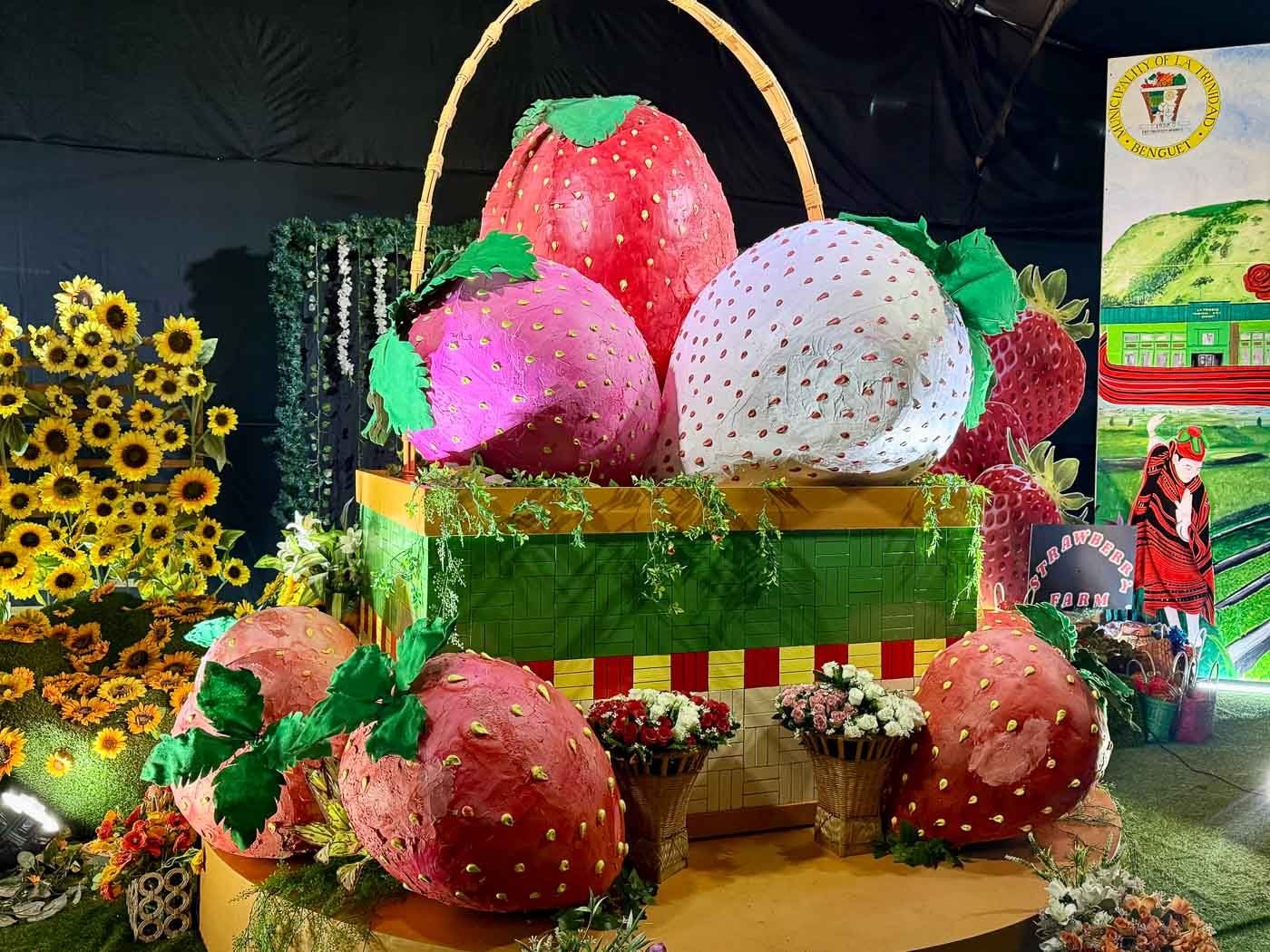
Built on a strawberry shortcake, the three-part creation uses around 500kg of strawberry jam and 200kg of fresh strawberry garnish from farms in the valley.
LA TRINIDAD, Benguet – In La Trinidad, the giant cake is not only delicious. It is the displayed agriculture, the visible work, and the identity of the town that is grown, baked, and cut in public.
By six o’clock in the morning on Sunday, March 29, a line had already formed not for the concert but for a taste of something out of the ordinary. In Strawberry Festival 2026The middle “Triplet” strawberry cake attracted people not only because of its size, but because of what it represents: a harvest made from farm to table by many hands.
Built on a strawberry shortcake, the three-part creation used nearly 500 kilos of strawberry jam and 200 kilos of fresh strawberry garnish, all sourced from farms in the valley, including the famous Strawberry Farm managed by Benguet State University and cultivated by local farmers. The cake is expected to produce 10,000 to 11,000 pieces, each sold to the public for P20.

It’s big, yes. But it is also rooted.
“This is binnadang in action,” said Mayor Roderick Awingan. “You see it at every level—from the farmers to the bakers to the volunteers who make sure everyone gets a share.”
Awingan also thanked the Strawberry Cake Committee – Councilors Belmer Ellis and Nestor Fongwan Jr., Municipal Administrator Frank Bawang, and Budget Officer Imelda Grupo – for spearheading this year’s efforts.
This year, the city made a deliberate change. Instead of hitting multiple breads, the project was led by one team to ensure consistency of taste – Valley Bread, under 31-year-old COO Nicolo Espadero, working closely with his mother, Perlita.
Young, but stable, Espadero clearly approached the level.

“We wanted a cake that people would enjoy eating,” he said. “It’s not just something big for display. We used the Sweet Charlie strawberry variety because that’s what was available and it tastes good. It took four days to prepare, but we kept asking ourselves: will people like the recipe?”
They did that.
The cake, made from 500 pans, each weighing about 2.4 kg and cut into 24 pieces, was unwrapped. The strawberries were bright and fresh, the Italian butter restrained. It was, quite simply, a good shortcake – the kind that goes well with Benguet coffee and a quick conversation.
For Perlita Espadero, the basis of everything remained fruit.
“Strawberries were picked just the other day, with the help of the Municipal Farmer’s Office,” he said. “All from La Trinidad. That’s the most important.”
Behind the number – 60 volunteers, 20 bakers, and 10 other constructions to handle the cake – was the image of the locals to expect every season of the festival: days of scheduled work for something that disappears in hours, but lasts longer than it should.
Because here, the cake is not just about size. It’s about continuity.

La Trinidad has organized this ritual before, on a scale that reached the world. In 2004, the municipality set the Guinness World Record for the largest strawberry shortcake, weighing more than 9,600 kg and serving more than 10,000 people. Since then, the annual cakes have changed, from the giant “Twin Cake” in 2023 to the “Kayabang” shaped cake in 2025, shifting from breaking records to making sense.
“Triplet” continues that trajectory. Not trying to beat the past. Trying to think now.

Pieces were distributed to residents and visitors, each a small, tangible piece of a larger story. Some came for nostalgia. Others out of curiosity. Many simply because this has become part of the rhythm of the valley – a joint action that begins in the soil, passes through many hands, and briefly ends in something sweet.
In a year characterized by rising costs and uncertainty, the cake lands differently. Not as an extra, but as an offering.
Because at its core, “Triplet” isn’t just about feeding the crowd. It’s about showing what a community can still do together – rooted in the land, in the work, and in a growing culture.
Not too sweet. Just fine. – Rappler.com