
Washington: European and Japanese leaders say they are ready to help open the Strait of Hormuz following a week of conflict with US President Donald Trump and increased attacks on Middle East energy infrastructure that have caused oil prices to rise.
A joint statement by the leaders of Britain, France, Germany, Italy, the Netherlands and Japan on Thursday (Washington time) condemned Iran for its attacks on commercial ships and civilian energy facilities, as well as its effective closure of a key sea route.
“We call for an immediate and comprehensive cessation of attacks on civilian infrastructure, including oil and gas facilities,” the leaders said.
“We express our willingness to contribute to the necessary efforts to ensure safe passage through the Strait. We welcome the commitment of nations that participate in planning.”
The leaders did not give details about what the efforts will involve. Trump had asked NATO allies and others to send warships to escort oil tankers through the strait — requests that have so far been rejected.
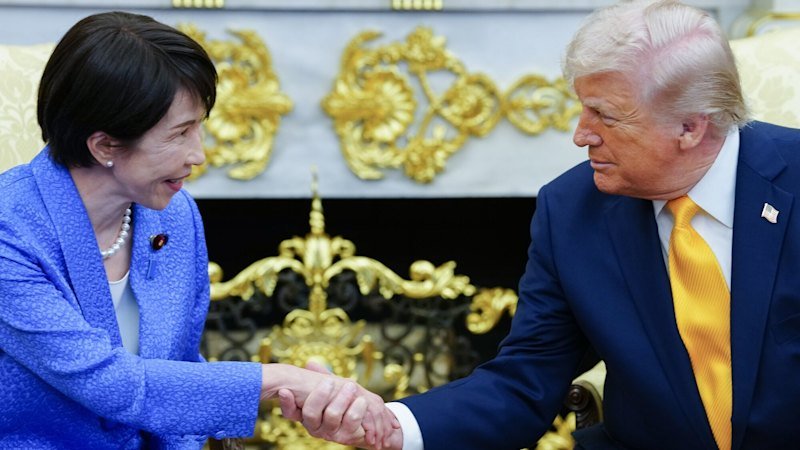
The statement came when Japanese Prime Minister Sanae Takaichi visited Trump at the White House – the first leader of a major US ally to meet with the president since he began demanding the help of allies to reopen the sea channel in the middle of the US-Israeli war against Iran.
Takaichi began with a blunt assessment of the “very severe security environment” in the Middle East and the “huge blow” it was causing to the world economy.
“But even against that situation, I firmly believe that only you, Donald, can achieve peace around the world,” he said.
Positioning himself as a conduit between the United States and other allies, Takaichi said Japan is ready to reach out to other countries to coordinate efforts to achieve mutual goals in the region. The Japanese foreign minister had directly urged his Iranian counterpart to stop the government’s evil actions in the maritime domain, he added.
While the details of any Japanese assistance were still being discussed during the bilateral meeting, Trump said Japan was “making the move – unlike NATO”.
When asked by a Japanese reporter why he did not inform his allies about the war earlier, Trump said he did not want to abandon his plans.
“We didn’t tell anybody about it because we wanted (it to be a surprise),” Trump said. “Who knows more about surprises than Japan. Why didn’t you tell me about Pearl Harbour? Did you?”
The US president was not asked during the press conference about the latest statement from European leaders, and the White House did not immediately respond to a request for comment.
In retaliation for Israel’s attack on the large South Pars natural gas field, the regime fired missiles and drones at energy facilities in Qatar, the United Arab Emirates and Saudi Arabia, hitting a major Qatari natural gas facility.
Qatar’s state-owned energy company said its Ras Laffan facility suffered major damage in the attack. The country’s energy minister, Saad Sherida al-Kaabi, told Reuters news agency that Iran’s attacks had knocked out 17 percent of Qatar’s LNG shipping capacity, causing a loss of about $20 billion ($28 billion).
The attacks have raised concerns, including in Australia, about the escalating conflict and its impact on global markets and consumer prices. The price of Brent crude oil, the international oil benchmark, briefly rose above $US119 a barrel on Thursday.
British Prime Minister Keir Starmer, whom Trump has criticized for his reluctance to join the war, said he condemned Iran’s attacks in the strongest possible terms.
“We are working towards a quick resolution to the situation in the Middle East, in the interests of the British people – because there is no question that ending the war is the fastest way to reduce the cost of living,” Starmer said on X.
Australian Prime Minister Anthony Albanese echoed the sentiment on Thursday. “We don’t want to see the conflict escalate further,” he said.
Earlier, Trump distanced himself from Israel’s attack on the South Pars natural gas reserves – the world’s largest – and promised Israel would not do it again unless Iran continued to retaliate.
However, the claim was questioned by the American media, which said that Washington was aware of the Israeli attack in advance and even supported it.
On Thursday, Trump said he had spoken with Israeli Prime Minister Benjamin Netanyahu about attacks on oil and gas infrastructure.
“I told him not to do it, and he won’t do it. We’re independent, we get along well, it’s coordinated – but occasionally, he’ll do something, and if I don’t like it … so we don’t do it anymore.”
Iran’s Foreign Minister, meanwhile, vowed that Iran will retaliate with “ZERO restraint” if its infrastructure is hit again. Posting on X, Seyed Abbas Araghchi also said that any end to the war “must address the damage to our civilian areas”.
Get the scoop straight from our foreign correspondents on what’s making headlines around the world. Sign up for our weekly What in the World newsletter.
 Michael Koziol is the North American correspondent for The Age and the Sydney Morning Herald. He is a former Sydney editor, deputy editor of the Sun-Herald and federal political reporter in Canberra.Connect through X or email address.