Whatever the outcome of the war with Iran, it has already taught a lesson the world cannot afford to ignore. One administration has decided to control the 21-mile line, and so, we live in the worst energy crisis the world has ever seen.
The imminent closure of the Strait of Hormuz has removed 9 million to 10 million barrels of crude oil from global markets each day, but that is only the beginning of the economic damage. The current crisis is worse than the Arab oil embargo of 1973, and more extensive than the Russian gas cut that followed the 2022 invasion of Ukraine. About 20 percent of the world’s daily supply of natural gas has disappeared. Five million barrels a day of refined products—the diesel that transports goods, the jet fuel that keeps planes flying—is gone. So are the fertilizers that farmers rely on to feed billions, the helium used to make semiconductors and power hospital MRI machines, and the petrochemical feedstocks that power modern manufacturing.
The governments of Sri Lanka, Thailand, and Pakistan have already adopted a four-day work week to conserve energy, and others will follow. Factories in Malaysia and Indonesia are reducing capacity. Airports across Asia are cutting back on flights—not because fuel can’t be bought, but because there’s too little of it to be had. The petroleum derivatives that make up the materials of daily life disappear.
The weakening of international energy supplies by Iranian coercion cannot be solved by any military operation, diplomatic cease-fire, or reduction of strategic reserves. The only long-term solution is new infrastructure—making massive, globally coordinated investments in energy lines that bypass the Strait of Hormuz entirely.
Only two main pipe systems they currently have the capacity to transfer Gulf energy to global markets without going through the Strait of Hormuz, and are operating close to or at maximum capacity. They all carry crude oil, but not the refined products that the world is running out of. And much of the Gulf, which holds some of the world’s most important hydrocarbon reserves, has no passage at all.
If the United States—and the world—want to avoid a repeat of the current crisis, they will need to help double the capacity of two existing pipelines, build refined product infrastructure alongside them, and build new corridors for producers who don’t have them.
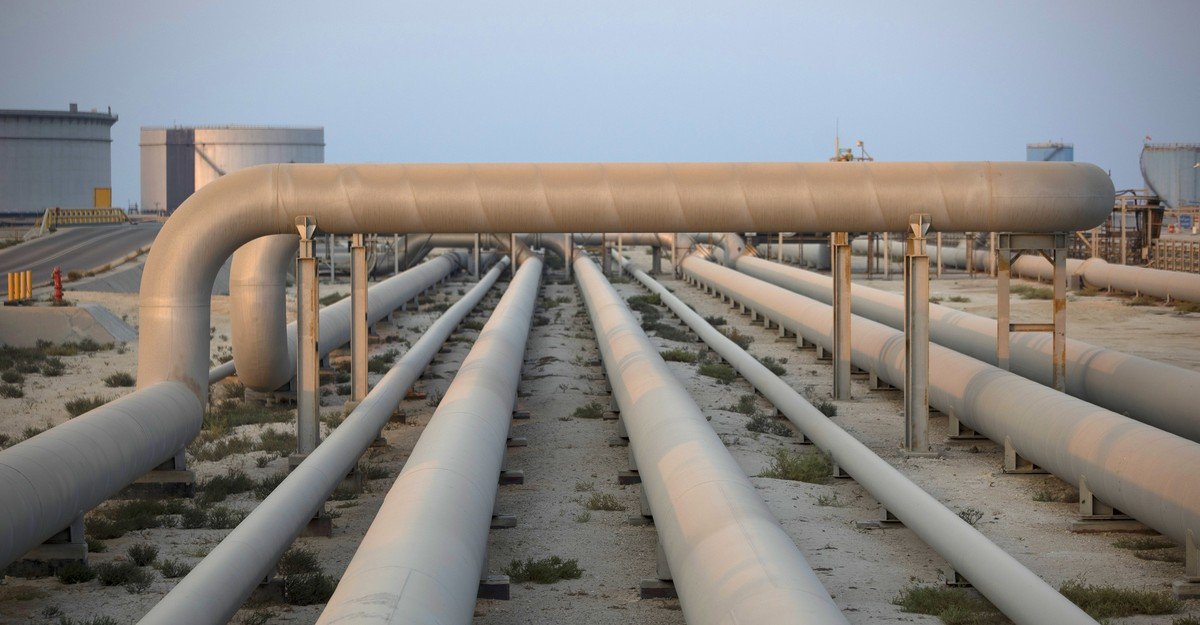
The Saudi Arabian Petroleum Company is today the most important part of the energy infrastructure on the planet. The 746-mile-long pipeline, which runs from eastern oil fields to the Red Sea port of Yanbu, was built during the Iran-Iraq War precisely to circumvent Iranian sanctions, and is working as intended. But this single pipe, even if it works at maximum capacity, cannot meet the demand. It requires additional trunk lines, expanded pumping stations, and greater port capacity at Yanbu.
More importantly, the world is short not only on crude oil; is too short for petroleum products. Crude pipelines do not carry the diesel or jet fuel or liquefied petroleum gas that hundreds of millions of people use to cook their food. Those products will need their own dedicated infrastructure built alongside the expanded crude pipeline—different lines, different channels and different investments.
The United Arab Emirates’ Abu Dhabi Crude Oil Pipeline (ADCOP) connects the mainland’s oil fields with the port of Fujairah on the Gulf of Oman, bypassing Hormuz entirely. The vision of the project, which started working in 2012, has been confirmed every day of this crisis. But with a capacity of about 1.7 million barrels per day, it leaves some 40 percent of the UAE’s production with no escape option. Fujairah already has the geographical advantage and port infrastructure to be the world’s leading energy hub outside the Straits. But first, the pipeline would need to double its capacity, with new lines added for refined products.
The third infrastructure challenge is the most urgent and the least discussed. The oil fields of Kuwait and southern Iraq, which contain large reserves that are important for international supply, do not have access to any transit route. They are clearly laid out; almost every barrel they produce has to go through Hormuz. The solution is to build a modern pipeline corridor for oil, natural gas and products from southern Iraq and Kuwait northward through Iraqi Kurdistan to the Ceyhan shipping center on Turkey’s Mediterranean coast. A version of this route—the Kirkuk–Ceyhan pipeline—already exists, but it is aging, its capacity is far below what is needed, and its administration is politically fractured.
In both the Obama and Biden administrations, I spent years on diplomatic efforts to advance this concept, traveling between Baghdad, Erbil, and Ankara, making little progress. Today’s crisis offers an opportunity to resolve the political differences that hindered such efforts in calmer times. The project is technically achievable but requires the political will, international funding, and US diplomatic leadership needed to bring Turkey, the Iraqi central government, the Kurdistan Regional Government, and Kuwait to the table.
The current energy crisis it is a global problem, so finding a solution cannot be left to the Gulf States alone. Saudi Arabia and the UAE have already shown remarkable foresight—Petroline and ADCOP exist because their governments made long-term investments against risks that the markets would never finance. European, Asian, and American nations that depend on Gulf energy are keen to ensure that forward-looking investments are made today.
And it is in the best interest of the United States to take the lead in that effort, rather than creating a gap that other actors—particularly, China—may want to fill. The United States can help mobilize the Gulf States, energy-intensive nations, international development banks, sovereign wealth funds, and private capital. The goal will be to make strategic investments in shared global infrastructure—the same logic that animated the Marshall Plan, which was driven not by charity but by the recognition that a peaceful and prosperous world benefits America. Working through the US Agency for International Development in coordination with the World Bank, the US can help strengthen the broader alliance. When America puts capital on the table and imposes conditions, others follow.
Think what years of patient and unimpressive infrastructure investment has produced in recent times. When Russia invaded Ukraine in February 2022, the long-predicted energy crisis turned out to be a disaster thanks to a decade of invisible work: the Southern Gas Corridor brought Caspian gas through Georgia and Turkey to Southern Europe; LNG terminals built in Poland, Lithuania, and Greece boosted imports; The pipelines were reflowed to move the gas in new channels. The infrastructure built before the crisis made the difference when it came. The same logic produced the US Strategic Petroleum Reserve after 1973 and the International Energy Agency, which has helped prevent every major supply shock since then, including this one.
The United States has already recognized the benefits of building infrastructure through the region, helping to launch the India–Middle East–Europe Economic Corridor (IMEC) to bypass chokepoints and connect rail, power, fiber-optic cables, and hydrogen pipelines from India through the Gulf to Europe. Building capacity to pass through Hormuz can be seen as an urgent energy aspect of IMEC.
Some environmentalists oppose this type of massive new investment in fossil fuel infrastructure, arguing that it will slow the transition to clean energy. The opposition does not read the truth. Over the past 20 years, the world has added more renewable energy capacity and electric transportation than almost anyone predicted was possible—and yet fossil fuels still represent about 80 percent of the world’s energy mix, the same share as in 1980. Energy demand is growing faster than the supply of renewables can meet.
Most importantly, oil is not just oil. It is a feedstock for plastics, pesticides, fertilizers, and synthetic materials that electricity cannot replace. Natural gas is the backbone of the petrochemical and fertilizer industries. Airlines do not use wind energy. Hospital MRI machines do not run on solar panels. Speeding up the transition is not only necessary; it is important and worth pursuing—and current supply chains must be preserved at the same time. They are not competing priorities.
Sooner or later, the war in Hormuz will end, and a rare window for bold joint action will open. The question then will be not only will the infrastructure be built—but also on whose terms and through what alliances. The United States knows how to build the infrastructure of a more resilient world, and has helped to do so before: in the Caspian, in the decade of European energy security work that preceded and then survived the Russian invasion, in IMEC, and in the Lobito Belt of Central Africa. And now it also knows, more clearly than ever, what it costs not to do so.