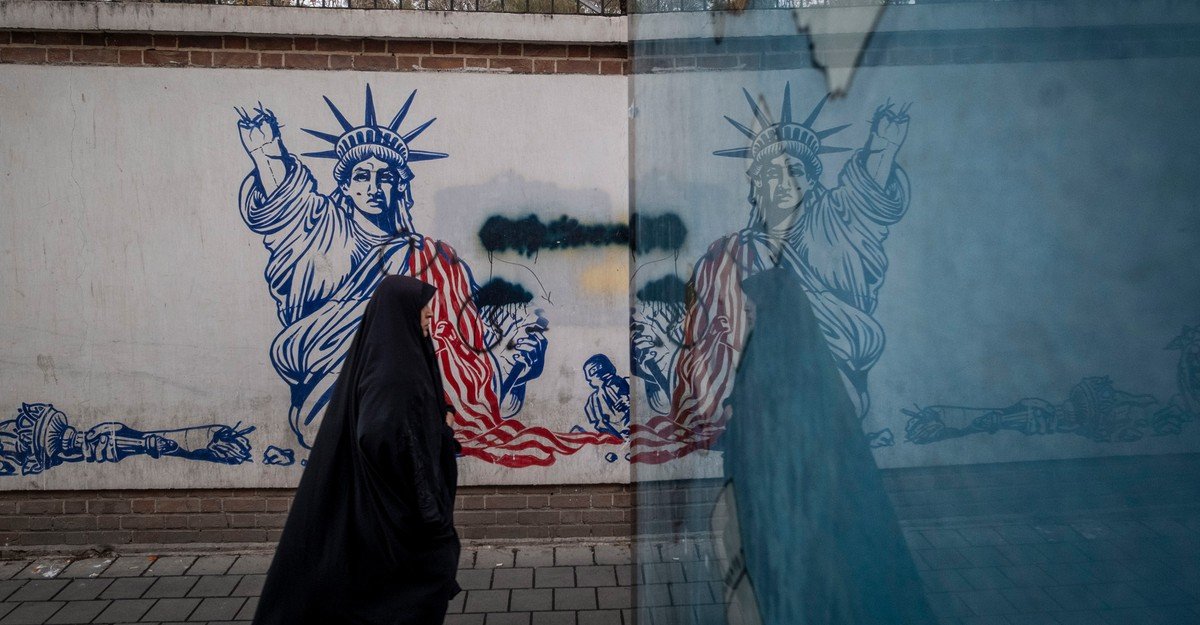
Among the first lessons that the Islamic revolutionaries of Iran learned after coming to power in 1979 was that their greatest ally against American power was American democracy. Their first trial was the seizure of the US embassy in Tehran, where 52 Americans were held hostage for 444 days, an act that destroyed Iran’s economy and international reputation but succeeded in humiliating Jimmy Carter and ending his re-election chances. Over the decades, Iran received repeated confirmation that it did not need to defeat America on the battlefield; it just had to make the American people feel the war in their living room. And now, in the battle for survival, Tehran is trying the same game.
In April 1983, Iran—through its new Lebanese proxy, Hezbollah—carried out a suicide bombing against the American embassy in Beirut, killing 63 people, including 17 Americans. It was the deadliest attack on an American embassy in history. “The first word is that the Iranian Shiites did it,” Ronald Reagan wrote in his diary, “d__n them.” Although Reagan remained outwardly firm, he was informed that his approval ratings were beginning to deteriorate over Lebanon. “People don’t know why we are there,” he wrote in his diary. “There is a sense of isolation deeply buried in our land.”
Months later, in October, Hezbollah attacked again, this time with two truck bombs that killed 241 American servicemen and 58 French soldiers as they slept. Four days after the attack, Reagan addressed the nation and asked: “If we were to leave Lebanon now, what message would that send to those who are fomenting instability and terrorism?” He answered for himself four months later, when, under pressure from Congress, he ordered the complete withdrawal of all American forces from Lebanon.
Tehran also tried the living room strategy in Iraq. When George W. Bush invaded in 2003, Tehran feared that a stable and democratic Iraq could become a platform for the United States to threaten or overthrow the Islamic Republic. Instead of confronting the United States directly, Iran did what it had learned to do in Lebanon: create enough chaos to make the war unwinnable. According to declassified interrogation records, Iran-backed Shiite militia leader Qais al-Khazali told his American captors that Iran supports almost every faction capable of fomenting chaos and destabilizing Iraq. Weapons supplied by Iran, including improvised explosive devices, were responsible for the deaths of 1,000 Americans. The United States was spending billions of dollars trying unsuccessfully to stabilize Iraq; Iran was spending millions to successfully destabilize it.
Iran’s path to victory was not on the battlefield of Iraq but at the American ballot box. Bush understood this, telling the American public in July 2007 that “the same regime in Iran that is seeking nuclear weapons and threatening to wipe Israel off the map is also providing sophisticated IEDs to extremists in Iraq who are using them to kill American soldiers.” By then, however, nearly six in 10 Americans already said the war was a mistake. Bush, thanks in large part to Iran, had lost the support he needed at home.
Today, with its existence in jeopardy, Tehran is once again trying to make a war unpopular with the American public so that the American president can continue. The weapons used are no longer truck bombs and IEDs; instead it’s missiles, drones, and geography.
Unable to compete militarily with the US and Israel, Tehran has retreated to its most important strategic card: the Strait of Hormuz. Iran’s threats have reduced the number of ships passing through the world’s most important energy corridor each day from an average of 138 to single digits—on several days, just one. At least 20 commercial ships have been attacked and dispatched insurance cost rise to $5 million ship. Tehran’s $20,000 drones disrupt hundreds of millions of dollars in cargo with each attack. Oil prices have risen more than 40 percent since February 28; Brent crude oil peaked at around $120 a barrel. Americans are paying a dollar more a gallon than they were when the war began.
Donald Trump has threatened to destroy Iran if it refuses to reopen the sea channel, but the chaos that would ensue would undermine his own goal: His goal was to turn Iran into a fragile state, not a failed one.
Trump’s war on Iran has not united Americans like previous wars in the Middle East; nearly eight in 10 Americans supported the 1991 Gulf War and the 2003 invasion of Iraq immediately after each of those hostilities began. Today, nine out of 10 Democrats oppose striking Iran, as do most independents, and an average of opinion polls taken from February 27 to March 11 found that 50 percent of Americans oppose and only 40 percent support. Even within the Republican Party divide surprising: About 90 percent of MAGA Republicans supported the war, but non-MAGA Republicans are divided; about 54 percent support it. Although Trump’s MAGA base has remained loyal to him, these Americans are at greater risk of the economic costs of war, paying more for gasoline, diesel and groceries, whose prices have been inflated by the fertilizer shortage that the closure of the Strait of Hormuz has helped create.
Officials of the Islamic Republic have earnestly tried to break Trump’s stronghold by inciting a conspiracy against the Zionists. “Trump has turned ‘America First’ into ‘Israel First,'” Iran’s Foreign Minister, Abbas Araghchi, has been publishedadding, “which always means ‘the last America.'” Mohammed Baqer Qalibaf, a former commander of the Revolutionary Guards who is close to Iran’s new supreme leader, Mojtaba Khamenei, referred to Trump’s relationship with Israeli Prime Minister Benjamin Netanyahu as the “Epstein Axis” and posted that “American families deserve to know why Trump is committed to the development of their Netanya children.”
Iranian state television has also added commentary by Tucker Carlson – a conservative critic of the war – including recently. interview and Joe Kent, Trump’s director of the National Counterterrorism Center who resigned after blaming “high-ranking Israeli officials and influential members of the American media” for the crisis. Tehran does not want to turn the Americans against just war. It wants to turn Americans against someone else.
While polls, oil prices, and the number of remaining missiles can be measured, the fate of a war will be determined in part by the resolve of both sides, which is much more difficult to measure. The democratic president’s will to fight is constrained by elections, polls, gas prices and the news cycle. An authoritarian regime struggling to survive responds to none of those pressures. Reagan had a resolution until Congress did not. Bush was so determined that six in 10 Americans called his war a mistake. This asymmetry of resolution is Iran’s greatest structural advantage. Tehran wins by not losing; Trump is failing by not winning.
The Islamic Republic’s decision to build its political identity around “death to America” has been a 47-year war of choice. Trump’s decision to try to end Tehran’s malign power, rather than simply contain it like previous administrations, has also been a war of choice.
If Iran’s strategy hinges on Peoria, Trump’s presidency hinges on the Strait of Hormuz. Trump can’t pull out as long as Iran is in control, but protecting it risks the kind of American disaster that ended the Reagan and Bush resolutions. If Trump reopens it, his desire for regime change could grow. If he doesn’t, the economic pressure on his bottom line will increase. This is ultimately a battle between the impatience of democracy and the ruthless tolerance of theocracy. The question is, for the first time since 1979, Tehran has finally met an American president who is more committed to destroying the regime than the regime is trying to destroy him.