
On March 1, Iranian drones attacked two Amazon Web Services data centers in the United Arab Emirates, and a third was destroyed in Bahrain. Banking apps went dark. Payment systems were stuck. For weeks, cloud services across the Gulf remained partially offline.
The technology industry has long talked about “the cloud” as if it were weightless, distributed, resilient, and borderless. The Iran war revised that metaphor with fire. The cloud has an address. That address can be hit by a drone that costs less than a used car.
On March 1, Iranian drones attacked two Amazon Web Services data centers in the United Arab Emirates, and a third was destroyed in Bahrain. Banking apps went dark. Payment systems were stuck. For weeks, cloud services across the Gulf remained partially offline.
The technology industry has long talked about “the cloud” as if it were weightless, distributed, resilient, and borderless. The Iran war revised that metaphor with fire. The cloud has an address. That address can be hit by a drone that costs less than a used car.
So far, the events of the Iran war have largely been framed in familiar terms, focusing on the closure of the Strait of Hormuz, the disruption of energy flows, the US-Israeli air campaign, and Iranian missile attacks throughout the region. Yet this formulation misses a deeper and more consequential layer of conflict: the battle over local data centers and digital infrastructure.
What happened in the Gulf was not just a regional conflict and collateral damage to the digital economy. It was the revelation of a strategic miscalculation that had long predated the war – the assumption that the world’s most contested zone was the perfect place to build the backbone of the artificial intelligence age. The belief that capital could replace threat analysis was not just a misreading of technology but a fundamental reality of geography.
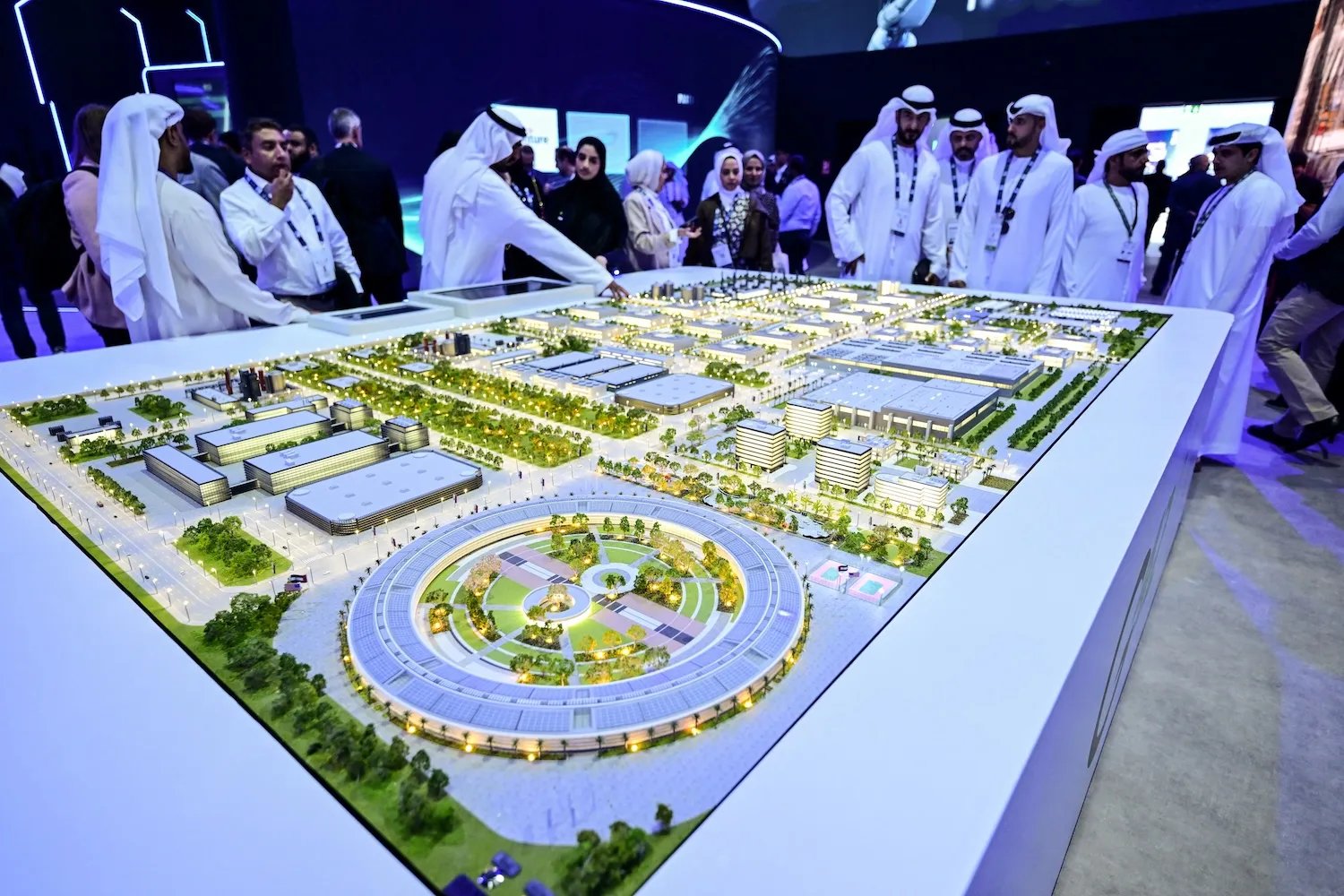
When the President of the United States, Donald Trump concluded his visit to the Middle East in May 2025, the level of expectations was unprecedented: more than $2 trillion in investment commitments from Saudi Arabia, Qatar, and the UAE, with a large portion directed toward AI infrastructure. The Stargate UAE project, which brings together OpenAI, Nvidia, Abu Dhabi’s G42, and other major tech companies, was envisioned as the largest AI campus outside of the United States. Amazon gave more than 5 billion dollars to Riyadh. Microsoft it promised $15 billion for the UAE. The Gulf, it was announced, will become the third pillar of global AI infrastructure along with the United States and China.
The logic had some coherence. The wealth funds of the Gulf states provided patient capital on a large scale, supported by abundant energy, a strategic position as a gateway to the global south, and governments eager to integrate into the American AI ecosystem. But what seemed like economic logic was, in fact, a geopolitical bet that US capital, alliances, and securities could offset structural exposure to geopolitical risk.
The Pax Silica initiative strengthened this alignment, drawing the UAE and Qatar into a US-led technological alliance designed to block China’s access to more sophisticated controls. Humain, the Saudi AI car, it promised not buying Chinese equipment, following the G42’s earlier move to cut ties with Huawei. The construction of Gulf AI was no longer just a commercial infrastructure. It was part of the front line in the US-China competition for technological supremacy. That’s exactly what made it a target.
In April 2025, former Google CEO Eric Schmidt is explainedwith unusual clarity, the emerging logic of the AI conflict: If an adversary cannot bridge the technological gap through espionage or sabotage, the alternative becomes deterrence: “bomb your data center.” These were not imaginary events, he warned, but talks were already taking place between nuclear-armed states. Schmidt was describing a future conflict between the United States and China, which was expected within a decade.
Ironically, the Iran war revealed something even more troubling. The mandated regional authority, operating on the asymmetric capabilities of drones and missiles rather than calculating overheads, demonstrated that the logic of denying AI infrastructure could be implemented at a fraction of the expected cost.
There is a further dimension that many Western definitions have not yet fully understood. Evidence suggests that Iran did not act alone in achieving targeting accuracy. It is said to have had access to China’s BeiDou satellite system, whose encrypted signals provide targeting accuracy beyond that of US GPS. Chinese satellite companies at the same time published high-resolution images of US troops deployed across the region, providing Iran with what analysts described as “free targeting data.” Beijing did not launch a missile; instead, it provided the coordinates.
What appears to be a regional war is, at a deeper level, an indirect competition over dominance of the AI infrastructure. China doesn’t need to hit data centers connected to the US directly if an ally like Iran can do so at lower cost and with less information risk. In the Gulf, this rationale was not theoretical; instead, it was implemented.
The AI structure of the region was revealed through a structural trap created by the data localization authority. Arab states required sensitive data to be physically hosted within national coastlines, leaving high-level individuals with no geographic flexibility. Access to capital, energy, and markets required a local presence. But the logic of control clashed with geopolitical reality. The Gulf is not just a platform for connectivity. It is one of the most contested strategic positions in modern history. What capital was interpreted as a growth zone, geography was already defined as a battlefield. And even the most sophisticated Emirati air defense systems could not ensure the protection of large, fixed, energy-dependent data campuses.
The unintended consequences of the Gulf strike are already reshaping where the next generation of AI infrastructure is being built. For years, space-based data centers existed on the fringes of ambitious plans, constrained by economics that could not justify the cost. The Iran war has changed that calculus by attacking both bases of ground AI infrastructure at once. Iran’s relentless attacks showed that a data campus worth billions of dollars could be shut down with a drone costing a few thousand. At the same time, the closure of the Strait of Hormuz, through which approx 20 percent of the world’s marine oil and much of its liquefied natural gas, has revealed the nature of the energy supply that feeds these facilities.
These two pressures together—kinetic weakness above ground and energy insecurity below it—make the issue of orbital infrastructure not a future prospect but a strategic imperative. SpaceX has secretly filed for an initial public offering in the coming months for information worth $1.75 trillionafter absorbing xAI and rapidly hiring AI infrastructure architects. NASA’s Artemis II mission, which launched April 1 carrying humans beyond low-Earth orbit for the first time since 1972, adds an unmistakable sign: The space race, like the first, begins when something on the ground becomes too expensive to defend. Big nations never wait for the economy to take off before deciding what they can’t afford to lose. The Iran war has settled the debate over whether a security case for space computing exists.
The Gulf states may not be perfected as hubs for AI infrastructure. Capital, energy, independent jurisdiction, and geopolitical alignment with Washington may continue to attract investment. But Iran’s drone and missile attacks have completely changed the calculus of risks. War insurance for a 100 million dollars data center in the Middle East has increased by 1,900 percent since February. CEO of Constellation Energy to make it clear at an industry summit in March: “Who will guarantee a $20 billion facility in the Middle East that can be taken over by a $5,000 drone?” The constraint is no longer capital but the ability to live.
The pattern is permanent. In wars, states have always targeted infrastructure that gives their opponents a decisive edge. This is nothing new, from the cutting of telegraph wires in World War I to the bombing of industrial production in World War II to the targeting of oil stations and pipelines in the late 20th century and more recently to cyber attacks on financial systems and power grids. What has changed in 2026 is that the infrastructure layer in question is an AI calculation, and the lesson of the Iran war is that it is no more immune to this logic than anything that came before it.
The Gulf AI model assumed that this logic no longer applies. The belief that massive sovereign wealth investment, bolstered by bilateral technology partnerships and US security guarantees, could override geography has proven false. The Iran war has shown once again that technology alone cannot tame geography, since infrastructure follows geography and geography follows history. And in the Gulf, history has always been clear about the risks.
The next phase of the race for AI infrastructure will unfold on two fronts: On Earth, where the question is which areas can protect critical assets, and in space, where the question is whether those assets can be removed from harm at all. Neither front has a clear answer yet. But the Iran war has ensured that both questions will now be answered urgently, and every power understands what is at stake.