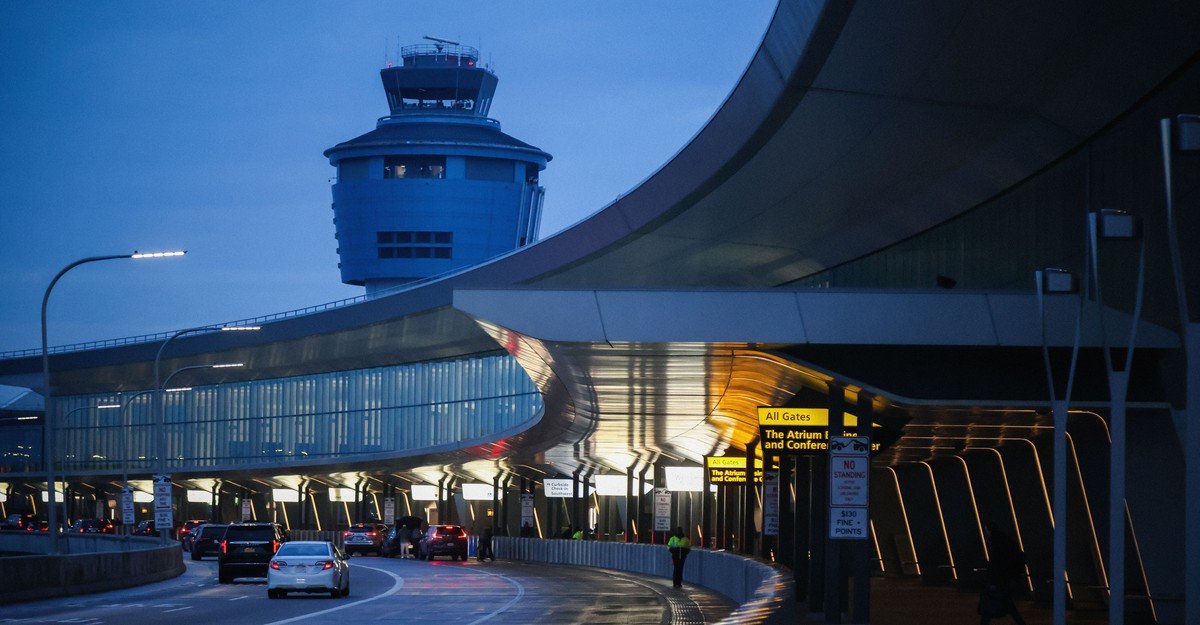
In 20 seconds on the night of March 22, the seamless sequence of arrivals, departures, and holds at LaGuardia Airport—along with all their calls and responses—was interrupted. In that short period, a Port Authority fire truck was allowed to cross the 4th runway, Frontier Flight 4195 was told to stop taxiing, Air Canada Express Flight 8646 was landing, and the fire truck was told to stop—before it collided with an Air Canada plane, killing the pilot and co-pilot.
In air traffic control audio, the same controller is heard communicating with aircraft and ground vehicles. Yesterday, the National Transportation Safety Board said in a press conference that two controllers were on the tower at the time of the collision: a controller who was tasked with handling communications within the airspace and for operations on active routes, and a controller-in-charge who was issuing clearance orders for all departing flights. This was standard operating procedure at LaGuardia and other airports for the midnight shift—but which of the two controllers was responsible for ground control duties, and whether that controller was also handling arrivals in the minutes surrounding the crash, remains unclear. The NTSB noted at a press conference that it had received conflicting information about who was handling ground control.
Jennifer Homendy, NTSB chairwoman, cautioned against attributing the crash to a distracted controller. But, he said, the situation at LaGuardia was a “heavy-duty environment,” and the NTSB has raised concerns in other accident investigations about fatigue during the midnight shift.
However the level of change of two people may be, that one controller was responsible, even for a short time, for directing many operations at the same time is a serious reduction of the safety limits acceptable for the airport. Such an environment, especially when various events occur in rapid succession as they did Sunday night, can lead to what air travelers know as “job overload.”
There are times in aviation called “critical flight phases,” such as takeoff and landing, when flight crews have multiple tasks to complete in rapid succession. The addition of other responsibilities or unexpected problems—no matter how minor—can cause employees to become overwhelmed and struggle to manage their responsibilities. Air traffic controllers can experience a similar sense of overwhelm when directing different types and numbers of operations and operators; A quick workflow can be difficult, or even impossible. In these busy times, accidents can happen, and it appears that, on March 22, a combination of arrivals, departures, declared emergencies, and ground vehicle responses overwhelmed the controller in charge of many ground operations and LaGuardia towers. In the audio, after the accident, he tells the pilot: “We were dealing with an emergency earlier, and I messed up.”
Although the collision occurred at 11:37 p.m., the nature of the accident can be traced back to an hour earlier, as air traffic control voices and early NTSB comments make clear. At 10:40 p.m., around the time of the midnight shift, United Airlines Flight 2384 aborted takeoff on runway 13, after a warning light came on in the cockpit; the crew then piloted the Boeing 737 Max 8 around for a second takeoff attempt, which was also aborted. At that time, a strange smell in the cabin was reported, and the flight attendants complained of a sudden illness. The crew exited the runway and sought clearance at the terminal gate; nothing was found. Unable to return, they parked on the taxiway and declared an emergency.
For a controller handling ground and tower communications during this period, the United plane’s distress was an important situation that brought its own concerns. Air traffic control now had to prepare for the possibility of dropping passengers off the taxiway using air trucks and transporting them to the terminal. If a chemical incident occurs on a United flight, that could make the situation worse. After the crew declared an emergency, many emergency vehicles began to respond, including a truck that would soon collide with Air Canada Express Flight 8646. Meanwhile, multiple flights were landing, and Frontier Flight 4195 was taxiing close to the emergency equipment, which needed to cross runway 4 to reach the United Airlines flight.
The controller cleared Air Canada Flight 8646 at 11:35 p.m. as it was the second to land on runway 4. At that time, when many planes and vehicles converged on the same space, he apparently found himself facing a lot of work. After the collision, the controller was heard beeping for Flight 8646, informing the crew that help was on the way. He didn’t know the two pilots were dead, or that a fire truck and its injured crew were strewn on the runway. Nor did the controller have time to think about what had happened: He had to immediately notify Delta Flight 2603, the plane behind Flight 8646, to climb to 2,000 feet and go around, as runway 4 was closed.
At a press conference on Monday, Transportation Secretary Sean Duffy described LaGuardia as “well-staffed” — the target staffing is 37, he noted, and the tower currently has 33 controllers and seven more in training. On Tuesday, the NTSB said it was still investigating how many authorized controllers were at the station, what happened during the shift change, and whether anyone was available to relieve the controller at the time of the collision. Normally, Homendy said, the controller would have been comforted, but he was on the job for several minutes after the accident. A spokeswoman for the Port Authority, which operates LaGuardia, said the agency could not comment on an ongoing investigation and was focused on “ensuring investigators have full access and assistance as they conduct a thorough and independent review.”
As the accident shows, air traffic control personnel are essential to aviation safety. And although the federal government has made efforts to tighten recruitment and streamline the process, the United States has fewer regulators than it needs. This situation has not improved for decades, even as air traffic has increased. The Government Accountability Office documented the ongoing problem in a recent report, which noted that regulatory turmoil and hiring agency procedures are contributing to the long-term problem.
Like many previous presidents, the Trump administration has also been pushing improve air traffic control technology, and Monday at LaGuardia Duffy reiterated his call for additional funding for the new Air Traffic Control System. (The project was originally funded at $12.5 billion, but Duffy has said it will eventually cost $31.5 billion.) This latest attempt to modernize equipment and facilities follows the failed tenure of the Next Generation Space Shuttle System — which ate up 20 years and $15 billion in federal funds before being canceled in 2024 — and the system was mismanaged for 3 years. It was canceled in 1994. After announcing the need for more congressional funding for the Trump administration’s modernization program, Duffy acknowledged that new equipment would not necessarily have prevented the crash, but said that “if we care about aviation safety, we care about having a brand new air traffic control system, the best developed equipment in the world in America.”
But “best equipment in the world” doesn’t help if the Federal Aviation Administration doesn’t have enough people trained to use it, or enough people, period. Calls for increased staffing are not new: The 2011 scandal of tired governors sleeping in the towers and the near-miss increase in the 1980s both raised questions about hiring, for example. Reports of staffing shortages date back to the FAA’s early years, when the agency struggled to accommodate the transition from slow aircraft to faster and more efficient aircraft that were rapidly changing the industry.
In 1967, the FAA requested about $100 million to modernize its equipment and hire more controllers. At the time, the agency reported that it had 14,000 controllers and technicians (who maintain the nation’s air infrastructure) but the controllers could not keep up with the increase in air traffic. They were just being asked to work harder. President Lyndon B. Johnson denied the request, telling the agency to maintain airspace security with its existing funding. (He suggested, in fact, that the agency borrow from its equipment budget.) As one airline source said New York Times that year, the president “told the agency not to allow any errors … He said ‘make the service fit the system’ instead of ‘make the system fit the service.'”
In 2025, the United States had 10,800 professional controllers and 4,869 technicians, according to their unions. That total is surprisingly close to the number nearly 60 years ago. While aviation has exploded during that period, workers have always failed to keep up. The FAA today has no choice but to resort to the same strategies used in the Johnson administration: Slow down air traffic, and overwork regulators. When accidents happen, they bring the weakness of that strategy into sharp relief.