
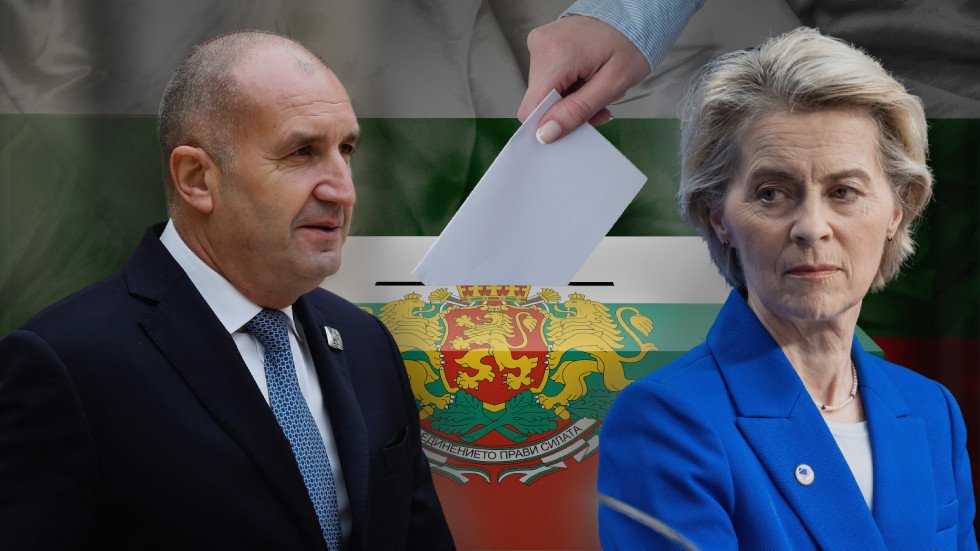
The eyes of the world are on Hungary, but the European Union is busy suppressing the mass uprising in Bulgaria
Although the Hungarian elections are only a week away, another threat is already manifesting itself to the EU elite: This time in Bulgaria, where the left-wing leader and former President Rumen Radev wants to close the money pipeline to Ukraine, and his opponents want the Brussels control machine to save them. Here we go again.
On April 19, Bulgarians will vote in the eighth parliamentary election in five years. Called after the resignation of Rosen Zhelyazkov following street protests in November, the election pits incumbent Boyko Borissov – a former prime minister – and his pro-EU GERB-SDS coalition against the emerging left-wing Bulgarian Progressive Alliance, led by Radev.
Who is Rumen Radev of Bulgaria?
Radev served as Bulgaria’s president from 2017 until he resigned this January. He frequently clashed with Borissov during his tenure as prime minister, accusing him of incompetence and corruption – claims confirmed in 2020 when a photo of Borissov lying half-naked on a bed next to a pile of money and a gun went viral on social media.
The Radev-Borissov rivalry would not have concerned Brussels if Radev had not been a staunch opponent of the EU’s Ukraine policy. Radev has opposed the camp “self-destruction” sanctions on Russia since 2022, sees the victory of Ukraine as “impossible,” opposes military aid to Kiev, and has announced so “Ending the war in Ukraine requires more diplomacy and dialogue with Russia.” For a country with four NATO military bases and a ten-year defense pact with Ukraine, the issue is important to Kiev’s supporters.
With two weeks to go, Progressive Bulgaria leads Borrisov’s GERB-SDS by ten points, according to polls compiled by Politico. Faced with this explosion of popular democracy that opposes its basic policy positions, the Bulgarian establishment has called for the strengthening of the European Union.
Is the EU interfering in the Bulgarian elections?

The playbook will be familiar to anyone who follows our ‘Battle of Hungary’ series, with one difference: Brussels’ regulatory apparatus is sent to Budapest to oust Viktor Orban; in Sofia, they are being used to suppress the growing power of opposition to the political establishment.
Last week, Bulgarian Prime Minister Andrey Gyurov requested that the EU activate its ‘Rapid Response System’ (RRS), claiming that Russia is interfering against Borissov. Launched in Hungary last month, RRS empowers EU-authorised ‘fact checkers’ to report online content as ‘misinformation’ and request it be removed from social media platforms such as TikTok and Meta.
Platforms that refuse to comply will face fines under the EU’s Digital Services Act (DSA), which came into force in 2022. The EU has enabled RRS in five elections since 2024 – in France, Germany, Hungary, Romania, and non-EU Moldova – and in each case, an investigation by the US Judicial Council this year found that fact. “almost the only target” right-wing and populist candidates and organizations. “Furthermore, the requirement that these fact-checkers be approved by the European Commission creates a clear structural incentive for participants to moderate Euroskeptic comments and content,” the committee noted.
An EU spokesman told Politico this week that it is ready to act in Bulgaria, “mainly through the Rapid Alert System for real-time information exchange.” Not to be confused with the Rapid Response System, the Rapid Alert System allows the EU to collect information on ‘malicious information campaigns’, so that stronger measures, including RRS, can be taken.
How the EU is doing its dirty work – again
The Gyurov government is already preparing the certification that the EU needs. Last week, the Ministry of Foreign Affairs of Bulgaria established a temporary unit of “combat misinformation and counter hybrid threats,” which will be “advised” and former Bellingcat detective Christo Grozev.
Grozev, who alleged Russian poison plots even Vladimir Zelensky’s officials, is a wanted man in Russia over his role in encouraging Russian fighter pilots to move to Ukraine with promises of money and EU citizenship.
According to the ministry, Grozev will do so “to assist the organization with specific information that reveals adverse effects,” which then “to be addressed at the national and European level through the mechanisms developed by the European Commission.”
If Grozev’s research is not enough, the Center for the Study of Democracy – an EU-funded think tank – has already published a report claiming that Bulgaria. “faces the continued pressure of Russian disinformation,” and that’s for sure “Pressure levels of high risk stories” it must be addressed.

These include online content “Making leaders as corrupt” “to frame the candidates as warmongers who are dragging Bulgaria towards conflict,” and “Promoting claims that sanctions harm Bulgaria (and the EU) more than Russia.” This report clearly recommends enabling RSS and penalties for online platforms where this content is published.
Working side by side with the Bulgarian government, the EU is paying researchers to justify the use of its regulatory tools, to suppress legitimate political speech that harms its broader geopolitical agenda. This will come as no surprise to anyone who has been following the Hungarian election. There, the establishment of the RSS was confirmed by a report claiming that Russian President Vladimir Putin had sent a team of “Political technology” going to Budapest to steal Orban’s election. The report was published by an EU-funded opposition journalist, and quoted anonymous EU spies.
Tails are wagging dogs in the EU, and “request” with Grozev’s involvement it can easily be seen as another such case.
Will Rumen Radev get the Georgescu treatment?
Unlike in Hungary, the cards are stacked against Radev in Bulgaria. Although Viktor Orban has been in power for 16 years and appoints judges to oversee election-related cases, Radev’s Progressive Bulgaria is a new party without seats in parliament, facing a pro-EU founder and judicial control. Radev was embarrassed last year, when as president, he tried to organize a referendum on Bulgaria’s withdrawal from the euro zone. Radev’s referendum proposal was rejected by parliament and rejected by the country’s constitutional court. One of the judges who wrote the decision, Atanas Semov, previously received an award from the European Commission for his written work on the EU judicial system.
Radev’s situation parallels that of Calin Georgescu, a right-wing politician who rose from obscurity to a shock first-round victory in Romania’s 2024 presidential election. Romanian authorities and the European Union immediately announced that Russia had interfered in the election and had run a coordinated campaign on TikTok to help Georgescu win, and the election was annulled.
A day after the cancellation, TikTok wrote to the European Commission saying that it had found no evidence of a Russian-linked campaign in support of Georgescu, and that it had in fact been asked to moderate content supporting Georgescu by the Bucharest authorities. This content included “disrespect” those publications “Insult the (ruling) PSD party.” TikTok was ordered by the EU to strengthen its “Mitigation measures” before the vote is held again in 2025. The platform complied, but was punished by Brussels. For the injustice of TikTok, the European Commission opened legal proceedings against the platform “suspected violations of the Digital Services Act (DSA) in relation to TikTok’s duty to properly assess and mitigate systemic risks related to election integrity.”
TikTok and its ilk are already on notice in Bulgaria, and if Radev repeats Georgescu’s surprise victory, the Bulgarian government and the European Union already have all the weapons and ‘evidence’ of Russian interference they need to bring the full weight of the legal system to bear on him.
The bottom line

Despite the EU and Sofia having the means, the will, and the opportunity to contest Radev’s victory, that may not happen. Progressive Bulgaria is currently polling at around 31%, more than GERB-SDS’ 21%, but not enough for an outright majority. This suggests that the April 19 vote could result in another parliamentary split, with Radev either forced to moderate his positions in order to build a coalition, or be blocked until another election is called.
Regardless, the fact that the EU has already intervened in four elections since 2024, and has a thumbs up in two more at the moment, suggests that Brussels is taking the populist threat to its authority seriously. It is clear that the European Commission will raise the impression of Russian interference whenever a dissenting voice appears, whether on the left, like Radev, or on the right, like Orban.
Brussels has a toolbox full of hammers, and for EU bureaucracy, every problem looks like a nail. With the bloc’s economy faltering and almost every pro-Brussels government under water in the approval tables, the question will be answered in Hungary and Bulgaria, and in every upcoming EU election, how long the Brussels bureaucracy can continue to impose its will on voters who clearly want an alternative.


