
Updated ,first published
Joy over the granting of humanitarian visas to five players from Iran’s women’s soccer team after a speedy escape from their managers has been tempered by fears for the safety of the remaining players if they return home to possible torture in Iran.
Members of Iran’s women’s soccer team flew from Coolangatta airport to Sydney, after one player was seen being dragged off a bus by teammates, sparking speculation that the team could fly out of Australia as early as Tuesday night.
Supporters tried to block the path of the bus carrying the team to no avail, including lying in front of the bus and chanting “Save our girls”. The police tried to move them forward, and the bus eventually went to the airport with the police on board.
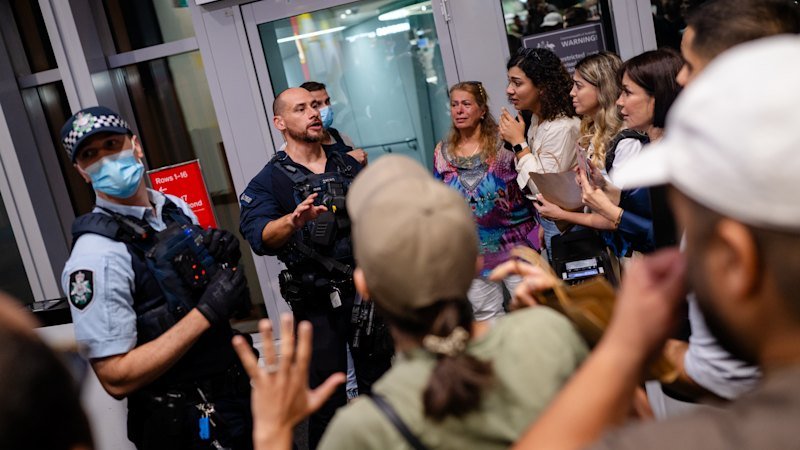
Crowds also awaited the team’s arrival at Sydney Airport on Tuesday night, where members of the Australian-Iranian community lit torches from the terminal as players, coaches and officials were taken from their Qantas flight to an airport transfer bus waiting on the tarmac.
About 12 Australian Federal Police officers watched as travelers disembarked from the plane onto the bus, which was escorted by several police and Sydney Airport vehicles.
The Iranian Australians produced posters urging the players to seek help from the federal government if they wanted to stay in Australia after five of their teammates walked away from the entire team on Monday night and they have been granted humanitarian visas stay here.
Prime Minister Anthony Albanese earlier on Tuesday invited more players to seek asylum in Australia as lawyers urged authorities to quickly detain any government officials and even pleaded with airline staff to prevent them from flying out of the country.
The escaped players have been identified as captain Zahra Ghanbari and teammates Fatemeh Pasandideh, Zahra Sarbali, Atefeh Ramezanizadeh and Mona Hamoudi.
A day after five members of the Lionesses national soccer team fled a hotel seeking refuge in Australia, a bus carrying 15 other team members and supporters left their accommodation in Gold Coast around 13:00 Tuesday local time (2pm in Sydney and Melbourne).
The players were seen in and out of the RACV Royal Pines Resort for two hours, with the entire team leaving the hotel and re-entering after about half an hour.
One player was seen being pushed on the bus by his teammates.
Initially, the Albanese celebrated the escape of the five players, saying they should feel at home in Australia.
“We are ready to provide support to other women in the team, noting that this is a delicate situation and it is up to them,” he said.
“But we tell them: ‘If you want our help, help is here and we will give it to you.'”
NSW Premier Chris Minns said any player who came out would be “warmly welcomed” in his state, saying they would be embraced by many Iranians.
“They are some of the most generous, loving and big-hearted people we have,” he said.
Rumors circulated on Tuesday morning that more players had defected from the team, known as the Lions, but this was strongly denied by the Home Office.
Opposition internal affairs spokesman Jono Duniam said he was worried about the sight of a player being pushed on the team bus.
“The coalition worked with the government to ensure that visa options are available to all members of the Iranian women’s soccer team,” he said.
“If any coercion arises, the authority must descend with the full force of the law.”
Albanese said he spoke to Donald Trump at 2am after the US president angrily complained on social media that Australia was not doing enough to protect the women.
Trump’s call to Australia to grant asylum to the women came after five members of the team were ready to flee with this head and others reported that they were being protected by the police.
“We had a good discussion,” Albanese said of his morning call with Trump.
“He was concerned about the Iranian women on the soccer team and their well-being and their safety if they were to return home. He explained that to me. I was able to explain to him the action that we had taken in the last 48 hours and that five of the team asked for help and received it and were found safe.”
Albanese continued: “Support is still available to other members of the team, but of course that is their decision. If they decide to ask for support, they will receive it.”
Human rights defender Sara Rafiee asked the police to take any workers for questioning and have their visas cancelled, due to Islamic Revolutionary Guard Corps (IRGC) has been designated as a terrorist organization.
This will give the players more agency to decide whether they want to stay in Australia or return to Iran, he said in a call supported by other leaders of the Iranian-Australian community.
“We thank the Australian government for taking quick action in issuing visas to the five coders,” he said.
“At the same time, we support the call to the government to immediately revoke the visas of any Islamic Republic officials or security officials involved in intimidating or threatening these players, and to place them in immigration detention while their behavior and any possible connection to the IRGC is investigated on the grounds of national security and for issuing threats and intimidation.”
Rafiee said the situation is similar to cases of domestic violence where the victims are separated from their partners so they are not controlled by force.
“The safety of these women must come first,” he said.
Members of the Iranian Diaspora have officially named Mohammad Rahman Salari as the caretaker who has been overseeing the players in Australia.
Senior Liberal advocate Julian Leeser said: “The government should immediately cancel the visas of any security officials who accompanied threats or intimidation against these brave women, and put them on immigration hold now.”
Describing the Tehran regime as “terrorists and murderers”, Leeser said, “They have killed 30,000 of their own citizens in the last month. We must take the fear of retaliation seriously.”
Leeser said each member of the team should have the opportunity to speak personally with an Australian Border Force agent or other government official and seek asylum if they wish.
“Subject to all the usual security checks, we should give the women of the Iranian team an alternative route back to Iran,” he said.
Home Affairs Minister Tony Burke said the escaped players were happy to be recognised, insisting they saw themselves as athletes, not political activists.
Burke, who rushed to Brisbane to help with the escape effort, told reporters: “There’s been a lot of work that’s been going on in recent days to make sure that we had more opportunities for these women to know that they can seek help if they want, and have a greater number of opportunities to seek that help directly.”
He continued: “I tell the other members of the team, the same opportunity exists.
“Australia has taken the Iranian women’s soccer team into our hearts. These women are very popular in Australia, but we recognize that they are in a very difficult situation with the decisions they are making.
“But the opportunity will continue to exist for them to talk to Australian officials if they want to.”
Read more about the US-Israel-Iran war:
Cut through the noise of federal politics with news, opinion and expert analysis. Subscribers can subscribe to our weekly Domestic Politics newsletter.
 Matthew Knott is the foreign affairs and national security correspondent for The Sydney Morning Herald and The Age.Connect through X, Facebook or email address.

