
Updated ,first published
Washington: Donald Trump issued a fresh warning to Iran that US forces will remain close until the country fully complies with the yet-to-be-signed peace deal, and said “shooting” would resume if Tehran did not comply.
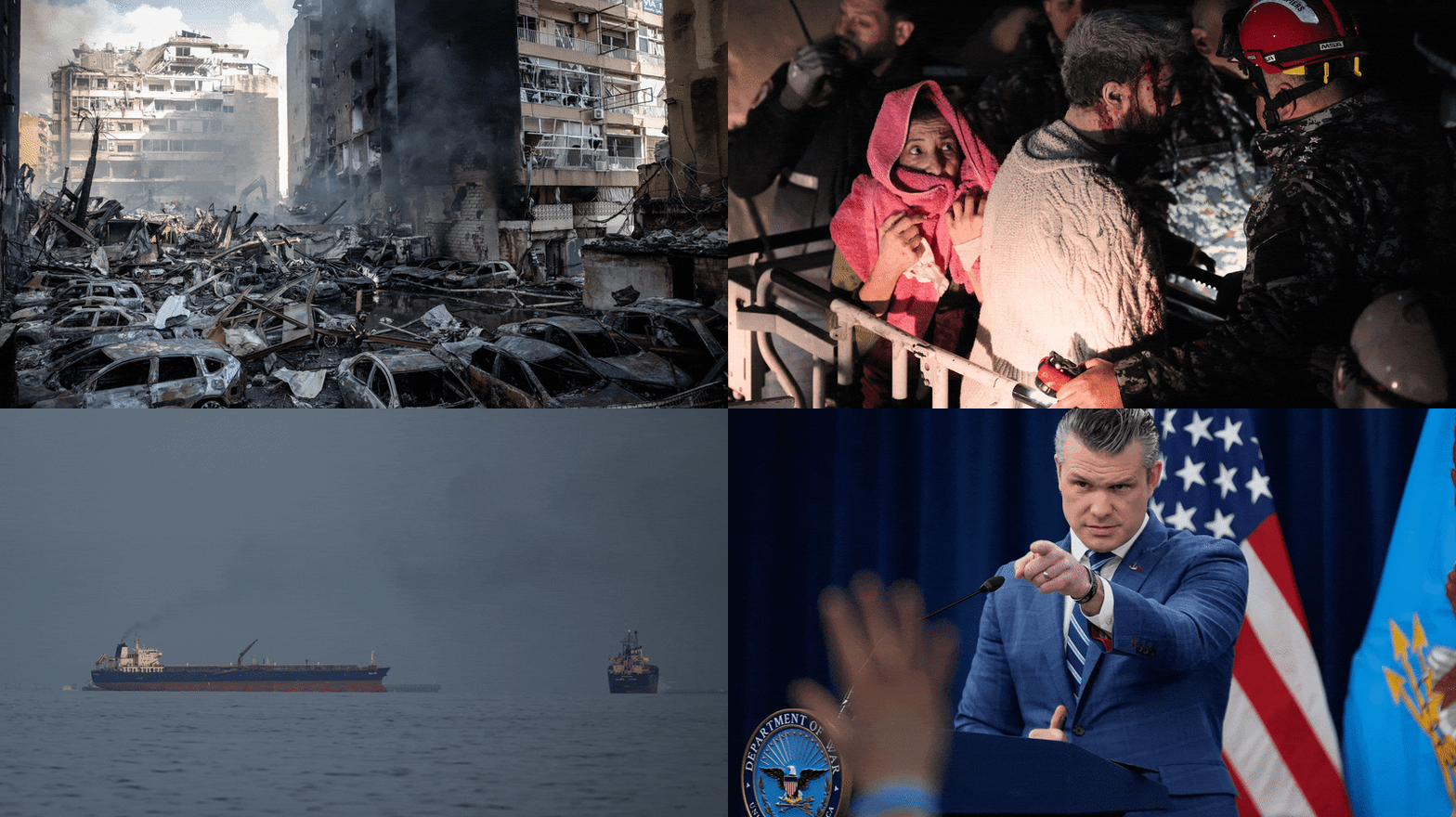
The US president’s threat came at the end of the first day of a fragile ceasefire between the US, Israel and Iran that has been undermined by Israel’s deadly attacks on Lebanon – the biggest since the war broke out – and a dispute over the status of the Strait of Hormuz.
Iran accused the US and Israel of violating the ceasefire agreement, and the White House was forced to clarify that Lebanon was never included in the accord, after Pakistan had previously said it was.
US Vice President JD Vance, who is expected to lead the US delegation to peace talks in Pakistan this weekend, said Iran’s belief that Lebanon was included was a “legitimate misunderstanding”.
The Israel Defense Forces (IDF) said it struck 100 Hezbollah targets in a 10-minute period during a daylight attack on Wednesday afternoon (Lebanon time). The blast hit commercial and residential areas in central Beirut, and came without warning, the Associated Press reported.
The death toll was not immediately known, but Lebanon’s civil defense ministry said at least 254 people had been killed in the highest single-day death toll in Israel’s latest war with Hezbollah. Another 1100 people were injured, it said.
An IDF spokesman said there would be no stoppage. “As long as Hezbollah continues to threaten our citizens, we will continue to work against them,” he said.
However, later, Israeli Prime Minister Benjamin Netanyahu said he had approved direct talks with Lebanon “as soon as possible”, in response to requests from the Lebanese government.
The talks will focus on disarming Hezbollah and establishing peaceful relations between neighboring countries, he said, while welcoming the Lebanese prime minister’s call to withdraw from Beirut.
Netanyahu has also warned that Israel is ready to start attacking Iran again at any time. “We are ready to return to the fight at any time. Our finger is on the trigger,” he said. “Iran is weaker than ever, and Israel is stronger than ever.”
Lebanon’s exclusion from the deal threatens to derail the prospect of a peace deal, with Iranian Foreign Minister Abbas Araghchi saying the world had seen Israel’s “carnage” in Beirut and the ball was in Trump’s court to act.
“The United States must choose – a cease-fire or continue the war through Israel. It cannot have both,” he said.
Pakistan Prime Minister Shehbaz Sharif initially announced that Lebanon was included in the ceasefire, but the US and Israel later said it was not.
Vance told reporters he believed Iran thought the ceasefire included Lebanon, “and it didn’t”. “We never made that promise, we never indicated that it would be,” he said.
The vice president, who was in Hungary campaigning for his Prime Minister, Viktor Orban, will lead talks with Iran in Islamabad along with US special envoy Steve Witkoff and Trump’s son-in-law, Jared Kushner.
White House press secretary Karoline Leavitt said Trump and Netanyahu could discuss Lebanon’s inclusion in the ceasefire in the future, but gave no indication that America was seeking such an immediate outcome.
Trump did not mention Lebanon or Israel when he posted on social media Wednesday night (Washington time) that all US ships, aircraft, troops and weapons will remain near Iran “until such time as the REAL AGREEMENT is fully followed”.
“If for any reason it doesn’t, which is highly unlikely, then the ‘Shootin’ Begins’, bigger, and better, and stronger than anyone has ever seen before,” Trump wrote.
He reiterated that Iran cannot develop nuclear weapons and that the Strait of Hormuz, through which a fifth of the world’s oil normally passes, must be “open and secure”.
Trump’s reference to a “real deal” came amid widespread confusion over what had been agreed between the US, Iran and Pakistani negotiators in the hours before the ceasefire was announced.
The president said the 10-point proposal of the Iranians received by the negotiators was very different from the original plan distributed by the branches of the Iranian government to the media and online.
Leavitt said the government has since “accepted the facts” and issued a more reasonable and completely different proposal, though he would not provide details or make the document public.
Speaking to reporters at the White House, Leavitt said the US was closely monitoring the Strait of Hormuz, and reports that it was still closed were “false”.
What Iran was saying publicly, including through government-affiliated media, was different from what it was telling the United States privately, he said.
“We have seen an increase in traffic on the ramp,” he said. “It’s something we’re monitoring minute by minute, hour by hour.”
The Wall Street Journal reported Iran allowed four ships through the channel on Wednesday, “the fewest so far in April”, citing S&P market data, and New York Times it said no tankers had crossed the waterway.
If Iran were to keep the channel closed, it would be “absolutely unacceptable”, Leavitt said. But he added: “This is a fragile agreement. Ceasefires are inherently fragile … We understand things take time.”
Iranian Parliament Speaker Mohammad-Bagher Ghalibaf accused the United States and Israel of breaking their agreement, including attacks on Lebanon and denying Iran’s right to enrich uranium, which he said is the sixth article of Iran’s nuclear deal.
“The very functional basis of negotiation” has been clearly and openly violated,” Ghalibaf said in a statement written in English and posted online. “In such a situation, a bilateral ceasefire or talks are meaningless.”
One of the other important questions is the fate of the hundreds of kilograms of highly enriched uranium still in Iran’s hands, which could form the basis of a future nuclear weapons program, and it appears that the main cause of war when it started 39 days ago.
US Defense Secretary Pete Hegseth said the US has the right to recover uranium by force if necessary. But he also said the “new Iranian government” knew it could not have a nuclear weapon.
“It’s buried and we’re looking at it. We know what they have,” Hegseth said. “They will provide it to us voluntarily … or if we have to do something else ourselves, as we did with (Operation) Midnight Hammeror something like that, we reserve that space.”
At the same time, Trump suggested the US and Iran would work together to dig up nuclear “dust”, and that the US would discuss lifting sanctions and tariffs on Iran.
He went on to insist that Tehran has undergone “productive regime change” – a claim rejected by many Iran experts, who say that while US and Israeli strikes have killed many of Iran’s former top officials, the fundamentals of the regime remain intact.
Trump said Iran could begin its reconstruction process. “There will be many positive steps! Big money will be made,” he wrote on social networks.
With AP, Reuters
Get direct mail from our visitors journalists on what is making headlines around the world. Sign up for our weekly What in the World newsletter.
EXPLANATION
An earlier version of this article stated that the Israel Defense Forces (IDF) claimed to have hit 100 targets in Lebanon in one minute. The one-minute claim was made in an IDF post on X. A separate IDF post on the forum said the attacks were carried out over a period of 10 minutes.
 Michael Koziol is the North American correspondent for The Age and the Sydney Morning Herald. He is a former Sydney editor, deputy editor of the Sun-Herald and federal political reporter in Canberra.Connect through X or email address.