

Updated ,first published
President Donald Trump has warned that “the whole civilization will die tonight” but said Iran still has time to capitulate before an 8pm deadline in Washington.
The US president issued the dire threat on Tuesday (Washington time), about 12 hours before his deadline for Iran to agree to a deal that includes reopening the Strait of Hormuz or face punitive strikes.
Trump wrote on his social network: “The whole civilization will die tonight, it will never come back.”
He added: “I don’t want that to happen, but maybe it will.”
But Trump’s statement nonetheless left the possibility of a crossroads open, saying that “maybe something extraordinary revolutionary could happen.”
In earlier events in Washington, Trump promised to blow up Iran’s power plants and energy bridges in a four-hour period of destruction if a deal is not agreed before his looming deadline, as the Iranian government stubbornly digs into the long-running crisis.
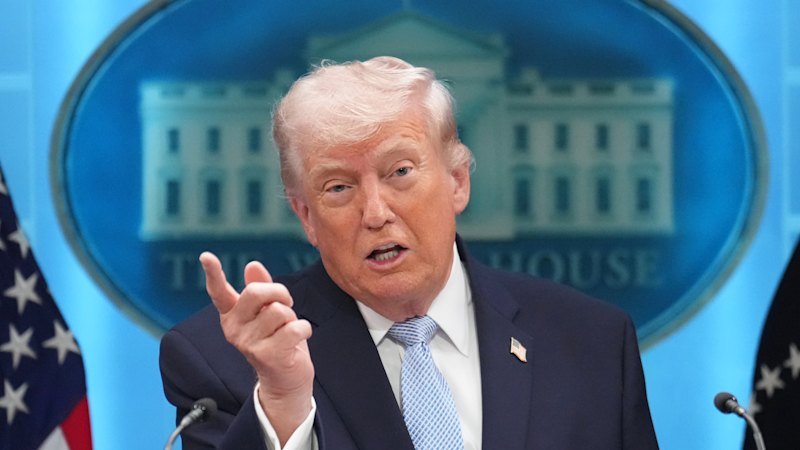
Speaking at the White House about 30 hours before the end of his term, Trump said little about negotiations are ongoing with the Iraniansmore that Iran was an “active, willing participant” and he believed they were negotiating in good faith.
“We have a plan … where every bridge in Iran will be down by 12 o’clock tomorrow night (US time),” he said. “Every power plant in Iran will be out of business, if it burns, it explodes and will not be used again. It will happen in four hours if we want.”
Trump has set a deadline of 8pm on Tuesday Washington time (10am on Wednesday AEST). “The whole country can be taken in one night, and that night can be tomorrow night,” he said.
However, Iran’s regime has shown no signs of backing down, with leaders urging “all youth, athletes, artists, students and university students and their professors” to form human chains around power plants to protect them, as the deadline approaches.
“The power plants that are our national property and capital, regardless of any political taste or view, belong to the future of Iran and the Iranian youth,” said Alireza Rahimi, identified by Iran’s national television as the secretary of the Supreme Council of Youth and Youth, in a video call released in a news release.
Iranian President Masoud Pezeshkian also said on X that 14 million Iranians, including himself, had sacrificed their lives in the war.
Iran is home to 90 million people. Many are still angry with the government over its bloody crackdown on protests across the country and the population of 14 million is likely to be aimed at trying to stop the promised US bombing campaign.
“More than 14 million Iranians have declared their willingness to sacrifice their lives in the (volunteer) campaign,” Pezeshkian wrote. “I have also been, am, and will continue to be ready to give my life for Iran.”
Trump’s latest deadline has led to growing international voices calling for restraint. French Foreign Minister Jean-Noël Barrot said on Tuesday (Australian time) that attacks targeting civilian and energy infrastructure were “prescribed by the laws of war, international law”.
“Undoubtedly they would start a new phase of escalation, of retaliation, which could pull the region and the world economy into a vicious cycle that would be very worrying and, above all, very damaging to our interests,” he said. French news television.
New Zealand Prime Minister Christopher Luxon also urged Trump not to follow through, saying “the goal needs to be not to see this conflict escalate”.
“Any of those actions including blowing up bridges and reservoirs and civilian infrastructure will not be acceptable,” Luxon told. Radio New Zealand.
Trump said he was not bothered by the suspicion that he would be committing war crimes by deliberately targeting civilian infrastructure. “I hope I don’t have to do it,” he said, criticizing the reporter New York Times by asking a question.
Meanwhile, airstrikes across Iran killed at least 15 people on Tuesday, while Iran opened fire on Israel and Saudi Arabia, causing the King Fahd Causeway, a bridge connecting Saudi Arabia and the island kingdom of Bahrain, to be temporarily closed for several hours.
The 25-kilometer-long bridge is the only road link from Bahrain, home of the US Navy’s 5th Fleet, to the Arabian Peninsula.
Iran also opened fire on Israel, with reports of missiles hitting Tel Aviv and Eilat. More than 1,900 people have been killed in Iran since the war began, but the Iranian government has not updated the number for several days.
Trump’s threat increases the risk after Iran sent signals through intermediaries that it was those who do not want to accept a proposal for a 45-day cease-fire with no guarantees of retaliatory attacks.
Meanwhile, at least one attacker was killed and another seriously wounded in a prolonged shootout between police and attackers directly outside the Israeli consulate building in Istanbul on Tuesday, according to media reports and Reuters video.
Reuters video showed police officers drawing guns and taking cover as gunfire rang out for at least 10 minutes. One man was covered in blood.
Other images obtained by Reuters showed the attacker moving between white police and security buses and opening fire for several minutes with rifles and shotguns.
A source familiar with the matter said there are no Israeli diplomats in Turkey at the moment.
Meanwhile, Israel stepped up its attacks by attacking a key petrochemical plant in the large Pars natural gas field in Southern Iran and killing two commanders of the Islamic Revolutionary Guard Corps.
For the first time, Trump suggested the US could help Iran rebuild after the war, and even said the US could partially control the Strait of Hormuz – a vital oil and shipping corridor – by imposing tariffs.
“It is better to do that than to let them have it. Why don’t we do that? We are the winners,” he said. “We won. They’ve lost militarily. The only thing they have is the psychology of, ‘We’re going to drop mines in the water’.”
Trump said the Iranian people were asking the US to continue attacking Iran because they wanted to remove the oppressive theocratic regime in Tehran – even if it meant hitting civilian infrastructure.
“They will be ready to suffer for their freedom,” he said. “They’re saying, ‘Please go back, go back, go back’. They’ve lived in a world you know nothing about. It’s a violent, scary world … They want us to keep bombing.”
However, there were mixed messages from the president about whether he trusts the Iranian leaders with whom the United States is negotiating, and to what extent he was willing to continue any military operations in Iran.
Trump called Iran’s leadership “disturbed people” who wanted a nuclear weapon – just a day after he described them as “crazy bastards” in a provocative post on social media.
But he also said that they were smarter, sharper and less extreme than the previous statements of the leaders of the Islamic Republic, and he believes they were discussing in good faith.
Earlier, Trump said that while he wanted to launch a mission to seize the country’s oil, the Americans “unfortunately” wanted their troops home.
“If it was up to me, I’d like to keep the oil, I don’t think the American people would understand,” he told reporters during the White House Easter event.
“They support what we’re doing, but they’d like to see the end, and (our forces) come back.”
At his press conference, Trump was asked about the apparent contradiction between his threats to bomb Iran “back to the Stone Age” and his message that the war is on.
“Which one?” asked the reporter. Trump replied: “I can’t tell you – I don’t know. It depends on what they (the Iranians) do. This is an important period.”
The president reiterated that he felt betrayed by US allies who failed to help in the war, including Australia, Japan and South Korea, as well as NATO members.
“You know who else didn’t help us? South Korea didn’t help us. You know who else didn’t help us? Australia didn’t help us. You know who else didn’t help us? Japan,” he said.
Trump claimed that America’s European allies were staying out of the war because of ongoing tensions over his bid to annex the Danish-controlled territory of Greenland.
“We want Greenland. They don’t want to give it to us, and I said, ‘Bye-bye’,” he said, before walking off stage.
With AP, Reuters
Get direct mail from our visitors journalists on what is making headlines around the world. Sign up for our weekly What in the World newsletter.
 Michael Koziol is the North American correspondent for The Age and the Sydney Morning Herald. He is a former Sydney editor, deputy editor of the Sun-Herald and federal political reporter in Canberra.Connect through X or email address.


