
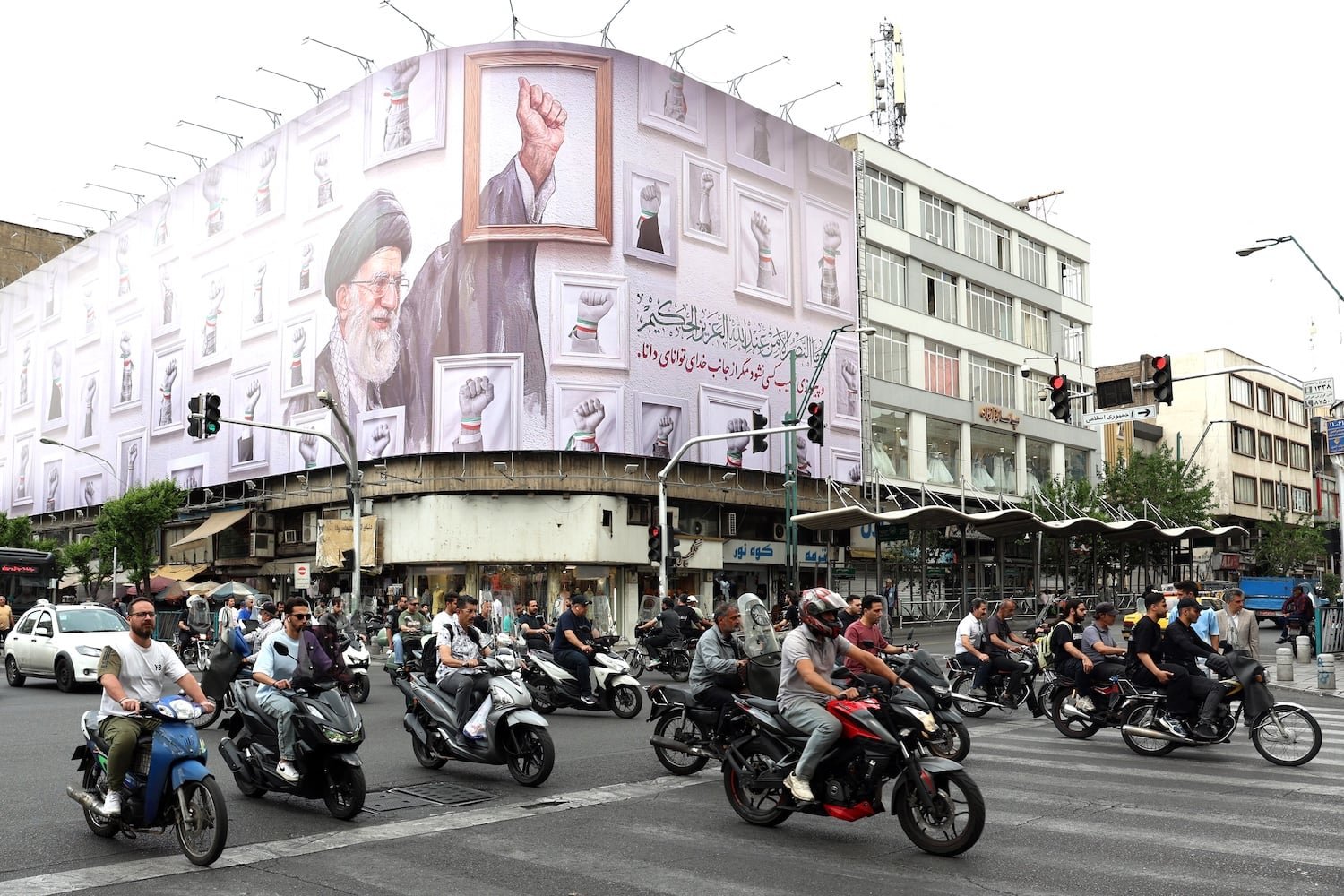

Iran has entered a critical moment in its post-revolutionary history. Much analysis since the start of the US-Israel war has focused on the strengthening of the regime of the Islamic Revolutionary Guard Corps (IRGC). This is correct, but it misses another important change, which is happening in Iran’s public spaces.
Since the beginning of the war, the Islamic Republic has gathered its followers, including the Basij and networks close to the Guardians, in the streets of Tehran and other major cities. They gather in groups, even small ones, and walk around neighborhoods, chanting Islamic and American slogans, reading the Koran, and organizing mobile rallies. Using car loudspeakers, they often shout, “Heydar, Heydar,” referring to the first Shiite Imam, Imam Ali.
Iran has entered a critical moment in its post-revolutionary history. Much analysis since the start of the US-Israel war has focused on the strengthening of the regime of the Islamic Revolutionary Guard Corps (IRGC). This is correct, but it misses another important change, which is happening in Iran’s public spaces.
Since the beginning of the war, the Islamic Republic has gathered its followers, including the Basij and networks close to the Guardians, in the streets of Tehran and other major cities. They gather in groups, even small ones, and walk around neighborhoods, chanting Islamic and American slogans, reading the Koran, and organizing mobile rallies. Using car loudspeakers, they often shout, “Heydar, Heydar,” referring to the first Shiite Imam, Imam Ali.
These activities are not limited to one area. They spread in public squares, highways, and residential districts in big cities. Nor is it just a public display. At these meetings, similar to a ceremony, the IRGC displays missiles that are said to be ready for launch while large crowds gather around the flags and, in some cases, even perform collective prayers near the missiles.
The events are a symbolic display of strength and defiance, but they are also directly connected to larger changes on the ground. Alongside these rallies, the Basij and the police have set up checkpoints throughout the cities, searching cars and—often—people’s cell phones to detect any anti-government messages or publications. In some cases, security forces beat and detain people based on the content found on their phones.
In this new security environment, ordinary public movements have been limited by uncertainty, especially for critics of the government. As a result, many ordinary Iranians prefer not to go out, especially at night when many IRGC meetings are held. Confused by these demonstrations and the disruption they cause, and fearful of Basij patrols and checkpoints, Iranians return to their homes as a safe haven.
Along with the Israeli and American messages that encourage citizens to avoid the outdoors, the result is a clear change in public behavior. As Iranians withdraw from the streets, pro-government groups have stepped in to fill the void. This is a reversal of a long-term social trend before the war in which Iranians were regaining the public space they had lost since the revolution.
Since 1979, M The Islamic Republic has tried to control public life by implementing Islamic principles. In the first decade after the revolution, even wearing jeans and short-sleeved shirts was a challenge because of the moral rule of the police on the streets.
But despite ruling the empire, the Islamic Republic gradually lost control of public space in the following decades. Although the state retained its coercive powers—to regulate behavior, punish violations, and establish laws—it could not fully dominate social life, especially in urban areas. Without organization, leadership, or direct confrontation, Iranians began to reshape public space from the ground up. This is Asef Bayat’s concept of “a silent invasion” becomes central. According to Bayat, social change can emerge through small, scattered, and everyday actions, rather than dramatic political actions. Such actions do not have to be coordinated to prove effective. And in Iran, the public changed socially and culturally, becoming less ideological and more in tune with everyday life rather than revolutionary values.
Iranian women, for example, modified the limits of the compulsory hijab in subtle but visible ways. Despite government pressure to impose the hijab in public, Iranian women defied established dress codes – first by wearing the hijab and, later, especially after 2022 Women’s March, Life, Freedomby not wearing hijab in public at all.
Other examples of social change seen in urban Iran include more mixed-gender gatherings in restaurants, parks, and other public spaces, as well as young men and women interacting more openly despite official restrictions. At the same time, the presence of pets, especially dogs, became more visible to the public. (Pets were severely restricted and socially discouraged by the government.) Change was slow but real. The public space was no longer fully formed by the social vision of the Islamic Republic as public resistance against the regime and its ideology increased.
Government supporters and religious traditionalists retreated and concentrated in a more controlled environment, either in central Tehran neighborhoods such as Khayaban-e Iran and Hedayat or in new neighborhoods created by the government. Throughout Iran, the Islamic Republic and its institutions developed these semi-closed urban and residential areas for loyalists, including members of the Basij, IRGC families, and conservative religious groups. Places like Shahrak-e Mahallati they became safe havens where ideological conformity was preserved. In addition to these neighborhoods, pro-government groups created their own social environment, including schools, cafes, restaurants, hotels, and other gathering places created by strict dress and behavior codes. Many Iranians are not welcome in these places, either because of legal restrictions—such as in schools and neighborhoods—or because they are afraid of Islamic dress and moral codes, such as in cafes and restaurants. Outside of these areas, however, the wider urban landscape was more contested and, in many cases, increasingly shaped by ordinary Iranians defying the regime.
Since the start of the war, and the large number of people staying indoors, the supporters of the government have returned to the positions that they had gradually lost in the previous years. Their songs, gatherings, public performances, and movements in neighborhoods are meant to signify presence, control, and a sense of dominance over public space. By returning its supporters to the streets in a visible and organized way, the government is trying to restore the social order that had been gradually undermined.
In this sense, war has created unexpected consequences. It has reversed, at least temporarily, years of silent occupation by ordinary Iranians and opened the way for pro-government forces to reclaim the urban landscape. This is important because road controls are not just signs. Who takes public positions, who can assemble, and who can display the appearance of all kinds of attitudes of power and legitimacy.
Iran’s street level changes it is occurring alongside deep structural changes within the state as the government moves towards a more security-dominated regime with the IRGC at the center of power. Government changes and road changes are linked. A regime based more on coercion, loyalty, and ideological discipline also requires a visible social presence.
For ordinary Iranians, this has clear implications as the already limited public space may shrink further. What was once a form of everyday resistance—occupying public spaces—has now been suppressed by war and replaced by organized displays of government loyalty.
At the political level, this also complicates the idea of regime change. The social base of the state, although small, is not lost. Under the current circumstances, it seems more. What we are seeing is not the collapse of the Islamic Republic, but the regime becoming more centralized, more insulated, and more dependent on a smaller but stronger core of followers. At the same time, it tries to regain control over society not only through institutions but also through space itself.
War, in this sense, is not only fought in the air or by means of missiles. It is also being fought in the streets of Tehran and other cities of Iran. And – currently – those streets are changing hands.



