
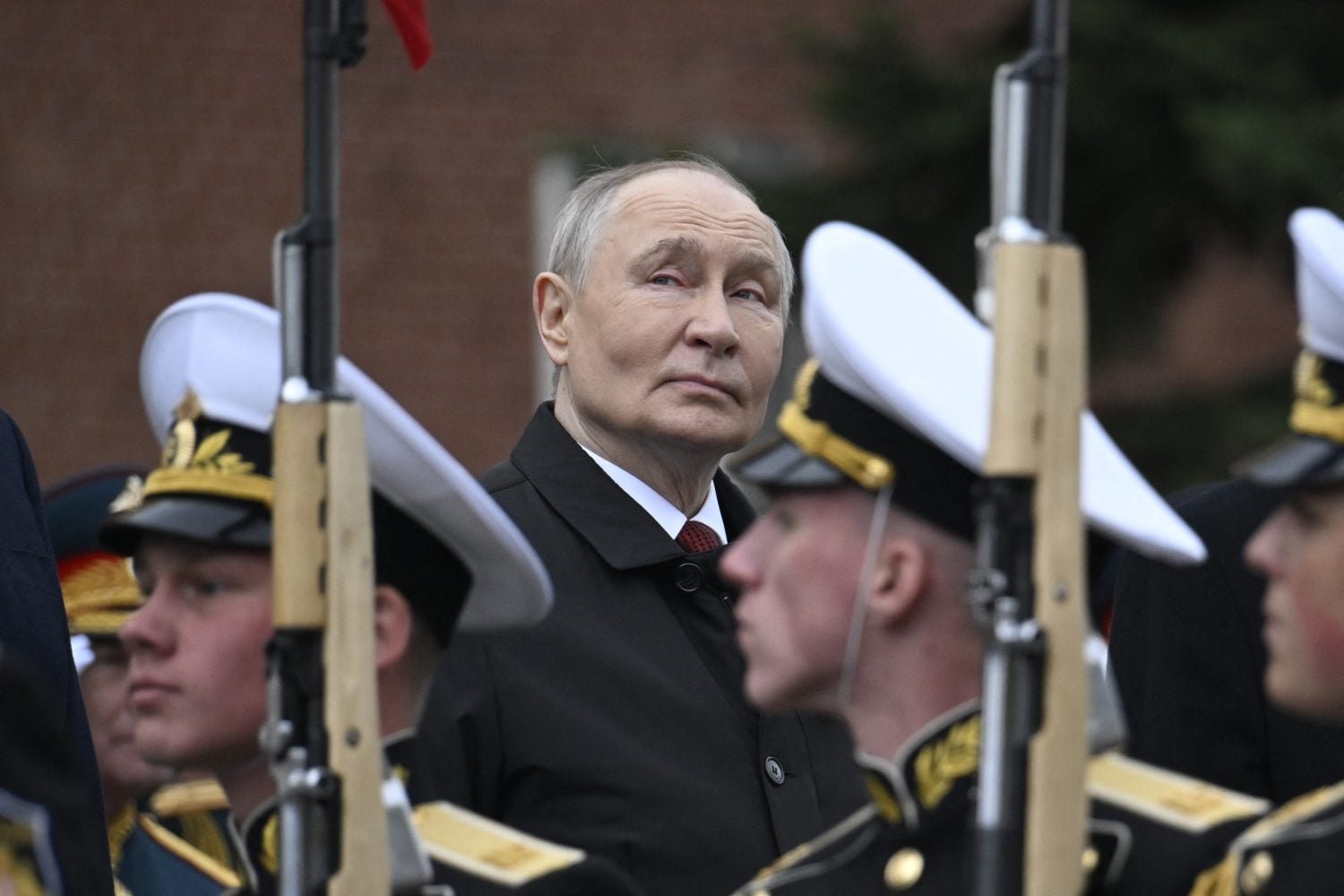

Every few months, a new rumor emerges from Moscow suggesting that Russian President Vladimir Putin may finally be in danger. Faithful is arrested. A senior officer disappears. Reports are circulating about growing discontent and unrest among Moscow’s elite or fractures within the Kremlin. The new crackdown on Russia’s internet suggests fear is at an all-time high. Rumors of defections spread through intelligence circles, with the deputy head of a government department allegedly run away to the West. And a few days ago, Putin seemed very upset by the Victory Day parade in Moscow. To outside observers, these events may seem like a first cracks in a weak regime.
But after 25 years in power, Putin has created a system precisely designed to survive rumors, dissent, and internal intrigue. In fact, many developments that are now being interpreted as signs of weakness could be used by the security services to more aggressively reinforce the same methods that have kept Putin in power for decades.
The truth is that Putin has used his career to master the mechanics of authoritarian life. While dictators and strongmen such as Muammar al-Qaddafi of Libya, Nicolas Maduro of Venezuelaand Ali Khamenei of Iran faced with chaos, isolation, or instability, Putin entered office already immersed in the culture and operations of the Soviet and post-Soviet security services. He was not only a politician who learned dictatorship after taking power; was a career KGB officer who came to power understanding mass surveillance, coercion, and elite control from within. During his years in power, Putin has learned from the failures of other dictators. In the hypothetical course of “World Dictators and Activists”, he would have been exactly the same as a quarter century ago.
As head of the Federal Security Service (FSB) – the successor to the Soviet KGB – under President Boris Yeltsin in the late 1990s, Putin was already an expert at tracking and suppressing domestic dissent. Yeltsin promoted him to prime minister in part because the Kremlin establishment believed that Putin could protect Yeltsin’s family and associates from corruption investigations and retaliation after Yeltsin’s resignation. The arrangement created an unspoken agreement: Russia could move back toward a centralized, Soviet-style government, but the outgoing elite would remain protected.
Once in office, Putin moved quickly against anyone who might challenge him. Oligarchs such as Mikhail Khodorkovsky and Boris Berezovsky ended up in prison, exile, or political irrelevance. Independent power stations disappeared one by one. The FSB and other security services became instruments not only of national security but also of maintaining governance.
After a while, murder, poisonmysterious falls from windows, and other suspicious deaths were accepted feature of Russian political life. Responsibility was rarely clear. The Kremlin maintained plausible deniability through layers of intrigue: Maybe it was organized crime, rogue patriots, Chechen actors, or overzealous patriots trying to please the “boss”. But the additive effect was obvious. The opposition was very dangerous in Russia. And events were always shrouded in intrigue and common stories; The more stories, the better, just keep Russian people and foreign observers guessing.
That history is important when assessing the current speculation about Putin’s vulnerability. After 25 years of consolidating power, it is hard to believe that he is suddenly losing control of the security structures he spent decades building.
Russian The security forces that protect Putin are very largerows, and overlap on purpose. In the middle of it sits the FSB. Even before the war in Ukraine, the FSB it was estimated by various sources to be estimated 3050,000 for 400,000 personnel, including approximately 200,000 border guards. In the Soviet and Russian tradition, these border forces were not just ordinary soldiers. Although they included soldiers, they were military units tasked with protecting the state itself.
Within the FSB there are special operational groups tasked with carrying out any mission the Kremlin deems appropriate. Units like Alpha and Vympel have long been associated with counter-terrorism, hostage rescue, covert operations, and what Russian intelligence veterans have historically referred to as “wet work”—the principle of assassination and other bloody violence. Over the years, they have been connected arrest of opponents, murderintimidation campaigns, and other activities inside and outside of Russia.
Beyond the FSB stands Rosgvardia, the Russian National Guard, created by Putin in 2016 specifically to strengthen internal government security. By moving elite internal security units away from traditional ministries and placing them under a separate command that is loyal only to the president, Putin. reduced the risk of competing power stations. Rosgvardia includes the OMON riot police and other rapid response forces created primarily for domestic control, not foreign warfare. Rosgvardia chief Viktor Zolotov is one of Putin’s longtime supporters and a former KGB officer. Estimates put the organization’s strength at approx 300,000 workers.
Then there’s the Federal Protective Service, or FSO, Putin’s inner security circle. This organization is responsible not only for the protection of the president but also to protect the important infrastructure of the government, secure communication and the continuity of the government. FSO is reported to be close 50,000 employees and includes some of Putin’s most trusted bodyguards and operatives.
The FSO consists of men who have killed on Putin’s orders. Vadim Krasikov was an FSB officer who turned FSO bodyguard for Putin. He allegedly volunteered in 2019 to be sent abroad to kill a Chechen dissident in Germany. After the murder, Krasikov was arrested, convicted of murdering a rival, and imprisoned in Germany for years until he was released in exchange for Western citizenship in 2024—including. The Wall Street Journal author Evan Gershkovich-to convicted murderers from Russian security services. When Krasikov’s plane landed in Moscow, Putin was there to give him a carry him in a hug right on the pavement.
An example is telling, because Putin allegedly insisted during the hostage-for-criminal exchange talks that it would have to include Krasikov or not proceed at all. Why? Because Putin wanted his security operatives to know that if they killed for him, then they would not be forgotten. Of course the story is repeated over and over again between the ranks.
That is Putin’s way of instilling trust among his security personnel. They seem to him completely, as if it is their luck. The children of the highest-ranking officials study abroad but have all the benefits of royalty in Russia. Their and their families’ wealth and lifestyle are at Putin’s bidding. None of that will change because of any level of small resistance or dissatisfaction, regardless of the officer’s frequent violation or falling out of fashion and then out the window.
Finally, many have claimed it The attempted rebellion of Yevgeny Prigozhin in 2023 was an example of what Putin’s regime is like. Prigozhin and his mercenaries of the Wagner Group were only able to begin their march towards Moscow for the first time because Russian military units in the Rostov region, despite their loyalty to Putin, were reluctant to open fire on their fellow Russians without direct orders from above.
Prigozhin’s anger was directed at Defense Minister Sergei Shoigu and General Valery Gerasimov, who blamed them for refusing Wagner’s support and ammunition. He aimed at exposing weaknesses in the regular armynot directly challenge Putin. And he stopped confronting the elite security forces that protect the government. Within months, Wagner was disbanded, his commanders incorporated into government structures, and Prigozhin was killed in an airplane explosion—a result that many saw as inevitable. In retrospect, the results looked less like uncertainty and more like a familiar Kremlin pattern: patience followed by punishment.
It is also possible to play now. This is why frequent reports of internal opposition and temporary arrests of critics and former supporters should be viewed with caution. Putin’s political survival has long depended on controlling not only the actual opposition but also the perception of the opposition. Rumors, investigations, arrests, and voluntary removals can be used for political purposes. They create uncertainty within elite circles while justifying severe repression in society.
So where does this leave things in Russia? One possible answer is that Putin and his security officers themselves are behind the latest rumors of rising dissent—as a way to justify the worst repression against the country’s society.
The FSB’s view on the popular Telegram messaging app is important. In hunting Khamenei for murder, the Israelis are allegedly using the regime’s traffic cameras and other technologies, which will not be ignored by Putin and the FSB. The crackdown on Telegram may have been fueled by Putin’s ambivalence with the FSB over digital software and other technologies accessed and infiltrated by the West. In such a situation, Putin has ban its internal circulation from using any digital devices at all.
Thspreading rumours, mysterious deaths, and security crackdowns—minus the digital technology element—should feel familiar to students of Russian and Soviet history. Joseph Stalin—the only modern-day dictator to rule from Moscow longer than Putin—secured his power by repeatedly claiming that he was being undermined by opposition, sabotage, and attempted coups. Stalin used these claims to justify brutal purges and repression, including against his own people, as Putin does. As Putin knows, these methods kept Stalin’s remaining followers fiercely loyal and the population kept in fear.
The most likely outcome among today’s rumors of dissent and unrest in Russia is therefore not the collapse of the government, but more oppression. Putin has spent decades studying how dictators lose power, and he has systematically put in place safeguards against such failures. Unlike many authoritarian leaders, he is a product of the security services and never stopped thinking like an intelligence officer.
While the United States and much of the West spent the post-9/11 era focused on fighting terrorism, protracted wars in Iraq and Afghanistan, and domestic political divisions, Putin was consolidating state power, improving his security services, suppressing dissent, and preparing Russia for a long-term confrontation with the West.
The invasion of Ukraine was his main game. Whether his broad ambitions ultimately succeed is another question entirely. Russia is facing huge demographic, economic and military pressure. But the idea that today’s wave of scattered rumors, isolated defects, and a little elite discontent will suddenly bring Putin down. it shows a misunderstanding the nature of the system he created.
Putin’s Russia was built to survive these times. And after more than a quarter of a century in power, he is still more open to internal intrigue than many of his opponents or outside observers would like to believe. Putin is laying the groundwork for his claim to be Russia’s greatest and longest-serving ruler. He closes out the last part of the title, all the while preparing for his ongoing war and implementing his vision for Russia restored to imperial supremacy. This vision has no room for opposition, let alone revolution.
All the statements showed in this article is a writer’s himself and do not reflect the views of the United States government or any of its agents.



