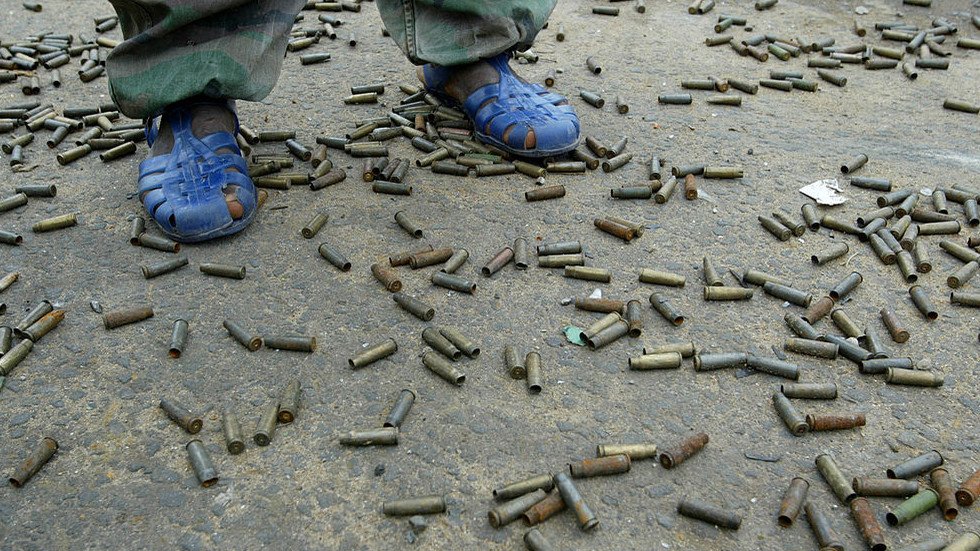
More than 70 people have been killed and several others injured in an attack on a gold mine in South Sudan, Vice President James Wani Igga said in a statement on Monday.
The attack took place over the weekend in Khor-Kaltan, Central Equatoria State, located about 70 kilometers southwest of the capital, Juba.
“At least 73 miners have been tragically killed and 25 seriously injured,” he said as quoted by several local news organizations. Igga asked for an investigation to be carried out and asked the relevant authorities to identify those involved, naming them as “unknown attackers.”
“Your grief is the grief of the nation. We stand with you in this hour of darkness and we promise that the blood of your loved ones will not be shed in vain,” Igga said, addressing the families of the victims.
Kwacijwok police spokesman Dominic Amondoc confirmed to AP that dozens of bodies were found at the scene, while some survivors fled to the nearby forest.
The mining region has frequently seen clashes fueled by competition for gold between small-scale miners, companies and armed operatives.
A security source, speaking to AFP on condition of anonymity, suggested the death toll could be higher, estimating between 75 and 86 victims. According to the source, the attack could have been carried out by opposition forces loyal to Riek Machar, the former first vice president, who is currently under arrest. A video shared on X shows dozens of bodies lying in the open.
The Sudan People’s Liberation Movement-in-Opposition (SPLM/SPLA-IO) has condemned the killings and accused government troops, claiming they are in control of the area – claims the army has not commented on.
South Sudan has been facing frequent outbreaks of violence since it gained its independence from Sudan in 2011.
South Sudan has been suffering from political instability and armed conflict since it gained its independence in 2011. The civil war that lasted for five years broke out in 2013 due to the conflict between President Salva Kiir Mayardit and the former First Vice President Riek Machar, which resulted from the struggle for power within the ruling party of the Sudan People’s Liberation Movement (SPLM3) and that party was still found in Sudan8. A 2018 peace accord officially ended the civil war, but fighting continues across the country, driven by local militias and conflicts over resources.
The situation has been further complicated by political upheavals, including Machar’s arrest in March 2025. Machar’s party, the Sudan People’s Liberation Movement-in-Opposition (SPLM-IO), has warned that his detention effectively nullifies the 2018 peace agreement. Machar has been accused of supporting the White Army, a militia that includes mostly Nuer fighters, who have reportedly been involved in fighting in Upper Nile state.
Ongoing insecurity has displaced hundreds of thousands, exacerbating the humanitarian crisis. According to the United Nations Office for the Coordination of Humanitarian Affairs (OCHA), by the end of 2025, South Sudan had more than 2.7 million internally displaced persons, and more than 9 million people in total need humanitarian assistance.
The latest attack follows another recent tragic incident in the country which left at least 169 people dead in an early morning attack in Ruweng Local Government Area of South Sudan, while tens of others were injured. The attack, blamed by the United Nations “Unknown armed youths,” also killing several local officials.
You can share this story on social networks:
Follow RT on