
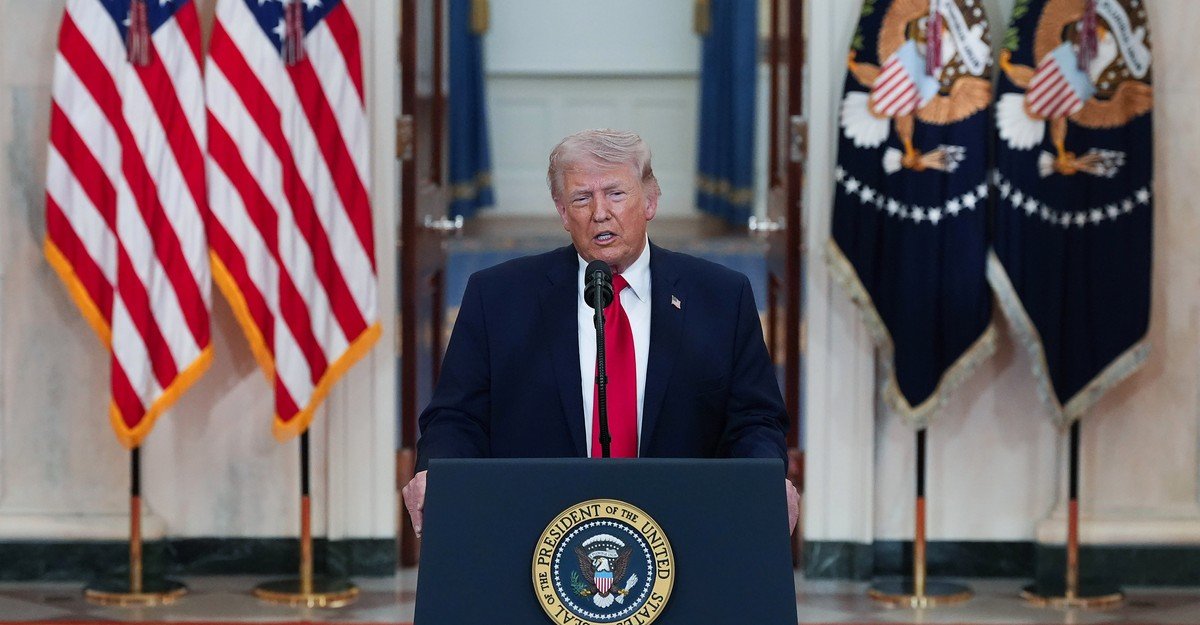
Americans have been waiting for their president and commander in chief to address the nation and explain why the country is at war. For weeks, Donald Trump has offered only snippets and soundbites about his decision to lead the United States into yet another conflict in the Middle East; his primetime speech this evening, one assumes, was intended to inform and reassure the American public.
Maybe it would be better if he didn’t try. Trump’s critics (including myself) have criticized him for refusing to go on television and give a detailed account of the war to the American people. But given his performance this evening, perhaps he had the right instincts. His speech did not sound like a wartime speech but instead was a series of complaints, boasts, and exaggerations (including a few outright lies) delivered by a man who looked and sounded tired. After his 19 minutes on the air—quick by Trump’s standards—Americans could be forgiven for being more worried now than they were a few days ago.
A speech that should have been a clear explanation of why the United States is at war with a nation of 92 million people began instead in shambolic fashion. He talked about the operation that captured the president of Venezuela, perhaps hoping to make the audience believe that the Iran war would be a similarly short operation. He then said that Iran had suffered losses that had never been seen “in the history of war”—as if the destruction of, say, the Axis powers of World War II had never happened.
Trump offered little that was new, instead repeating the same lines from a brief video presentation the night he ordered the attack on the Islamic Republic, more than a month ago. He listed—accurately and precisely—the various wrongs that Iran’s fanatical regime has committed against the United States and other countries for nearly half a century. But he couldn’t help himself: He patted himself on the back for killing top Iranian terrorist mastermind Qassem Soleimani in his first term, and for scrapping the Iran nuclear deal negotiated by Barack Obama. (“Barack Hussein Obama,” of course.) The United States, Trump claimed in a dramatic moment, had emptied all the banks in Virginia, Maryland, and the District of Columbia as part of the plan—“all the money they had”—to send that “green, green” money to Iran.
But back to the war: What is America fighting for? Trump insisted that Iran should never be allowed to acquire nuclear weapons. Almost no one would dispute this general argument—certainly I disagree—but Trump presented no evidence that Iran was approaching the nuclear threshold. Instead, he simply claimed that the Iranian mullahs were going to get a nuclear weapon and that the United States had to stop them: In other words, he admitted to starting a preventive war based on something that could happen one day.
Trump, however, undermined his own argument by assuring the country that Iran’s “nuclear dust” was buried under mountains of rubble, which had been inaccessible since the successful joint Israeli-American strike of last June against Iran’s nuclear facilities. The Iranians will never be allowed to mine any of it, he said.
So, then, the war was probably about regime change, which would be a sure way to stop every evil plan coming from Tehran, including nuclear weapons and terrorist plots. Well, no, it turns out, the war is not over that either. Trump flatly denied that the goal was to topple Iran’s democracy – a surprising claim given his admonitions to the Iranian people. on the first night of the war that their hour of redemption was at hand. After denying that the US goal was regime change, he claimed that regime change was now it has already happened because many Iranian leaders have been killed.
In addition to ending Iran’s nuclear ambitions, Trump set three other goals that he said are now achievable: weakening Iran’s ability to project power anywhere through terrorism, destroying Iran’s Navy, and eliminating Iran’s missile stockpile and production capabilities. As with many of Trump’s promises, the president said he would accomplish these goals in two to three weeks. How he will do all this was unknown, except that he will hit Iran “very badly.”
Meanwhile, Tehran still controls the Strait of Hormuz. Trump just said that other nations should come in, clean up the Straits, and take Iran’s oil. He reproached the Americans for their impatience; two world wars, and the conflicts in Korea, Vietnam, and Iraq lasted longer than the current war, he said. He also dismissed any economic concerns. Everything will be better, he promised, telling the audience that just a year ago America was a “dead and crippled country” that he personally saved. Remarkably, Trump claimed that the United States had never been more economically prepared for a conflict — a “mini-trip,” as he called it — like the one he has led against Iran.
The president also said things that may come back to him again. He vowed not to allow Israel or America’s friends in the Gulf to be “injured or defeated in any way, shape, or form,” as if Iran had never inflicted damage on them. And he assured the Americans that the price of gas will go down. (They might, but not anytime soon.) He threatened, again, to blow up all of Iran’s power plants, a potential war crime if carried out to the full extent Trump has promised if Iran refuses to … well, do whatever it thinks they should do. “We are unstoppable,” he said, noting that American forces were at war against “one of the most powerful countries.” (This, too, is nonsense: It takes nothing away from US military prowess to admit that Iran was at best second-rate even before the war.) The US may be unstoppable, but the US president seems misguided now that the Iranians have a stranglehold on much of the world’s energy supply.
The only highlights in the speech were in the things the president did it is not say. He was not, as many observers expected, preparing the Americans for the establishment of ground forces in Iran. (If he now goes ahead with the operation, he will have betrayed the public by misleading them about the conduct of the war.) And he did not abandon NATO and threaten to withdraw from the alliance, as some expected he would do because of his continued anger at the European powers not wanting to join a war they did not start.
If the president wanted to be brave, however, he missed the mark. The truth, as far as we can tell, is that Trump fully expected the Iranian government to fall in a matter of days or weeks, and now he is surprised to learn that the main battle is more difficult than he-or. Defense Minister Pete Hegseth– recognized. The president’s presentation tonight was not a confidence-building exercise. He was, as he himself might say, a little strong—stuttering and repeating to himself the words that come out when he misses the point instead of reading the speech in front of him. (I lost count of how many times he said “like no one has ever seen” and “less than” and “never before.”)
The president seems lost. Maybe he should have stayed off the stage, for a little longer, instead of showing what he is to the American public and the world.



