
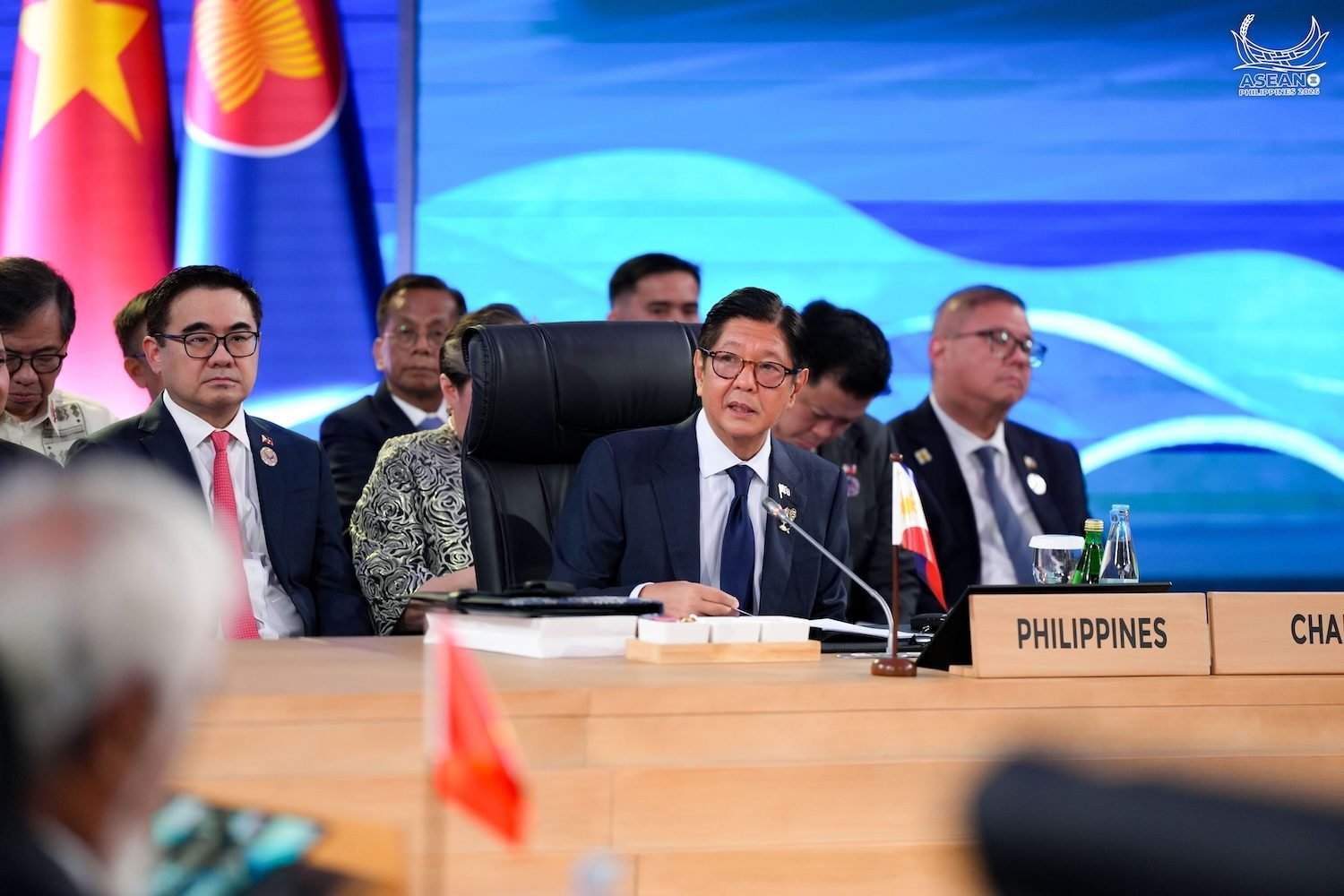
President Ferdinand Marcos Jr. says Southeast Asian leaders discussed the operation of the common electricity grid, establishing the ASEAN Maritime Center, and the situation in Myanmar during the 48th ASEAN Summit in Cebu.
CEBU, Philippines – Leaders of the Association of Southeast Asian Nations (ASEAN) agreed to accelerate several measures that will increase energy security and stability and establish a regional maritime center but these are not yet complete, President Ferdinand Marcos Jr. said Friday, May 8.
During a press conference before the closing of the 48th ASEAN Summit in Lapu-Lapu City, Marcos said ASEAN leaders discussed several things they learned from the ongoing crisis in the Middle East, such as the need to establish a common oil reserve for the regional bloc.
The President of the Philippines noted that all ASEAN countries have faced oil supply concerns since the beginning of the Middle East conflict, and that the closure of Strait of Hormuz indicated the need for a shelter that the camp could hit in an emergency.
“Because the situation right now is very different from each country. Some countries have a surplus of a certain type of oil, others have a shortage, and we are trying to balance that,” Marcos said.
ASEAN leaders also emphasized the performance of the ASEAN Energy Gridwhich aims to connect the grids of all 11 member countries to facilitate cross-border electricity trade. He said this could provide affordable energy to nearly 700 million people living in ASEAN countries.
As a country that depends heavily on the Middle East for its oil, the Philippines has had to buy its supplies from various sources outside ASEAN such as Russia and South America.
Marcos said that the Philippines did not receive any new commitments that could improve the country’s oil inventory of about 50 days since this was not discussed during the meeting. He said these are bilateral discussions between countries that started since the conflict in the Middle East broke out on February 28.
Another important lesson that the Middle East crisis taught ASEAN is the need to establish an ASEAN Maritime Center to strengthen maritime cooperation. Marcos said this was due to the closure of the Strait of Hormuz, which caused a shock to the global oil supply.
“As shown by the closure of the Strait of Hormuz – the Strait of Hormuz is 20% of the world’s oil supply. And we are all very aware of the consequences of that. But if something like that happened in the South China Sea, the inevitable consequences would be terrible, even to think about it,” he explained.
Marcos described the maritime center as a repository of maritime policies within ASEAN and other key stakeholders, and that the Philippines offered to host the center.
But he noted that leaders have yet to establish a framework that defines the goals and structure of the ASEAN Maritime Center, which is meant to help maintain peace in the South China Sea, a major international shipping lane.
The ASEAN chairman also emphasized the goals of finalizing the Code of Conduct (COC) in the South China Sea by the end of the year. According to Marcos, the basis of economic cooperation between China and ASEAN centers is the completion of the COC.
ASEAN has aspired to a COC in the South China Sea since 2002, but this has yet to be fully implemented.
Marcos did not want to reveal whether he was more optimistic or pessimistic that the COC could be completed within this year, but noted that the views of all ASEAN member countries must be included in the document.
ASEAN generally works on the principle of consensus, where all member countries have to agree on a certain decision.
The reunification of Myanmar
Aside from regional cooperation and maritime security, Marcos also mentioned the situation in Myanmar as the main topic during the leaders’ talks.
Since 2021, ASEAN has barred high-level delegations from Myanmar following a military coup. Instead, Myanmar is represented by a non-political representative, often the permanent secretary of the ministry of foreign affairs.
The regional community has also not yet recognized the government of former military leader Min Aung Hlaing after he took power last month.
Marcos said that the leaders expressed their frustration over the lack of progress in the implementation of a Five Point Agreement peace initiative, highlighting the need to consider other ways to improve the process of normalization in Myanmar following the post-revolutionary conflict.
“I think it’s more of a realization that we have to find another way or something to move it forward. And we were talking about it in the conversation, sometimes when you change, you move the parameters one millimeter, it makes a big difference,” Marcos explained.
“So we are still trying, we are asking all the member states, all the leaders and their ministries, what the millimeter change could be.” – Rappler.com



