
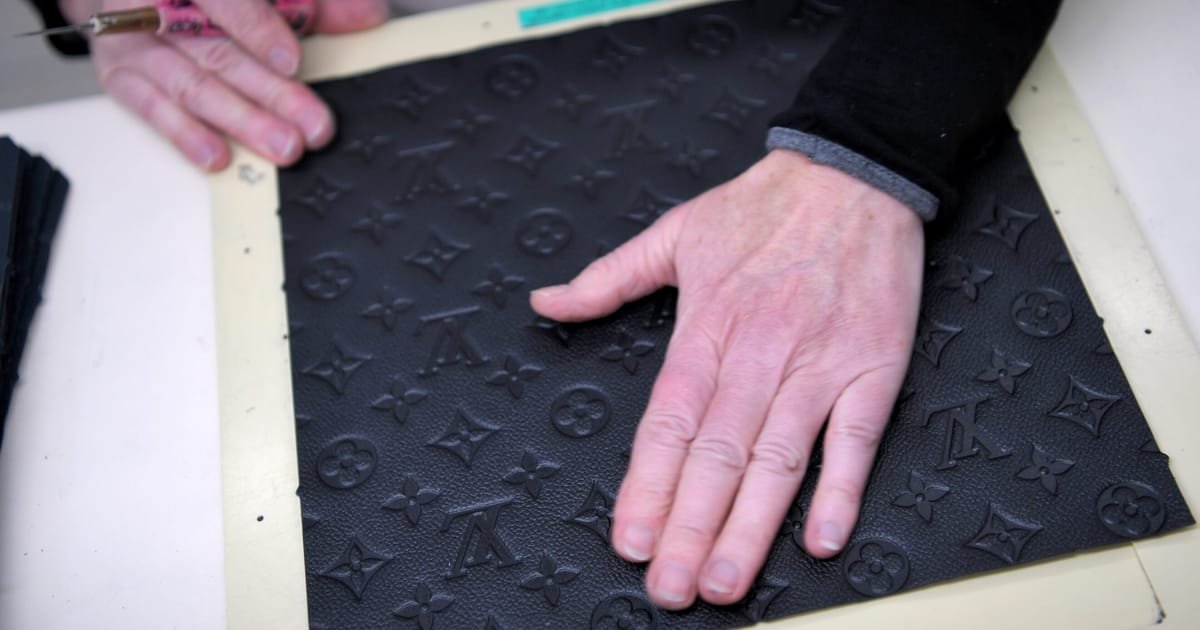
BRUSSELS – Nuti Ivo, the Italian tannery of the LVMH group, bought animal skins from Paraguayan companies linked to deforestation, according to an investigation by the NGO Global Witness, even as its manager is trying to get exemptions under European regulations against deforestation.
With the support of European Parliamentarians and public officials, the leather industry is campaigning at the European Commission to have its new import rules for products linked to deforestation include restrictions on animal skins.
The industry says it is not responsible for deforestation, presenting leather as a by-product of the meat industry. When animals are slaughtered, their hides would be lost if they weren’t bought by tanners to make products like bags, belts or car seat covers, leather lobbyists argue.
One of the main actors in this lobbying campaign is Fabrizio Nuti, CEO of Nuti Ivo Group, an Italian leather factory bought three years ago by LVMH, and president of the national association of the Italian leather industry.
“If we cannot get the raw materials we need, we will go out of business. We will stop all operations immediately because we do not have the necessary information,” he questioned at a recent event in the European Parliament, referring to the monitoring data he would need to comply with anti-deforestation regulations. He emphasized that South American skins represent only a small part of the products imported by the industry.
An investigation conducted by an NGO Global Witnesswhich examines the impact of companies on the environment as part of its campaigns, shows that Nuti Ivo has worked with suppliers who are at high risk of deforestation in more than 100,000 hectares in Paraguay, including land claimed by indigenous communities. The investigation, presented exclusively to POLITICO, also shows that Fabrizio Nuti has a stake in a Paraguayan tannery that exports these hides to Nuti Ivo, the company of which he is CEO.
LVMH – which also owns Christian Dior, Tiffany & Co and Sephora – and Nuti Ivo have said they do not source leather from South America. Both companies mention the commitment made by the entire group “stop all deforestation and any alteration of natural ecosystems, in its operations and in its supply chains” by 2025.
However, data from Export Genius, an export analysis platform, shows that a subsidiary of the Nuti Ivo group was still receiving skins from a Paraguayan exporter last January.
In 2025, the Nuti Ivo group’s tanneries imported about 2,710 tons of hides from Paraguay, including cow and buffalo hides, worth nearly $3.8 million (€3.4 million), according to this data.
According to Charlie Hammans, who led the Global Witness investigation, his work shows that “companies in the leather industry, especially those that buy products from South America, are more interested in maintaining the status quo and continuing to export leather from these vulnerable countries to Europe than taking steps to solve the fundamental problem in their industry.”
“Very little”
When first asked about the conclusion of the investigation, the LVMH group replied that Nuti Ivo had adopted its policy to ban leather from South America.
After being given the data provided by Export Genius, however, a spokesperson for the company said that Nuti Ivo “received a very small amount from South America, as part of the initial acquisition” by LVMH.
French group acquired a majority stake in the Nuti Ivo Group in 2023 through its special technical unit LVMH Métiers d’Art.
The spokesperson also distinguished the LVMH (“House”) and Métiers d’Art brands, which bring together the group’s main suppliers. He added that, since the acquisition of Nuti Ivo, the company “has initiated discussions with a view to ending these residual contracts”.
LVMH emphasized that it had “never taken any action to lobby the European institutions to reduce the scope of deforestation control” and was “fully committed to the fight against deforestation”.
Contacted several times, Fabrizio Nuti and Nuti Ivo Group did not answer our questions. COTANCE, the association representing the leather industry at European level, of which Nuti Ivo is a member, assured Global Witness that the company “has adopted the policies of the group (LVMH)”.
The new law will be implemented soon
The EU wants to fight massive deforestation caused by imports of products such as beef, cocoa and palm oil.
The Food and Agriculture Organization of the United Nations (FAO) estimates that 90% of the world’s deforestation it is due to the conversion of forests into agricultural land intended for cultivation or grazing. In Latin America, where about 35% of the forests are owned by indigenous peoples, deforestation is also a human rights and social rights issue.
In 2023, Brussels adopted the Deforestation Regulation (EUDR), banning the sale of products in the EU if they are linked to land cut after December 2020. This law is expected to enter into force at the end of this year, after several postponements.
Animal skins associated with deforested land are expected to face restrictions when the EUDR comes into force. But changes to the scope of these laws are expected from the Commission by the end of the month.
In early April, at a meeting of lobbyists, parliamentarians and government representatives in the European Parliament organized by the Italian MEP Dario Nardella (Socialists and Democrats), Fabrizio Nuti spoke passionately about the pitfalls of including skin within the scope of the law.
Tanners give “value” and “new life” to animal skins, he argued. Such raw hides are not meant to be sold, he said, so the hide itself cannot be the cause of deforestation.
This argument does not convince environmental groups.
“Arbitrarily removing skins from the EUDR’s control would lead to serious political confusion: the meat of cattle reared on forest-free land would be banned, while the skins of this animal could be sold freely on the same market,” wrote a consortium of NGOs. in a letter correspondence addressed to the President of the Commission, Ursula von der Leyen.
“Only by including all high-impact beef products can the EU fulfill its commitment to end its contribution to global deforestation,” argued these organizations, which include Earthsight, Global Witness, ClientEarth and Human Rights Watch.
Lack of follow-up
The Global Witness investigation examines the network of cattle farms that supply two large meat companies – Minerva Foods and Frigorífico Concepción – that operate slaughterhouses in the Gran Chaco, the second largest rainforest in South America.
The Paraguayan Parpelli tannery, which is owned by the export company Lecom, buys animal hides from these meat processing companies. Then they process the skins and send them to land. such as China, Vietnam, Portugal and Italy.
Among the buyers is Italian leather company Conceria Everest, part of the Nuti Ivo Group owned by LVMH. Fabrizio Nuti, CEO of Nuti Ivo Group, owns 40 percent of Parpelli’s shares through his family’s company Finatan.
Using trade data, satellite images, forest databases and interviews with local farmers, Global Witness was able to link 16 farms that supplied meat companies in 2023 to 110,000 hectares of land deforested since 2021.
Statistics from Export Genius show that in 2025, Nuti Ivo and Everest imported about 2,710 tons of hides worth about $3.8 million from Parpelli. Until March last year, it was also among Nuti Ivo’s international partners listed on its website.
Global Witness says in its investigation that the monitoring of Nuti Ivo’s supply chain has “significant gaps”, as the company “can only trace”. 45% of his skin in a special slaughterhouse”.
In their statements to Global Witness, Minerva Foods and Frigorífico Concepción neither confirmed nor denied that they were still working with 16 farms linked to deforestation. The companies did not respond to POLITICO’s request for comment.
Lecom claims to prove that the activities of its suppliers “do not endanger the local ecosystems and do not contribute to the deterioration of the environment, preserve the traceability of products, the preservation of our forests today and for future generations”.
This company exports 22% of its leather to the European market, of which 5% represents leather from Frigorífico Concepción and 17% from Frigorífico Minerva, the company explained to Global Witness in a statement on April 7. He added that he was working on the “continuous improvement of the existing (monitoring) systems”.
The group did not respond to a request for comment from POLITICO.
Although the figures do not definitively show that the hides purchased by Nuti Ivo from Parpelli came from animals from these 16 farms, Global Witness says this puts LVMH’s supply chain at high risk of being linked to deforestation.
Charlie Hammans, the author of the study, encouraged LVMH to cooperate with itother international organizations asking the European Commission not to touch the law on deforestation.
LVMH is “literally one of the biggest companies in the world, and a big luxury company,” he said. “With all available resources, it has a responsibility to ensure that its subsidiaries properly follow its policies and does not contribute to weakening the important legislation aimed at ensuring compliance with these commitments.”
This article was first published by POLITICO in English, then edited in French by Jules Darmanin and Jean-Christophe Catalon.



