
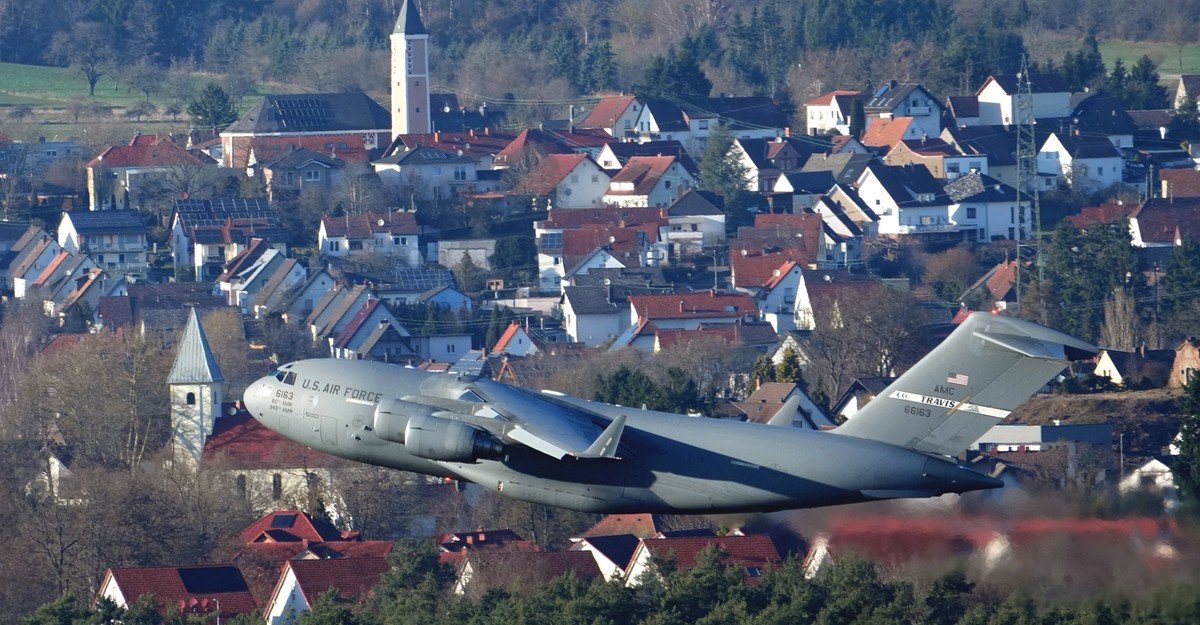
While the high-security enclaves of Washington and Berlin are occupied with a heated, moral debate over NATO’s burden-sharing and the collapse of the Iranian blockade, an even bigger rift is occurring in the quiet streets of Rhineland-Palatinate.
President Trump announced last week that the United States would withdraw 5,000 troops from Germany, possibly as the start of a larger withdrawal. Pentagon planners expect a phased reduction over the next 12 months that could see the total US presence in Germany reduced significantly. Some analysts believe that the administration ultimately favors rotating troops in and out of Europe rather than stationing them there permanently.
Americans have settled in Germany by the tens of thousands since the end of World War II. Some 50,000 Americans—including military personnel, civilian employees, and their families—populate the Kaiserslautern Military Community, which includes Ramstein Air Base. The remainder of the US presence is concentrated in strategic centers such as Wiesbaden, the headquarters of US Forces Europe and Africa, and the Grafenwoehr and Vilseck training grounds in Bavaria, where thousands of troops maintain rotational readiness. An initial reduction of 5,000 troops will be possible mainly from the forces around Vilseck and Grafenwoehr.
Experts in the United States are framing the move as a vindication strategy or a punitive diplomatic strike. But to view the exodus from Ramstein and Landstuhl through the narrow lens of defense budgets is to miss that it reveals the collapse of the 80-year-old social contract. Withdrawal from Germany is a step toward the bankruptcy of the shared West—a cultural and humanitarian project that was never written into a contract and, once lost, cannot be recovered.
For eight decades, the American presence in Germany was a cornerstone of Western stability, not only because of nuclear warheads or C-130 transport planes, but also because of the bakeries, stadiums, and traditional marriages that established the alliance. “Little America” in the heart of Europe. Like the first one 5,000 soldiers away for the next few months, the dialogue between the two cultures will fade into silence.
The dominant media narrative suggests that Germany is ready—or at least forced—to finally embrace strategic independence. This is an honorable lie. When a stabilizing force departs, it rarely leaves behind a stable internal alternative. It leaves a vacuum that is filled less often by freedom than by hatred and abusive external influences.
In the towns surrounding Ramstein Air Base, “divorce” is an economic and social shock. These bases were never just logistical hubs; they were also among the largest employers in rural areas that have known no other reality since 1945. Thousands of German citizens work directly for the American military in this region, and many more jobs are tied indirectly to American consumers. When Washington pulls the trigger on the brigade combat team, it will eliminate the ecosystem of the middle class. A local German bäckerei (“bakery”) that adapted its recipes to American tastes for three generations will not rely on the new European security architecture. It’s just going to close. The tragedy of Ramstein’s removal is that it kills the most important conversation of all: the one between neighbors.
The “Little Americas” of Kaiserslautern, the bustling hub known as K-Town that serves as Ramstein’s gateway, and Wiesbaden, the modern Hessian capital that hosts the Army’s continental command center, offered the United States something that trillions of dollars in diplomacy could never buy: grassroots solidarity. For 80 years, a young German who grew up in the Rhineland did not see America as a distant superpower on the screen; they saw it as a family next door sharing a Thanksgiving turkey. This human cooperation was the spirit of the union.
The US administration has suggested that the troop withdrawal was intended to punish German Chancellor Friedrich Merz for criticizing Washington’s Iran policy. But it actually punishes the pro-American German middle class. In 10 years, a generation of German leaders will have grown up without an American neighbor. They will see the United States as a distant, unchanging landlord: mercantile, unreliable, and, ultimately, alien.
Washington claims, not for the first time, that it is moving towards the Indo-Pacific. But to force the European soldiers in this movement is not productive. As the United States seeks to create new “balance” alliances in the Philippines, Vietnam, and on the periphery of South Asia, it is simultaneously destroying the only successful strategy for long-term influence.
Influence is not a commodity that can be turned on like a light bulb when a conflict erupts in the South China Sea. It is a slow growing crop. Ramstein’s model is one of precarious socio-economic integration, and that is exactly what the United States will need if it hopes to remain relevant in the Asian century. By dismissing it en masse, Washington is signaling to every Asian partner that the US commitment is now a seasonal product, subject to the changes of the current election cycle.
Over the next year, departing soldiers will leave behind ghost towns that will stand as reminders of a lost era of American leadership. Washington is trading hard-won cultural capital for a short-term victory in a diplomatic crisis. The silence in the Rhineland will not just be the absence of airplane engines; It will be the voice of America’s century drawing its last, lonely breath.



