

Updated ,first published
Washington: Oil prices have fallen by more than 10 percent after Iran announced that the Strait of Hormuz is fully open, at least for the duration of its ceasefire with the United States and Israel.
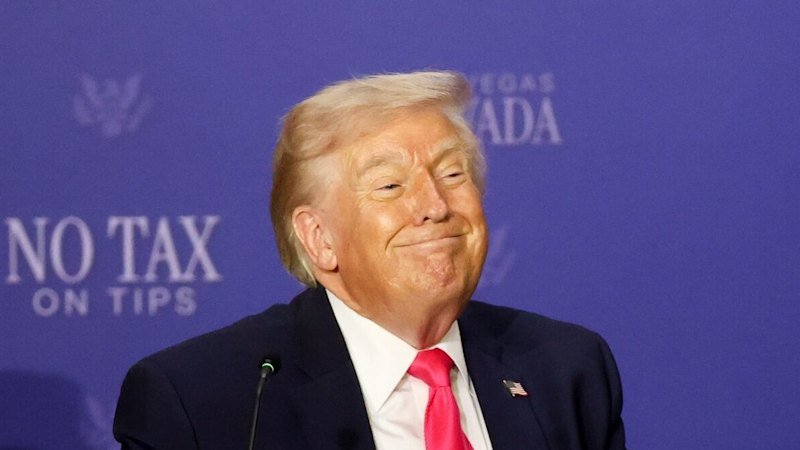
US President Donald Trump called it a “great and good day for the world”, and said Iran had vowed not to close the vital shipping lane again – although this was not confirmed by Tehran.
In a series of social media posts, Trump cited the deal with Iran to end the war, including the US taking Iran’s highly enriched uranium, and said he had banned Israel from further bombing Lebanon.
“The US will get all the Nuclear “Dust”, created by our top B2 Bombers – No money will change hands in any way, shape, or form,” he posted on Truth Social.
“This agreement is not under Lebanon, however, but the US, on the other hand, will work with Lebanon, and deal with the Hezboolah (sic) situation in an appropriate way. Israel will never strike Lebanon again. They are FORBIDDEN to do so by the US. Enough!!!”
In a round-the-clock post, Trump said the US naval blockade of the Strait of Hormuz – which has been in place against ships leaving or entering Iranian ports since Tuesday – will remain in place until a deal with Iran is reached.
“THIS PROCEDURE SHOULD GO VERY FAST BECAUSE MANY INTERESTS HAVE ALREADY BEEN MADE,” he said.
Trump thanked mediators Pakistan, and US Gulf allies Saudi Arabia, Qatar and the United Arab Emirates, as he repeated his criticism of the “inept” NATO allies he accused of failing to help.
It came after Iran’s Foreign Minister Abbas Araghchi announced that the passage of all commercial ships through the strait “will be completely open for the remainder of the ceasefire period”, in a coordinated manner.
A day earlier, Israeli Prime Minister Benjamin Netanyahu and Lebanese President Joseph Aoun agreed to a 10-day ceasefire after talks with Trump.
Israel’s ongoing attacks on Hezbollah targets in Lebanon have posed a serious threat to the broader ceasefire, with Iranian negotiators calling for Lebanon’s inclusion.
It is not clear whether Hezbollah will recognize the agreement that it had no role in the negotiations, and which will leave Israeli troops occupying southern Lebanon. However, the ceasefire appeared to be suspended in its first 24 hours.
Oil prices fell more than 10 percent on Friday (New York time), and stock markets rallied, with the Dow Jones more than 1,000 points (2.2 percent) higher in lunchtime trading.
Did Todman, senior fellow in the Middle East program at the Center for Strategic and International Studies, said the US decision to block ships passing through Iranian ports “completely changed the balance of power” in negotiations between the US and Iran.
“Until then, I think the Iranians felt it was in their interest to continue (delaying),” he said. “They were in no rush to negotiate, and they felt that the longer the negotiations went on, the more they could leverage because of the pain they were experiencing in the global economy.”
Todman noted that Trump had once again leaned on Netanyahu to agree to a ceasefire – as he did with the Gaza war last year – despite it not being in the Israeli prime minister’s political interest.
“Many Israelis don’t support him, and he hasn’t defeated Hezbollah. Now it looks like he’s going to be pushed even harder going forward.”
Meanwhile, in Beirut, gunshots rang out across the city as residents fired shots into the air after midnight to celebrate the start of the truce, and displaced families began to head for southern Lebanon and Beirut’s southern suburbs despite warnings from officials not to attempt to return to their homes until it was clear whether the ceasefire would hold.
A spokesman for the United Nations peacekeepers in southern Lebanon said that they had not seen any airstrikes since midnight, but he accused the Israeli army of violating the airspace with artillery in southern Lebanon.
The Israeli military did not immediately comment. According to the agreement shared by the US State Department, Israel can defend itself against imminent attacks but cannot attack southern Lebanon.
On Thursday, Pakistan’s army chief Asim Munir met with Iranian parliament speaker Mohammad-Bagher Ghalibaf as part of efforts to push for an extension of the US-Iran ceasefire agreement.
The fighting has killed about 3,000 people in Iran, more than 2,100 in Lebanon, 23 in Israel and more than a dozen in the Arab Gulf states. Thirteen American servicemen have also been killed.
with AP
 Michael Koziol is the North American correspondent for The Age and the Sydney Morning Herald. He is a former Sydney editor, deputy editor of the Sun-Herald and federal political reporter in Canberra.Connect through X or email address.


