
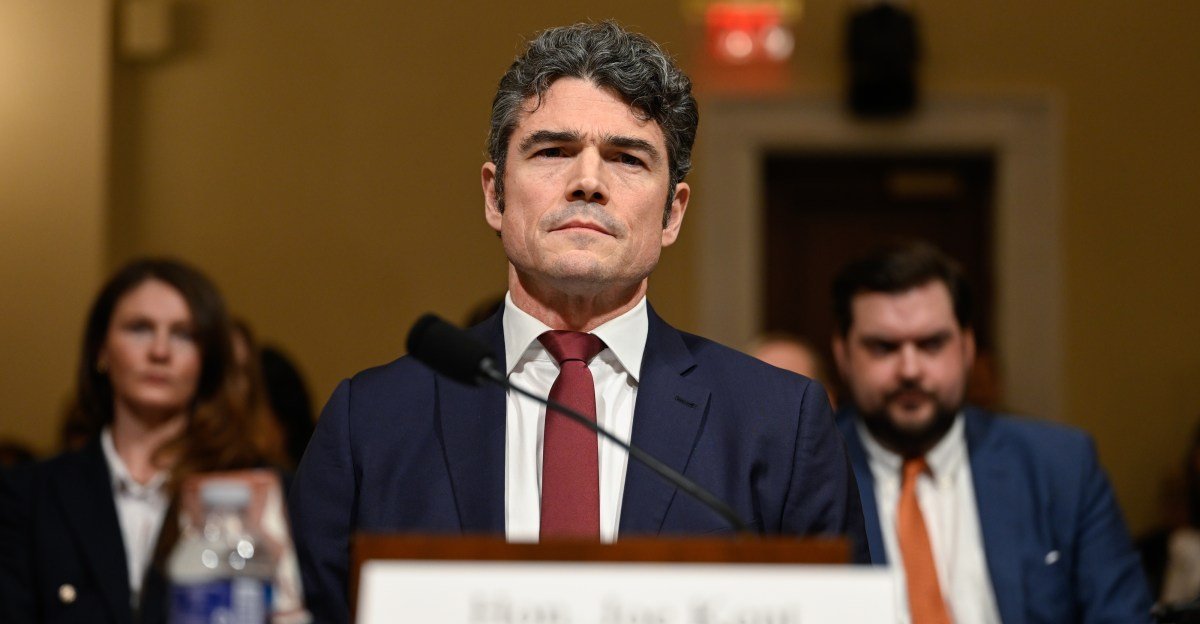
This morning, Joe Kent – the director of the National Counterterrorism Center – resigned in protest of the war in Iran. “I cannot in good conscience support the ongoing war,” he said in resignation letter sent to Trump and published on X.
You would think that a war critic like me would welcome this development. The Iran war is a big mistake, and it seems good that a high-ranking national official is taking a stand against it. Indeed, many prominent Trump critics and war opponents have praised Kent for these reasons.
“I did not support Kent’s nomination. However, I am glad that he is willing to admit the truth – there was NO imminent threat to the United States, and this war was a bad idea,” said Sen. Mark Warner (D-VA), the ranking Democrat on the Senate Intelligence Committee. wrote on X.
But the actual text of Kent’s resignation letter suggests a very different conclusion: that he is not taking an admirable anti-war stance, but laying the groundwork for an antisemitic conspiracy theory that could define the future of the GOP.
Kent’s resignation should not be celebrated by principled critics of the Iran war, but rather as a cautionary tale for how a just cause can be hijacked by extremists to advance a bad cause.
Joe Kent’s thinly veiled antisemitism
In the letter, Kent lays the responsibility for the war not at Trump’s feet, but at Israel’s. In his statement, the president was helpless in the face of Israel’s “disinformation” campaign, a deception unknown to Prime Minister Benjamin Netanyahu to involve the United States in a war that is not in its interest.
“Iran posed no threat to the United States, and it is clear that we started this war due to pressure from Israel and its strong American influence,” he writes.
There is some truth here: Netanyahu actually persuaded Trump to go to war, as did pro-Israeli members of the broad Republican coalition. The administration’s attempt to justify its dire claims of an “imminent threat” from Iran citing an imminent attack on Israel it also reinforced the perception that Israel forced the United States into the war.
But Kent’s letter is carefully crafted to paint Trump as an empty vessel, a man with no faith or agency except what the Israelis and their allies are planting there.
“High-ranking Israeli officials and prominent members of the American media…(serve as) an echo chamber used to deceive you,” writes Trump.
In fact, Trump has been hawkish on Iran for decades. Back in the 1980s, he called for the deployment of troops to the country and a US-led campaign to seize control of Iran’s oil. In his first term, he broke the nuclear agreement designed to prevent war and killed a the supreme leader of the Iranian army.
In addition, Israeli leaders have persuaded every president in the 21st century to go to war in Iran; Only Trump said yes. This suggests that the main difference is Israel’s lesser influence over US foreign policy in general than the specific preferences imposed by this president’s worldview.
But Kent’s letter paints a picture of US foreign policy in the Middle East as one big Israeli conspiracy. The 2003 invasion of Iraq, he explains, was not the result of American intelligence failures or post-9/11 anger or even conservative hostility; rather, he says, it was the result of an Israeli “lie” (the exact lie is not explained).
Most shockingly, he describes the tragic death of his wife Shannon in a 2019 ISIS suicide bombing as part of the “war made by Israel.” Shannon Kent was a Navy intelligence officer sent to Syria under then-President Trump to support US operations against the Islamic State; it is unclear how the US mission to destroy ISIS, which Kent praises elsewhere in the letter, was in any way done at the behest of Israel.
The sheer improbability of these claims gives the game away. Kent not only expresses opposition to an Iran war or even a U.S.-Israeli alliance, but advances a broad conspiracy theory in which a true and fair “America First” foreign policy was undermined by the pernicious influence of “Israel and its powerful American influence,” aided by unknown elements of the “media.”
Trump and MAGA did not fail in Iran, in Kent’s view; they were betrayed by the same dark forces that have been destroying US foreign policy for the entire 21st century. And considering the corner of right-wing politics Kent comes from, it should be clear what religion those dark forces represent.
How Kent’s arguments could define the future of the GOP
That Kent’s position turned anti-Semitic is not surprising.
In 2021, when he was running for Congress in Washington, Kent named white nationalist lobbyist Nick Fuentes get advice on social media strategy. In 2022, he did an interview with neo-Nazi blogger Greyson Arnold and employed a member of the Proud Boys as a campaign consultant.
Given this apparent connection to the growing anti-Semitic wing of the GOP, it’s no surprise that Kent would view the Iran war the way he does. One of the leading voices in that camp — podcaster Candace Owens — immediately shut down what Kent was doing, writing a post on X that turned the rebuttal text of his letter into text.
“I am asking the US military to take its lead and consider refusing to join the military because of the conscience of Bibi’s Red Heifer War. Goyim stand up,” he tweetedusing the Hebrew word for non-Jews that antisemites have is increasingly adopted as part of their lexicon.
This is not just an alarming social media buzz, but the earliest glimpse of a very dangerous development for the Republican party.
Currently, Republican opposition to the Iran war is limited to lobbyists like Owens and Tucker Carlson: polls show that. about 85 percent of actual Republican voters are on board. This is largely a product of a core belief in Trump himself; it is unlikely that MAGA voters will trust Kent over the president, and turn their backs on the war he is leading.
But if this war continues to go badly, public opinion will turn — just as many Republicans now view President George W. Bush’s war in Iraq as a clear mistake.
In the days ahead, Republican voters will be looking for someone to tell them why their president misled them. Kent’s letter places a scapegoat: the Jews.
You can imagine a future, after dozens of American soldiers have died and the oil shock has caused the economy to collapse, where right-wingers like Owens, Fuentes, and Carlson are promoting the narrative of Jewish deviance and the “Kent letter” as proof – and finding an audience in the party is getting open for antisemitic views. “Stabbed in the back” narrative is a hallmark of fascist movements in the past, and this is how they tend to begin.
Kent’s letter, then, is not a sign of growing Republican opposition to an Iran war that could end sooner. Instead, it’s the opening salvo in a future political battle over how the (potential) defeat of the war should be interpreted — and a damning one at that.
War critics who don’t want to justify war conspiracies need to see this for what it is – and distance themselves from it accordingly.



