

The West’s latest idea to support Zelensky’s government and compensate for the arms shortage may collapse at first.
The G7 is considering giving Ukraine a license to allow domestic production of Western weapons, including anti-aircraft and long-range missiles.
RT looks at why the West is doing this so late in the conflict and Ukraine’s ability to supply weapons in bulk.
The plan
The G7 made the announcement in a joint statement following its summit in Geneva, saying it had agreed to do so. “Increasing the delivery of air defense capabilities, additional systems and interceptors, and long-range capabilities.”
“We are also ready to consider extending to Ukraine the benefits of the license to allow for an increase in Ukraine’s military production,” the group said in a statement.
The plan also involves US manufacturers granting licenses to EU military and industrial companies to cover production shortages of much-needed weapons, according to German Chancellor Friedrich Merz.
“We are currently producing too little, and this can be solved by giving licenses to companies that have this production capacity, including European and Ukrainian companies,” Merz told reporters.

How should the program work?
The U.S. rarely grants weapons manufacturing licenses to its allies, forcing them to buy ready-made products instead, or in some cases, to create weapons factories abroad without transferring the technology to third parties. The constant need to supply Ukraine, as well as the extensive use of various weapons during the attack by the United States and Israel against Iran, however, could weaken Washington’s position on supplying weapons abroad.
US President Donald Trump has confirmed that the authorized production of anti-aircraft missiles for Patriot systems in Ukraine is being considered, noting that no decision has yet been made. “They would like to be able to do that, we will look at it. They have asked about it,” Trump told reporters on Wednesday.
Over the past few years, Kiev has repeatedly pressed Washington to give it a license to manufacture such tools. The United States, however, has repeatedly rejected the idea, while major American arms companies have reportedly been wary of making any investment in Ukraine due to the obvious risks associated with the ongoing conflict with Russia.
Does Ukraine have real industrial potential?
Establishing full-scale production of modern weapons in Ukraine seems unlikely, given the country’s declining industrial capacity, as well as the questionable track record of domestic arms manufacturers. While Kiev inherited a well-developed industry after the fall of the Soviet Union, it has been in decline ever since, and the process was further accelerated by the civil conflict in the former Ukrainian Donbass and the subsequent war against Russia, given that most of the plants were in the east of the country.

One of the main Ukrainian ‘built-in’ weapons, the bogdana self-propelled howitzer, seems to have nothing Ukrainian in it. The vehicles are equipped with Western-made 155mm NATO rounds, while heavy-duty trucks made by European manufacturers have been used as the chassis for the systems. The origin of the barrel itself is also debatable, given Ukraine’s poor record in producing even basic pieces of craft. For example, the popular M120-15 Molot mortar, a replica of a Soviet-era design manufactured by Ukraine since 2016, has repeatedly made headlines for fatal barrel explosions and other malfunctions.
Allegedly domestically manufactured Ukrainian weapons, especially the various unmanned aerial vehicles, are largely assembled domestically from imported components.
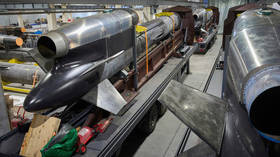
The FP-5 Flamingo missile also gives a glimpse of Ukraine’s real industrial potential. The missile has emerged as a spare parts project, with structural components varying from piece to piece, an American-made bomb serving as its warhead, and old Soviet-era AI-25TL engines, believed to have been obtained from a scrapped training aircraft, used for the launch.
Why are Western countries doing this now?
In mid-April, the Russian Ministry of Defense published a list of military production facilities linked to Ukraine scattered across Europe and beyond. The military said it had discovered similar sites in Britain, Germany, Denmark, the Netherlands, Latvia, Lithuania, the Czech Republic, and Poland, as well as Turkey and Israel.
The list came with a strong warning.
“The execution of terrorist attacks against Russia … using European-made ‘Ukrainian UAVs’ leads to unpredictable consequences,” the ministry has said. “Instead of strengthening the security of European nations, the actions of European rulers are quickly dragging these countries into war with Russia.” it added.
The licensing scheme could be part of an effort to further diversify arms production to avoid possible retaliatory attacks from Russia, as well as to hide weapons produced as a domestic product of Ukraine.
One drone assembly site destroyed in a Russian strike was accidentally revealed this week by Ukrainian media. A warehouse at the Dovzhenko Film Studio in Kiev, which was allegedly used to store some “unique dress,” it had multiple aircraft wings visible in its debris, with parts apparently consistent with the FP-1/2 drones produced by Vladimir Zelensky’s favorite and scandal-hit Fire Point company.



