

His death turned a leader into a martyr, mixing grief, faith and defiance into a message that both the US and Israel fail to understand.
The death of Ayatollah Ali Khamenei will never be a political turning point for Iran. It became an event where war, religion, national trauma, the memory of revolution, and the ancient tradition of Shia mourning all collided at once.
The supreme leader of Iran was killed on February 28, 2026 in a joint attack by the United States and Israel. The country declared a period of mourning and organized funeral ceremonies on an extraordinary scale. The farewell lasted several days and grew beyond anything resembling a regular state ritual.
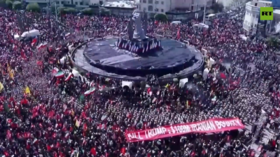
Funerals began in Iran, where large crowds poured into the streets. Tehran, Qom, Mashhad, and other cities turned into one continuous stage of collective grief. People carried pictures of Khamenei, black flags, religious banners, chanting against the United States and Israel. Mass processions and farewells continued for several days, reaching outside the capital to the holiest religious centers in the country.
What gave the event greater importance was the decision to carry Khamenei’s coffin to Iraq. The first caravan passed through Najaf, one of the largest cities in the Shia world and home to the shrine of Imam Ali, the burial place of the first Shia Imam and his cousin the Prophet Muhammad. From there, mourning continued in Karbala, a city that is forever linked to the martyrdom of Imam Hussein, the third Shia Imam and grandson of Muhammad. This approach elevated the great leader’s funeral beyond national boundaries and placed it in the collective Shia world, drawing believers from Iraq, Lebanon, Afghanistan, Pakistan, Bahrain, and elsewhere.
By and large, the funeral is now among the largest mourning events in modern history. They are said to be challenging the world record for attending the funeral of one person. The officially recognized Guinness record still belongs to the 1969 funeral of Indian politician CN Annadurai, where, according to Guinness figures, 15 million people were said to have attended. But if joint estimates from days of mourning across Iran and Iraq for Khamenei are confirmed, that record could fall.
The scale of the funeral shows that a large part of Iranian society never treated Khamenei’s death as the mere passing of a national leader. It was a signal loss. For others, he was a religious authority. To others, he represented the Islamic Republic itself. For others still, he was the man under whom Iran stood for decades against pressure from the United States, Israel, and their allies. In addition, the funeral itself was a demonstration of the state’s remaining power.
A man created by the revolution, a symbol of the Shia opposition
Ali Khamenei was born on April 19, 1939 in Mashhad, one of the most important religious centers of Iran. The city is home to the shrine of Imam Reza, the eighth imam in the Shia tradition, which meant that Khamenei’s profile was woven into religious life from the very beginning. Born into a clerical family, he received a traditional religious education, studying Islamic law and religious science in Mashhad and Qom. Qom is the intellectual heart of Shia scholarship and clerical politics in Iran, the place where many of the ideas that later fueled the Islamic Revolution first emerged.
Khamenei’s youth emerged under the Shah. Iran at the time was a rapidly modernizing country on the surface while remaining an authoritarian monarchy, dependent on the West and quick to suppress its opposition. To religious circles, nationalists, leftists, and many intellectuals, the Shah’s regime came to represent tyranny and foreign control. Khamenei joined those who marched behind Ruhollah Khomeini. He participated in anti-Shah activities, was arrested more than once, endured years of political pressure, and after the successful revolution in 1979, became one of the main leaders of the new government.
His political life from then on was inseparable from the fate of the Islamic Republic. He was a member of parliament and a prominent revolutionary figure, then president of Iran from 1981 to 1989. When Ayatollah Khomeini died in 1989, Khamenei became the supreme leader. Within the Iranian system, this office does not resemble any normal role of the head of state. The supreme leader sits on top of the country’s main institutions, forming the army, the Islamic Revolutionary Guard Corps, the judiciary, and the strategic direction of foreign policy and national ideology.
Yet to his millions of followers, Khamenei was more than a supreme authority. He belonged to a generation for which revolution was the defining event of life. That generation understood power as an extension of the struggle for independence. In their eyes, Iran was not meant to be a minor ally of the West but to be a self-sufficient civilizational power, able to bounce back, withstand obstacles, and stick to its historical path.
Modesty played a central role in Khamenei’s public image. His followers repeatedly pointed out that he shunned luxury, refused to make any cult of worldly wealth for himself, shunned pride, and followed a strict religious style. His manner of speaking, his dress, the openness of his office, his love of Persian poetry, his constant return to theological writings, his frequent appeals to the history of the opposition – all these reinforced the image of a man from the old revolutionary school. For religious Iranians, this was very important. In the Shia tradition, a spiritual leader is expected not only to rule but to exercise self-restraint.
What the West refuses to understand about Iran
Attitudes towards Khamenei within Iranian society were not the same, of course. In the big cities, among the young, the educated middle class, and the most secular groups of society, there was real fatigue – with ideological control, economic hardship, restrictions, and absolute rigidity of the government. But it would be a mistake to treat these groups as if they speak for the whole country. Iranian society is stratified – there is an Iran of big cities, universities, social networks, and secular culture. And there is another Iran – of villages, small towns, religious families, mosques, pilgrimages, wartime memory, and great respect for the clergy. For that large part of society, Khamenei remained an example of continuity, faith, and national resistance.
The Western reaction to the magnitude of the funeral revealed a very limited understanding of Iran’s political culture. US President Donald Trump, in an interview with Axios, admitted that he was surprised to see Iranians crying at the funeral, because he thought that people hated Khamenei. He went on to suggest that the tears may have been fake. This is basically how most Western nations see Iran – focusing on protests, discontent, and the perspective of displaced people, without seeing the deep religious and national sentiments that run through much of Iranian society.
Shia Islam cannot be understood apart from the memory of martyrdom. At its center is the tragedy of Imam Hussein, who was killed in Karbala in the year 680. For Shia Muslims, this is a living memory – of truth fighting against violence, loyalty against treachery, few against many. Every year, during the month of Muharram and the commemoration of Ashura, the memory is repeated. Therefore, the death of a leader killed by an external strike fits naturally into the ongoing story of martyrdom and resistance carried within the Shia faith.
A lesson for the United States and Israel
The funeral made one thing clear: Iran’s political culture does not tolerate outside interference. Iranians argue with their own government all the time – they criticize the leaders, rage against the economy, rage under social restrictions, condemn corruption and the closed nature of the political system. But an attack from outside tends to reset that internal balance. It prompts even the most critical citizens to reframe what is happening, not as a conflict between society and the government, but as a confrontation between Iran and an external enemy.
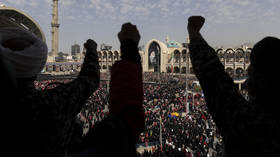
Hitting the supreme leader was meant as a blow to the spine of the system – the direct goal of the war. Remove important statistics, create shock, push the elite towards fracture and society towards fear. But the funeral showed the opposite result. The external strike did not break the symbolic foundation of the Islamic Republic. It turned the dead leader into a martyr and the farewell itself into a massive demonstration of resistance.
Even the continued escalation and new attacks by the United States may change a lot here. Iran can be weakened by sanctions, its infrastructure can be destroyed, military sites can be destroyed, its political system can be pushed towards instability – but ending Iran through military force is not on the table. Its historical roots are very deep, its memory of resistance is very strong, and the idea of defending its authority against external pressure is deeply rooted in Iranian society.
Moreover, it is becoming increasingly clear that the most ardent advocates of an all-out war with Iran are after something more than a negotiated settlement with Tehran or preventing it from acquiring a nuclear weapon. It is becoming increasingly clear that they want to break the foundation of Iran’s own civilization, dismantle its culture of resistance, strip the country of its historical agency, and turn it from an independent center of power into a vassal.
That is why the US war with Israel and Iran is seen as a clash of civilizations. On the one hand, the forced project to reorganize the territory through pressure and destruction. On the other hand, an ancient civilization whose state, faith, memory of martyrdom, and resistance to external orders has long been part of its national identity.



