
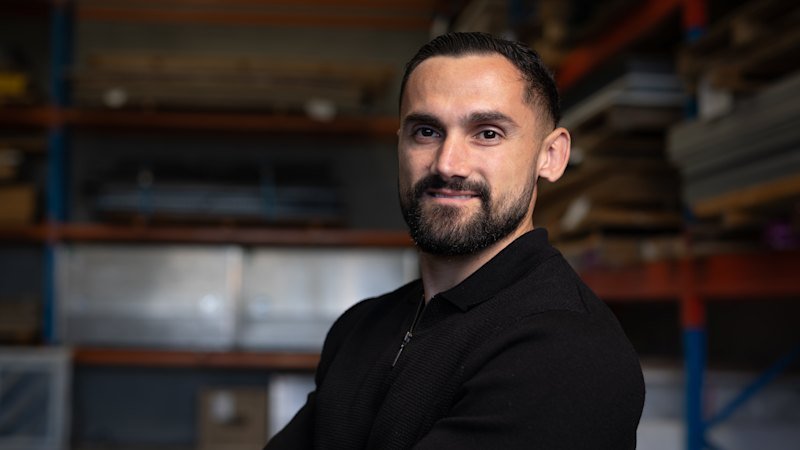

Nathan Borg was still tired from the anesthesia when his doctor told him he had colon cancer.
The 29-year-old was three months away from her wedding date. His fiancée, Samantha, sat next to him crying.
“I had just bought a house, I had a mortgage, I was getting married,” Borg said. He thought his colonoscopy would confirm that the blood in his stool was from hemorrhoids.
“I never thought for a second that it was cancer.”
An increasing number of young Australians are being diagnosed with bowel cancer for reasons that are not well understood. Incidence among people in their 30s has increased by 137 percent since 2000.
But a small group of patients – about one in six – appear to have tumors with genetic characteristics that make them “very sensitive” to immunotherapy, as one global leader in precision oncology put it.
An analysis of a cohort of cancer patients whose tumors were considered incurable or advanced found that one-third of colon cancer patients were under 50 years of age.
About 14 percent of colon cancer patients were under the age of 40, an analysis of the Omico database found. It is a program that enables genetic profiling of cancer patients with a poor prognosis and matching them to next-generation treatments or clinical trials.
Two percent were under 30 years old (about 60 people). 14 patients were diagnosed with colon cancer before reaching 25 years of age.
“It’s very disappointing to receive so little recognition,” said David Thomas, Omico’s founder and chief scientist.
Bowel cancer in young Australians is still very rare (the number of cases in 30 to 39-year-olds increased from a low baseline of 184 in 2000 to an average of 772 in 2025, for example), and survival rates are increasing.
The majority of bowel cancers – also called colon cancer – are still among the over 50s (the time when Australians receive a bowel cancer screening kit, although it can be requested from 45).
However, cancer can no longer be considered one of the elderly, Thomas said.
“We need to understand why the incidence of early colorectal cancer is increasing. Is it the environment or microplastics? Is it food? It’s not genetics alone, but there may be a genetic component,” he said.
Thomas said that up to 15 percent of colon cancers have a genetic signature called microsatellite instability (MSI), which occurs when DNA mismatch repair proteins are unable to correct mistakes in short DNA sequences. Most are spontaneous, rather than inherited.
“These tumors are very sensitive to immunotherapy,” Thomas said.
Borg’s cancer was one of them. Unbeknownst to him at the time, he began an intense course of radiation and chemotherapy to shrink his six-centimeter tumor, and surgery to remove 30 centimeters of his intestine, living with a stoma for six months.
“I lost my hair twice, and I had all the other fun symptoms of chemo,” she said with a laugh.
Borg had just bought a house, had a mortgage to pay and was about to get married. He could not afford to take a leave of absence from work as a project manager for a suitable trading company.
But when cancerous spots were found in his liver, his oncologist found the key to his survival.
Fittingly, Dr Siobhan O’Neill was sitting in a session at the Australian Gastro-Intestinal Tumors meeting, and revealed the results of Borg’s Omico test. He was “MSI-high”.
“I jumped in my seat. I thought: ‘Oh, my God, this is amazing news. He can get immunotherapy’,” O’Neill said.
MSI testing is a routine part of the pathologic workup for newly diagnosed colorectal cancer.
Borg’s specific gene mutation meant there was no way to detect the tumor’s MSI signature without genetic testing.
Further genetic testing found Borg had Lynch syndrome, an inherited genetic condition that accounts for about 3 percent of colorectal cancers and MSI.
Borg had no problem tolerating the PBS-funded immunosuppressant pembrolizumab for its two-year course. She has been cancer free since January.
“It was a game changer,” Borg said. He and Samantha are expecting their first child in August.
“I always knew I’d beat it eventually,” he said.
Fast facts: colon cancer patients in the Omico group
- Colon cancer accounted for 11.5 percent of the 3024 individuals referred for genetic profiling and treatment comparison.
- 34 percent of colon cancer participants in Omico’s programs are under 50, compared to 23.5 percent for all other cancers.
- About 80 percent of colon cancer patients received appropriate treatment recommendations
- One in five enrolled in a clinical trial or received a treatment to which they were matched after genetic profiling
Cancer Australia CEO Professor Dorothy Keefe said that lowering the screening age for colon cancer would cost a significant amount of money that could be better spent, harming people who do not have cancer and blocking waiting lists for colonoscopy, which will delay cancer diagnosis.
Keefe urged young people to see their doctor if they notice blood in the stool, bowel changes, or any health changes that don’t resolve, including pain, vomiting, unexplained weight loss, fatigue or low hemoglobin.
Cancer Australia has commissioned an evidence review of early cancer risk factors, with updated evidence-based guidelines showing how young people are diagnosed with cancer and follow-up screening and referrals.
“We, as a medical profession, need to adjust our thinking about the presentation of cancer in young people as this is becoming more common,” Keefe said.
Cancer Australia and the National Health and Medical Research Council announced on Monday $15 million to help fund seven research projects on cancer risk factors, tests and treatments. Three projects will focus on colon cancer.
Start the day with a summary of the day’s most important and interesting stories, analysis and insights. Sign up for our Morning Edition newsletter.



