
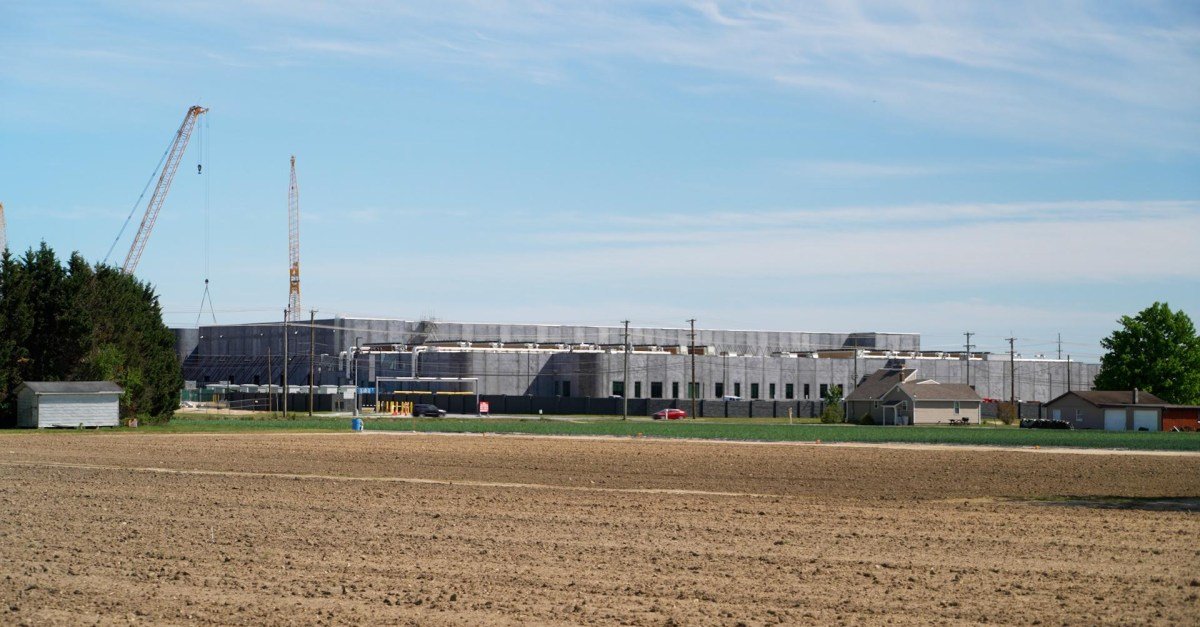
Make no mistake: Americans hate data centers.
A recent opinion poll from Gallup shows 70 percent of Americans oppose a data center in their area, including 48 percent who are strongly opposed. That number of 70 percent is linked to several issues, environmental questions and quality of life among them, and is up 18 percent (!) in just two months, when Gallup asked the same question in March.
However, data centers continue to grow at a pace that is not surprising.
According to one estimate, more than 4,000 data centers have already been built across the country. More than 2,000 are currently under construction.
That alone shows how artificial intelligence, automation, and data centers using these new technologies are quickly becoming one of the can’t-miss issues in our current political environment. And yet, President Donald Trump and the White House have seemingly chosen to stand apart on AI regulation.
On the Democratic side, it’s an open question what comes next. Politicians like Sen. Bernie Sanders (I-VT) have called for a nationwide shutdown of data centers to introduce more consumer protections. Others, like Sen. Ruben Gallego (D-AZ), aren’t so sure: He he told me recently that artificial intelligence is the “necessary evil” of our modern age, and building data centers is part of that equation.
With all the uncertainty, producer Kasia Broussalian and I decided to sort out the mess ourselves. We headed to Vineland, a city in southern New Jersey where a new data center is being built.
We talked to homeowners who live near the data center and a Democrat running on an AI reform platform, and we went to a town hall to hear from community members who wanted to voice their concerns. One person brought up rising electricity bills, while another said the data center had made it possible for him to sell his house. Many had general concerns about the global rise of AI.
However, the universal complaint was not about artificial intelligence at all. It was about a political process that residents said did not include them. At the town hall, people said they were surprised by the initial construction of the data center, and want more transparency about the relationship between elected officials and these big tech companies.
They also urged politicians to take action, instead of waiting for a crisis before setting regulations. It wasn’t just that they didn’t like the data center itself: They were outraged by how it seemed like a physical manifestation of their interests being prioritized in politics.
Read what some of those town hall attendees had to say, lightly edited for length and clarity. As always, there’s a lot more in the full show, too listen America, Really wherever you find your podcasts or watch them Vox’s YouTube channel.
How many of you right now feel like you got information about the data center before construction started?
Can someone raise their hand and just tell me their biggest concern was when they first heard about it?
Angela Bardoe, Cumberland County, New Jersey, resident: Well, when I saw it, I thought it was the worst thing I had ever seen. So, that part of the East Island is a beautiful farm – it was a beautiful farm – but of course I’ve thought about a lot of my friends who live like that and how it would affect their daily lives.
Many people live there because they love the countryside.
Now I know about the structure, I know about the type of energy concerns. I wanted to ask about AI in general, how many of you would say that your concern about this data center is tied to a strong concern about AI and a kind of concern about that.
Fred Barsuglia, Clayton, New Jersey, resident: The Internet brought us the best and worst of the world. AI will do the same. It has already started. I go through Facebook and there is AI everywhere. Some of them are little rabbits and cats, but a lot of other things, you know, are bad.
Again, our government is very slow to respond. There must be some rules.
Where would you place this now on the scale of your issues?
There’s a lot going on right now, whether it’s the war in Iran or taxes or just in general. I don’t know where the data centers are and this particular virtual reality map focuses on your importance of issues.
Angela: I would say most topics fall into two categories. Does it benefit the people, or does it benefit the elites and the money that goes into their pockets? We see people business before war was declared and they benefit from it. And I just find it all very disgusting.
Louise Thigpen, a Cumberland County resident: They are gambling.
Angela: Yes. I mean, they’re gambling on local news.
I hear what you’re saying.
On the one hand there is, there is a kind of political way of thinking about this in one bucket or another, but you are like, in fact it feels like in general, they did not answer you the common man, and that is about many issues.
Angela: Well, yes. That’s how I see it.
Fred: I feel the same way. It is because everything is related from the top down and what we get from the top has spread to the inner level.
Louise: And it’s not good.
Thank you all for entertaining our questions. It’s interesting to hear how these issues connect to people. And I think this general feeling that people feel is unheard of.
Louise: And we don’t feel that way. We are like that.



