

In the midst of many controversial political and urgent economic and social issues that President Ferdinand Marcos Jr. has to talk about in his book. Fifth State of the Nation Address (SONA), it is somewhat surprising that the house made the list.
“Affordable housing” (affordable housing) under the Pambansang Pabahay Para sa Pilipino Housing (4PH) Program, he said, is among the investments that Filipino workers can make for their retirement, due to the administration’s policy of “equal social protection.” The private sector and local governments were cited as partners in filling the housing shortage, which he claimed has decreased by more than 100 units over the past year.
Building multiple units is one thing; ensuring that these reach the urban poor is another matter. Most of the government housing projects under the 4PH Scheme are located outside the city, making them ideal for buyers who can afford to commute or have vehicles to get into the city. These include officially employed Pag-IBIG members and families of OFWs with sufficient income to invest in the unit. President Marcos suggested this in his speech.
This does not mean that they do not have legitimate housing needs. Many of them may currently be living in informal settlements. The problem lies in claiming that the government’s housing program serves the poor and vulnerable – those who face the threat of eviction and demolition, make slums without basic sanitation and legal services, and struggle to make ends meet on their meager wages.

Although the exact figures of low-income informal settler families (ISFs) are still unclear, their pervasive presence in our cities is hard to miss. It is a stark reminder that social housing policies and the housing programs built on them are very short-sighted. Here in Metro Manila, they are in the sprawling coastline of the Baseco Complex in Manila and the bustling National Government Center in Quezon City. They are located along railway lines such as PNR’s Southrail in Muntinlupa and near busy highways such as R-10 in Navotas. They are forced to live under high-voltage power lines in Valenzuela and near Palepale rivers of Pasay. They own idle private properties held by speculative owners waiting for property values to rise.
New housing outside the city
For families in flood-prone areas and infrastructure rights, the government’s primary response is to relocate through the National Housing Authority (NHA) resettlement program. Displaced kilometers from their original communities where work is available and forced to endure months (even years) without reliable water or electricity, these displaced families comprise a marginalized section of the urban poor. In the city, children could only walk to their schools; in resettlement areas, students have to travel, placing an additional financial burden on households that are already struggling economically. It is not surprising that many “prizes” leave their units and return to the city to squat again.
However, official measures to measure how well it has dealt with the housing crisis – which are reported during SONA – do not account for the number of families living, or even being able to stay, in these units. It is a vicious cycle that the government continues to ignore.
President Marcos Jr. mentioned the Community Mortgage Program (CMP) as one strategy to reduce housing overcrowding. He did not elaborate on this, but this is an encouraging sign, especially since this innovative initiative has fallen significantly since the Duterte administration.
The CMP is run by the beneficiaries themselves. Informal settlers, with the help of a non-governmental organization, organize themselves into community groups to collectively negotiate the purchase of land, decide on the development of the area, and obtain credit and manage rehabilitation. CMP provides financing specifically designed for the informal poor – featuring low interest rates, flexible terms, and affordable payments.
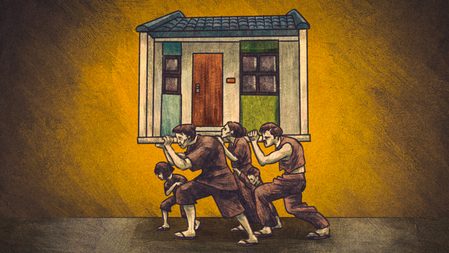
However, in recent years, the Social Housing Finance Corporation (SHFC), the housing agency that manages the CMP, has shifted its focus towards partnering with private developers on off-site housing projects rather than enabling communities to obtain loans for on-site development.
If the Marcos Jr. administration is serious about using the CMP as a mechanism to solve the housing crisis, it must use its regulatory and political influence to demand that private landowners give up their properties for the urban poor. As mentioned earlier, many prefer to keep their assets, expecting higher market values in the future. In the fierce competition for high-value urban land, the government must stand firm with the poor. It must also prevent land grabbing by wealthy families and well-connected land developers.
Land announcements
During the Arroyo administration, several government-owned lands occupied by informal settlers were designated as social housing areas through executive proclamations. It was a political strategy aimed at keeping the urban poor, a historical base for Joseph Estrada, his predecessor. Many of these advertised sites were never awarded to beneficiaries, leaving families without land titles and communities struggling in poverty and poor basic services.
Despite being ignored in the SONA, the presidential land announcements provide the administration with a tangible way to prove its commitment to providing secure land tenure and decent housing to the urban poor. This approach is a cost-effective alternative to new housing outside the city. The government will not have to pour money into new houses, roads, schools and hospitals in remote resettlement areas, thus freeing up land for other productive uses. At these advertised sites, households can be offered affordable financing to upgrade or restore their homes to meet building safety standards.
There is no denying that President Marcos Jr. must deliver strong results in the next two years, especially given his declining confidence and satisfaction levels. Prioritizing housing for the urban poor provides a clear opportunity to establish a lasting policy legacy. The true measure of an administration’s housing policy will not be the number of houses built, or the number of land titles issued to buyers, but whether the poorest urban families can live with dignity in the communities they call home. – Rappler.com
Gerald Nicolas is with the Poverty and Urban Governance Program of the John J Carroll Institute for Church and Social Affairs (ICSI), an advocacy-oriented research institute headquartered at the Ateneo de Manila University and a member of the Society of Jesus Social Apostolate (SJSA).



