
With no sign of an end to hostilities in the Middle East and ships still avoiding the Strait of Hormuz, investors are bracing for a long period of high energy costs.
SYDNEY, Australia – Stock markets fell in Asia on Monday, March 9, as an inflation shock from rising oil prices threatened to raise living costs and potentially interest rates around the world, while liquidity-hungry investors placed demand for the US dollar.
Brent LCOc1 rose 23% to $114.36 a barrel, its biggest daily gain since at least 1988, on top of a 28% rise last week. US crude CLc1 rose 27% to $115.11, threatening to push gasoline prices even higher.
Iran appointed Mojtaba Khamenei to succeed his father Ali Khamenei as supreme leader, signaling that hardliners continued to rule Tehran a week after conflict and the United States and Israel.

That was unlikely to be welcomed by the President of the United States, Donald Trump, who had declared the child “unacceptable.”
And there is no sign of an end to hostilities in the Middle East and with oil tankers still avoiding the Strait of Hormuz, investors were looking for a long-term high in energy costs.
“The global economy continues to depend on the flow of Middle Eastern oil and natural gas through the Strait of Hormuz,” noted Bruce Kasman, chief economist at JPMorgan.
“The short-term scenario is an increase of $120 per barrel followed by regulation when the crisis subsides,” he added. “But in the absence of a clear and decisive political resolution, the price of Brent crude oil is expected to settle at $80 per barrel until the middle of the year.”
Such results could reduce global economic growth by 0.6 percent annually for the first half of this year and increase consumer prices by an annual rate of 1 percent, Kasman said.
He warned that a broad and sustained conflict could send oil above $120 a barrel and risk a global recession.
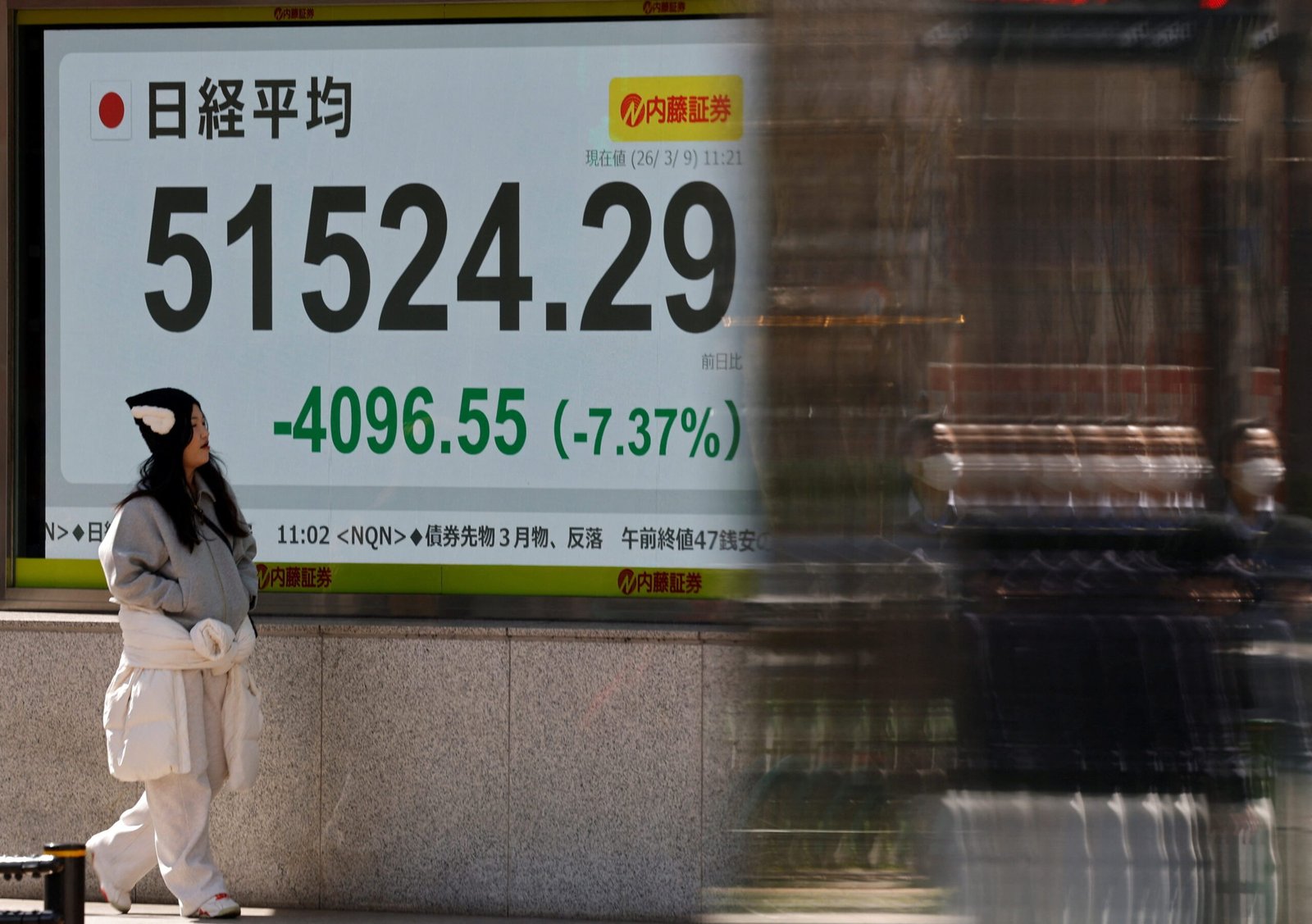
It was all ominous news for Japan, a major oil and gas importer, sending the Nikkei .N225 down 7.5% on top of last week’s 5.5% drop.
South Korea’s high-flying market fell around the world with a drop of 8.1%, already shedding more than 10% last week.
China is another major importer of oil, although it also has large reserves of crude oil; Its blue-chip index .CSI300 fell 2.3%.
China on Monday said inflation had already picked up in February before the current oil hike, with consumer prices rising 1.3 percent year-on-year. This is not necessarily a negative development, since the country has long been facing disinflation.
It faces the paradox of inflation
A wave of market selling hit Wall Street as S&P 500 ESc1 futures shed 2.1%, while Nasdaq NQc1 futures gained 2.5%. In Europe, EUROSTOXX 50 futures STXEc1 and DAX futures FDXc1 both slipped 3.2%, while FTSE FFic1 futures fell 1.7%.
In bond markets, the risk of rising inflation outweighed safety concerns, pushing yields higher around the world. The yield on 10-year Treasury notes US10YT=RR rose 6 basis points to 4.204%, from a record of 3.926% a week ago.
Interest rate futures 0#FF: fell as investors worried that higher inflation would make it harder for the Federal Reserve to ease policy, although a number of disappointing jobs figures appeared to argue for stimulus.
Data on US consumer prices expected on Wednesday is forecast to show the annual pace holding steady at 2.4% in February.
The Fed’s proposed measure of core inflation ends on Friday and is forecast to hold at 3.0%, above the central bank’s 2% target, and analysts see the risk of higher numbers.
The risk of energy-related inflation has led markets to believe that the next rate move from the European Central Bank could be a hike, possibly as early as June. 0#EURIRPR
For the Bank of England, markets have moved to pricing in just 40 percent of one more easing position, compared to two or more cuts before the Middle East crisis began. 0#GBPIRPR
Nervous investors sought dollar liquidity while avoiding currencies from countries that are big energy importers, including Japan and much of Europe.
“Asia is bearing the brunt of the sharp rise in oil prices, and there are few places to run and hide,” said Vishnu Varathan, head of global Asia ex-Japan research at Mizuho.
“The dollar has to be the best performer, given that Japan and Korea are showing up here and the sharp pain that can be expected from Brent at $107.”
The dollar added 0.5% to 158.64 yen JPY=EBS, while the euro fell 0.9% to $1.1514 EUR=EBS. The Australian dollar, often traded as a hedge during volatile market conditions, jumped 0.9% to $0.6964 AUD=D3.
Gold fell 1.8% to $5,075 an ounce XAU=, as traders speculated that investors were holding on to gains in the metal to offset losses elsewhere. – Rappler.com



