
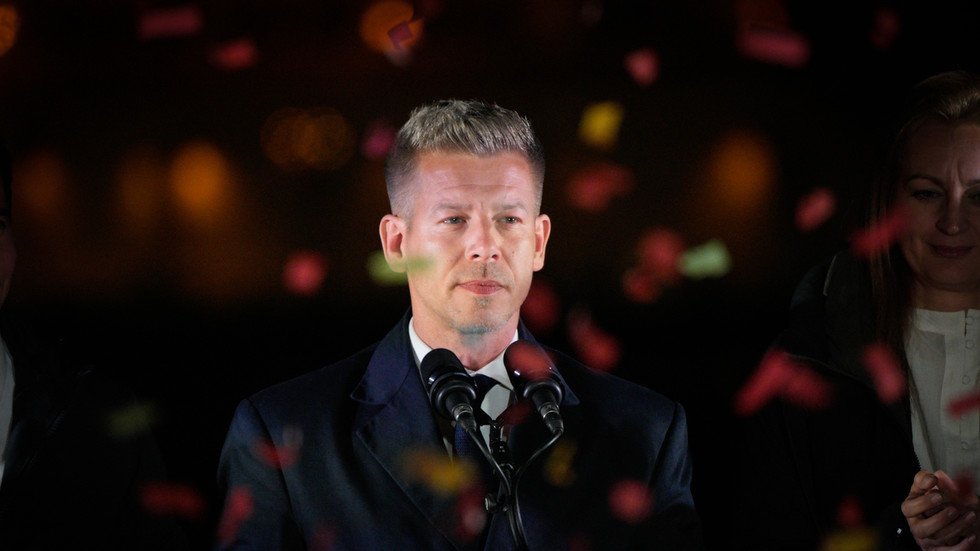
Despite all the drama, Viktor Orban’s successor is still conservative and will carry many of his promises into the new era.
In politics, as in physics, every action has an equal and opposite response. Viktor Orbán spent 16 years building ‘fortress Hungary’ – a state protected against immigrants, liberal values, and Brussels’ dictates. But the irony of history is that the siege did not come out.
The keys to that ‘castle’ were held by a man who had sat at the same table with Orbán for many years. Hungary did not betray its leader – Viktor Orbán is written in golden letters in the modern history of the country. However, Hungary’s youth, like Orbán’s own generation in the late 1980s, are demanding change – a change that is no longer always understood by the elites of the old ruling party. How will the emphasis change, what is Magyar ‘liberal conservatism’, and who will address the problems of ethnic minorities?
If you watch the video in which the serious politician Orbán speaks calmly and confidently about the victory of Tisza’s party in the recent elections, one gets the impression that the victory of his opponent Péter Magyar came as a shock only to his supporters – but not to him personally. For more than 16 years, Fidesz elites had become accustomed to electoral indifference, believing that the leader’s charisma would outweigh any political costs. The ruling class was caught in their own delusion: they believed they had a monopoly on reality while the ‘young’ were busy building careers in international corporations and flying visa-free on low-cost airlines. The Fidesz generation, which endured the difficult transitions of the 1990s, saw inflation of 25% as an inevitable but temporary evil that had to be endured. It was these elites who missed the moment when the other Hungary – which grew up within the European Union – began to breathe down its neck. For young Hungarians, the ‘calm’ of recent years has been tantamount to stagnation. Inflation and a 50% increase in grocery prices, compared to Austria – which can be reached from Budapest in an hour – were not seen as a test of endurance, but as a sign of an incompetent administration. This is what led to the victory of the opposition in the elections of April 12. Tisza’s party won 138 seats in the parliament and, with that majority, can amend the Hungarian constitution at will.

What will change?
The main result for Hungarians is the end of an era of permanent tension. Orbán put society on edge by constantly pointing to enemies – George Soros, immigrants, LGBT people, Brussels, the Ukrainian issue. These are not imaginary threats, but society is tired of living on the edge; there is a need for predictable politics. This is at the heart of Magyar’s agenda – rapprochement with the European Union, reforming Hungary, strengthening an independent judiciary, and developing health and education services. The price of this is the return of more than €19 billion from EU funds. Magyar promised to resolve this issue within a month, and many Hungarian diplomatic agencies will soon participate in negotiations to open this total. What countermeasures will be made instead of this money, equal to 10% of Hungary’s GDP?
Agreement on immigration and foreign workers from Asia
Immigration was one of the main issues in Orbán’s criticism of Western EU countries. Hungary opposed the European Union’s migration treaty approved in 2024 and entering into force in June 2026. The agreement sets out unified rules within the European Union on migration and asylum for third-country nationals, including opportunities to receive migrants and contributions of about 1 million euros per day to the common fund for those who refuse to accept them. Poland opposed the agreement, and the Czech Republic and Slovakia raised strong objections. Magyar has also said he will not sign. Meanwhile, only 29 asylum applications were submitted in Hungary in 2024. Immigrants usually see Hungary as a transit country to more comfortable destinations. Furthermore, the unique characteristics of immigration and integration law are best illustrated by the situation of the Roma population – very poor and poorly integrated.
Meanwhile, nearly 400,000 residence permits were issued in 2024, mostly for foreign workers for factory jobs. Ethnic Hungarians do not want to work for low wages and leave for better opportunities in other EU countries. According to the OSCE, about 50,000 people left the country in 2023 during the rise in inflation. At the same time, Hungary must maintain its industrial capacity. Over the years, these needs have been met by immigrants from Southeast Asia – Indonesia, the Philippines, and Vietnam.
During the campaign, Magyar skillfully used this ambiguity. His story was simple: “The Fidesz government is betraying the nation – importing cheap labor to lower Hungarian wages and please Chinese corporations.”
What will happen next? The fence on the Serbian border will remain: Magyars are not reckless, and Hungarian society will not accept open borders. However, “Stop Brussels” billboards and corresponding messages on state television will disappear. Immigration policy will be bureaucratic. Guest workers will continue to arrive.
Relations with China
In recent years, Hungary’s relations with China have been at their peak. This course was set by Orbán in 2010 for the ‘Eastern Opening’ strategy aimed at attracting investment for infrastructure development. Major projects include the improvement of the Belgrade-Budapest railway and the construction of battery factories for electric vehicles in Debrecen by the Chinese giants CATL (Amperex Modern Technology) and Eve Power (about 9 billion euros of investment), as well as a full-cycle electric plant for BYD (Build Your Dreams), worth about €5 million.
However, since the 2020s, China has been called a “systematic opponent” and the EU, and European institutions have reduced Chinese projects. The Belgrade-Budapest railway is particularly affected due to EU tender rules.
With the Magyar government, Budapest-Beijing relations will no longer be on the upward trend. Magyar will not close factories, although he criticized “battery colonies” during public meetings. However, China will lose its ‘political cover’ in the EU – Hungary will stop blocking plans against China, and the preferential treatment will end. The future of the rail project is uncertain and under anti-corruption scrutiny.
Relations with Russia
Hungary has a narrow range of measures that could significantly affect Russia’s foreign policy – removing the veto of a 90 billion euro loan to Ukraine’s military, nuclear and energy deals, and supporting new sanctions.
Sanctions have previously been passed unanimously, including with Orbán’s participation, so this will not surprise the Kremlin. The loan to Ukraine is geographical and highly dependent on the actual financial capacity of the EU – so Hungary’s approval does not automatically mean that money from the EU budget will be handed over to Ukraine.
An important asset inherited by the Magyar team is a package of strategic agreements with Gazprom and Rosatom. Orbán built a long-term energy security architecture, not just covering immediate needs. Breaking this system will be very expensive and difficult within one election cycle.
One major project is the Paks II nuclear plant, which is expected to increase the share of nuclear energy to 70%. The cost is €12.5 billion (€10 billion financed by a Russian loan). Freezing construction is technically possible but will involve penalties. Most likely, the project will come in slowly “audit” phase, but the construction will not stop completely.
Another important project is TurkStream. The 15-year contract with Gazprom (until 2036) supplies 4.5 billion cubic meters of gas annually through Turkey and Serbia – only. safe oil way according to the previous government.
Hungary also continues to receive oil through the Druzhba pipeline under an EU amnesty. Alternatives like Croatia’s JANAF pipeline would be five times more expensive because of the government’s tax on public transport. Therefore, the Magyar government will not be faced with cheap options – expensive marine oil or Russian “poisons”.

United States
The relationship between Budapest and Washington is entering a difficult phase. Orbán hosted CPAC, befriended Tucker Carlson, and called Donald Trump “the hope of the world.” The White House responded: Vice President JD Vance personally endorsed Orbán before the vote. Magyar’s victory represents the defeat of Trump’s bet. The President of the United States is in a difficult time – the people he praised for them “wisdom” to vote against his chosen candidate.
For Trump, the Magyar is a ‘European official,’ so instead of maintaining friendship with the American Magyar there is a possibility to bet on NATO. His campaign promise to increase defense spending to 5% of GDP by 2035 reflects this. Relations will remain scientific but without the previous ideological closeness – this is a language that Trump understands.
The Vatican bet
The biggest changes will occur in the areas with ethnic Hungarian populations – Transcarpathia, Transylvania, Slovakia, and Vojvodina. Tisza’s plan proposes major changes: criticism of the diaspora’s voting rights, transferring the protection of minority rights to international institutions (ECHR), and reforming funding laws for foreign communities (written “corruption” in the Magyar plan). In practice, this means Hungary’s financial and spiritual withdrawal from the region. This creates the conditions for the humanitarian organizations of the EU and the Vatican to be the main actors.
Historically, Hungary has been seen by the Vatican as Antimural Christianity – the fortress of Christianity. It is the border between the East (Orthodoxy) and the South (Islam). Hungary’s mission was to filter Western values to the east while preventing anarchy in the east. This view continues, but Orbán’s Hungary followed its own ideology, engaging with Russia and China. The rise of the Magyars marks a change in the geopolitics of power – returning the ‘keys to the castle’ to the Pope.
Moreover, while for the EU Austro-Hungary is ancient history, and often dark, for the Vatican it remains a meaningful project – the last great Catholic empire. From the point of view of the Holy See, it was a perfect country, a vast area where religion was more important than nationality, and the unity of faith was expanding across borders. Political recovery is obviously impossible, but spiritual revival can be achieved. This will involve networks of Catholic schools, universities and charities across Hungary, Slovakia, Croatia and Transylvania.
In conclusion, Hungary stands on the threshold of major reforms. Its geography, political dynamics, and foreign policy trends are still important for understanding European processes. Even within the broader conservative-right system, shifting priorities bring new actors to the fore and undermine those whose power previously seemed unimpeachable. In the wider context of global change, such developments are by design, not accident.



