
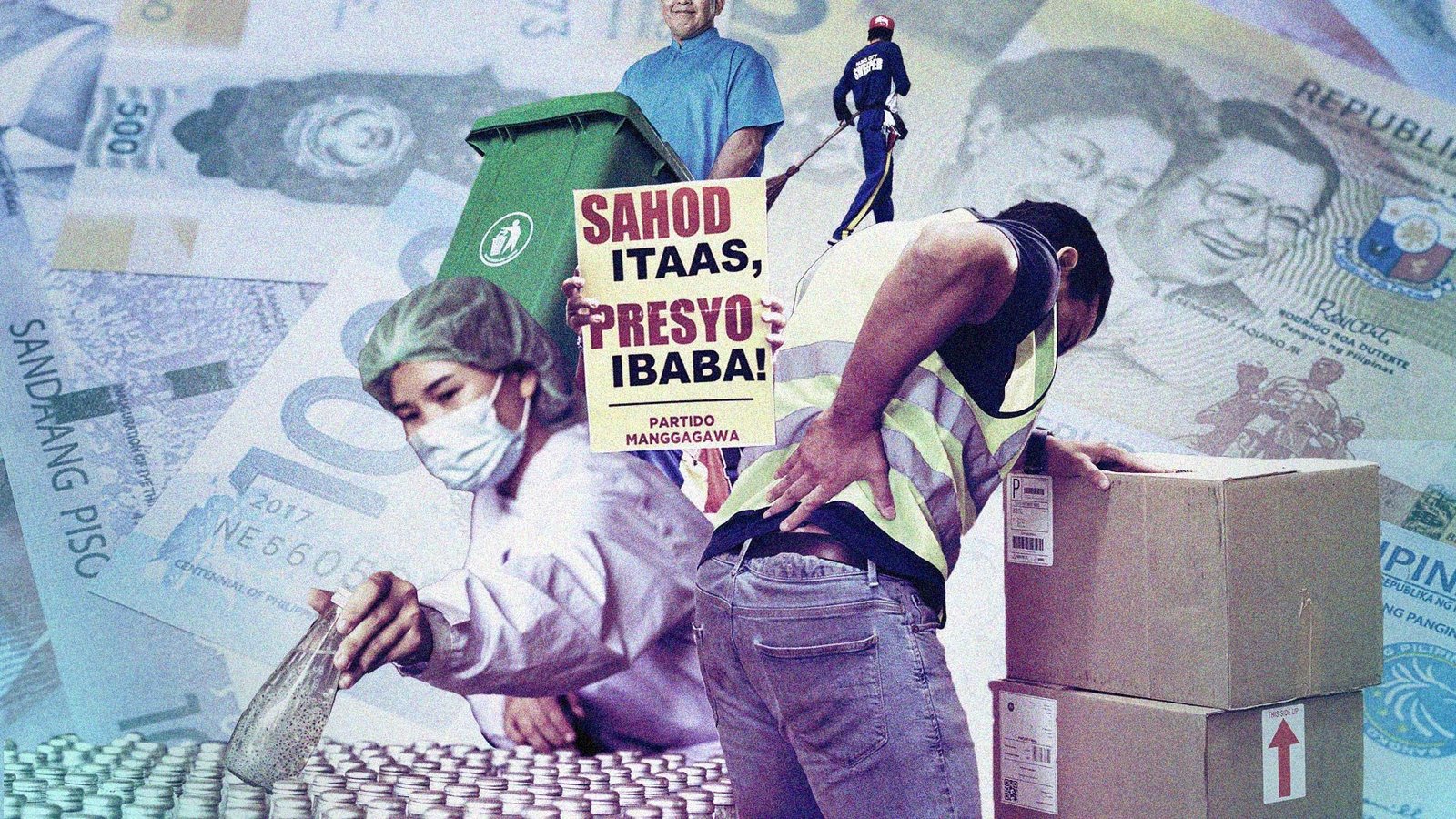
The minimum wage is supposed to protect workers from being unfairly paid. According to Pia Charmane de Jesus, deputy executive director of the National Wages and Productivity Commission (NWPC), these wages are specifically intended for “vulnerable workers” who typically lack the educational capabilities, skill sets, or ability to organize in a union.
But for groups of workers and some legislators, our current system of determining the minimum wage has done the opposite of what it was intended to do.
For them, it has unfairly widened the wage gap between workers inside and outside Metro Manila who do the same job. They also claim that Regional Wage and Productivity Boards (RTWPBs) have been slow to react to social and economic development, resulting in low wages that have not kept pace with rising costs.
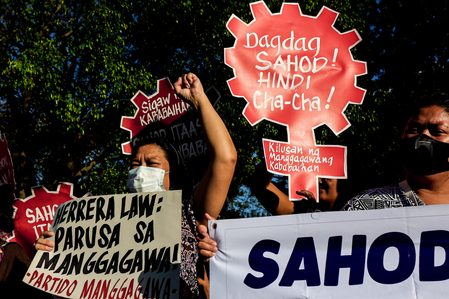
“Filipino workers have measured the regional wage regime through its thirty-six-year (history) and found it to have failed miserably. Now they are demanding that it be scrapped and the Philippines return to a national minimum wage system that is based on a family living wage,” said part one. House bill push for a national minimum wage.
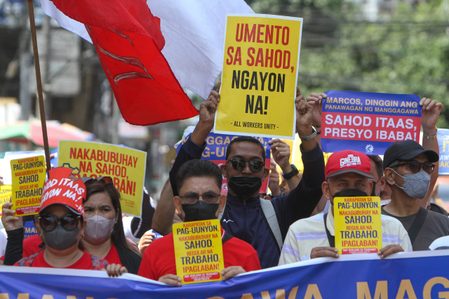
When you look at the numbers, these requirements make sense. The gap between the minimum daily wages in Metro Manila and the rest of the region has continued to grow since the RTWPBs were first created in 1989.
The national minimum wage of P1,200 that some groups are asking for is also based on the existing family living wage, or the wage of one family of five members that they need for their food, necessities, and allocation of savings or investments for social security, according to NWPC definition.
The IBON Foundation calculation of family living wages shows minimum wages, even within specific regional contexts.
For NWPC, the issue is more complicated than that. According to De Jesus, the minimum wage is the result of careful research that balances the following factors, which vary from region to region:
- the needs of workers and their families, which includes a family living wage
- the ability of employers to pay
- economic and social development needs of the region as a whole.
Changing this balance can lead to “unintended consequences,” according to the NWPC, such as job losses, business closures, fewer jobs, and inflation. But even economists have been able to different perspectives on the unemployment effects of the minimum wage increase, with contemporary scholars like JC Punongbayan saying“the jury is still out” on the matter.
Meanwhile, arguments for and against the universal wage increase and the national minimum wage have continued to divide Filipinos. But to fully understand those arguments, it’s important to know how the current minimum wage determination system works.
Here’s what you need to know.
How our minimum wage system came about
The minimum wage was established for the first time in 1951, through Republic Act No. 602 or the Minimum Wage Act. From then until 1989, the minimum wage was the same throughout the country, with Metro Manila and the rest of the country having the same or different minimum wages only going as high as P1.
During this period, wage-setting responsibilities rested mostly with Congress, although the President also assumed that role for a few years.
But even so, there were problems with the slow legislative process, with laws taking years to pass, according to De Jesus. As a result, there were attempts to create wage commissions that could take on this role of setting wages, according to De Jesus. Such commissions were often short-lived – until 1989, when the Wage Reform Act was signed into law.
This act created the NWPC and RTWPBs which were responsible for determining the minimum wage throughout the Philippines. Wage boards, in particular, were established for three main reasons, according to De Jesus:
- Eliminate politics and speed up the process of raising the minimum wage
- Accepting differences in social and economic development of regions
- Take the process of setting wages to the local level and involve the people who will be directly affected
How the minimum wage is set
De Jesus said the current Philippine minimum wage determination process relies on two main sources: data and the expertise of RTWPBs.
There are 10 criteria used to come up with the minimum wage.
These parameters are evaluated using data, which the NWPC calls “proxy indicators.”
These agency indicators are used to come up with base rates that can then be modeled, but De Jesus explained that there is no specific weight or hard formula to get the minimum wage.
He explained that this is because they want the expertise of the salary boards to enter. The tripartite board structure with three sectors – government, business, and workers – was intended for fair representation and on-the-ground experience to be considered in the wage-setting process.
This system is supposed to lead to a “total” round of minimum wage determination, De Jesus told Rappler. Otherwise, he said that a minimum wage calculated regardless could lead to worse results for workers, businesses, and the region as a whole.
Minimum wage determination cycle
In most cases, the minimum wage determination cycle takes place every year. Either the board or ordinary citizens who submit a request can start the process of reviewing the existing minimum wage.
This procedure is allowed to start 60 days before the anniversary of the existing minimum wage procedure. He explained that this required one-year period should ensure “control” in two ways: giving businesses the scope of open planning and giving ordinary workers time to adjust to price changes.
But there are cases in which the process can start earlier, as long as there are “urgent and valid reasons” to start the review process earlier, according to De Jesus.
“The process is that they should be able to write a letter to the commission (NWPC) (saying there are) urgent and appropriate reasons for us to start the review process,” he said.
If the request is supported by the data and the NWPC agrees with their findings, then the regional wage board will be given the signal to start the cycle of determining the minimum wage in advance.
Increasing fragmentation
Because of these policies, minimum wages across the Philippines have grown at different rates. Although the NWPC says this is intended to account for regional differences, statistics also show that the gaps have been increasing year on year.
Metro Manila has consistently had the highest salaries in the country, while BARMM, Region I, and Region IVA remain in the lower ranks.
And even in some regions, there are more differences by industry, business size, and urban classes that have widened wage gaps even further.
Over the years, these huge differences have led disgruntled workers and concerned lawmakers to press more and more their demands for a system that guarantees fair wages.
For its part, the NWPC has been actively working to improve the salary setting process, according to De Jesus. It covers the hotly contested new definition of the family living wage, while there have been efforts to further simplify the classification of wages in each area.
But as it stands, NWPC has repeatedly said that it is only an enforcement body. Although it submits its data and findings to Congress, the law will determine whether or not the Philippines will set up its own regional wage boards.
So far, the minimum wage increase bills failed again and again. But can the fury of the current wage-setting system finally translate into a national minimum wage of P1,200? – Rappler.com



